
Inspect BBMDs and routers
The Network screen, 4, is where B/IP broadcast problems show. Its BBMD tabs are for B/IP. Its Networks tab, which maps routers, works on every transport. Every read here is a BVLC or network-layer request; nothing on this screen writes to a BBMD or a router.
The foreign-device panel
Section titled “The foreign-device panel”When the session runs as a foreign device (a profile with a BBMD, or --foreign-bbmd), the top panel follows the registration:
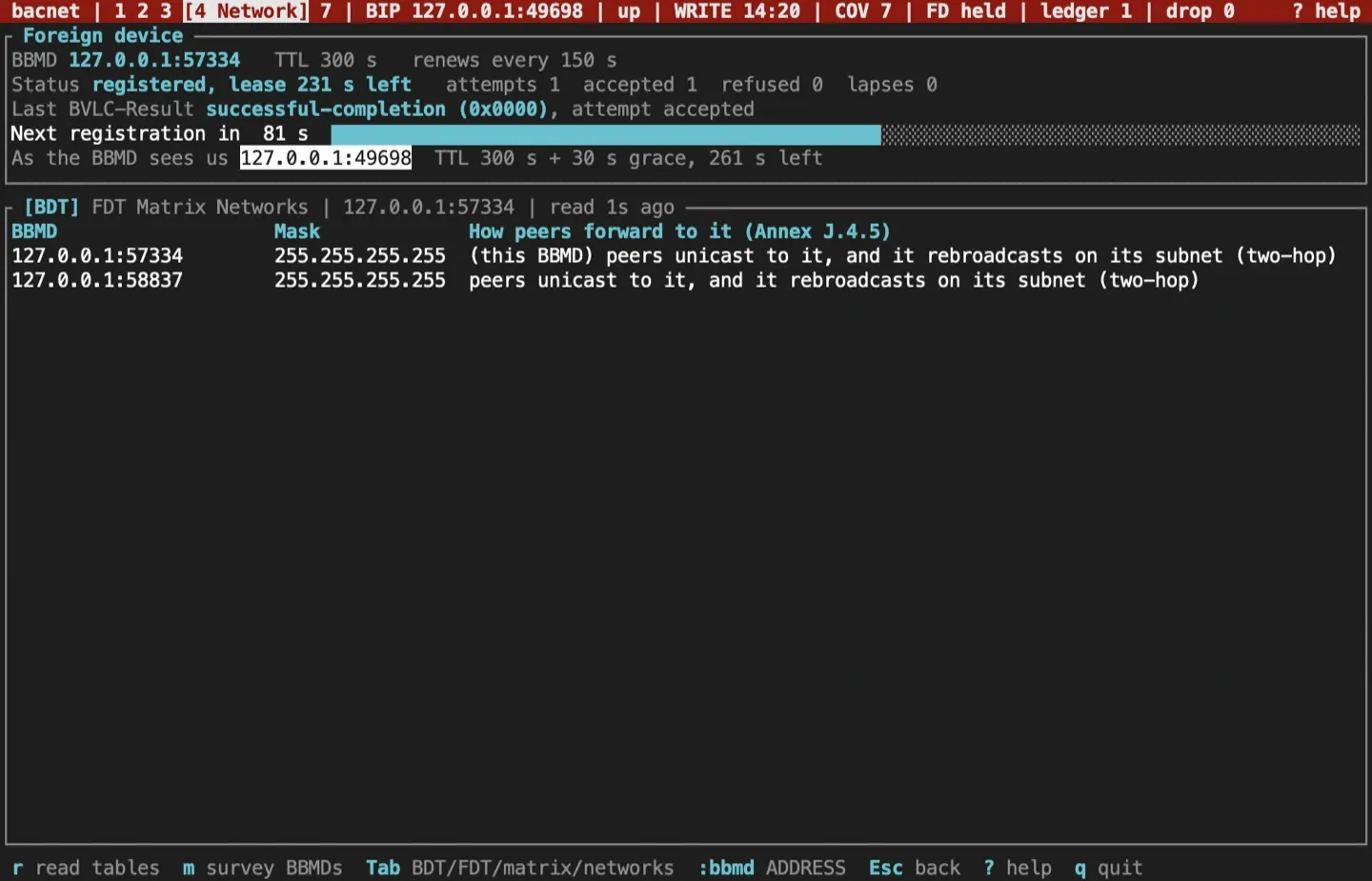
- BBMD, TTL and renewal. Where the TUI registers, for how long, and how often it renews (half the TTL unless set).
- Status. Registered with the lease left, or not registered; with the count of attempts, acceptances, refusals and lapses.
- Last BVLC-Result. The BBMD’s answer to the latest registration, with its code.
- Next registration. A countdown bar to the next renewal.
- As the BBMD sees us. Once the BBMD accepts, the TUI reads its FDT and shows the entry recorded for this client: the address the BBMD forwards broadcasts to. If no entry has our address, a NAT router may have rewritten it.
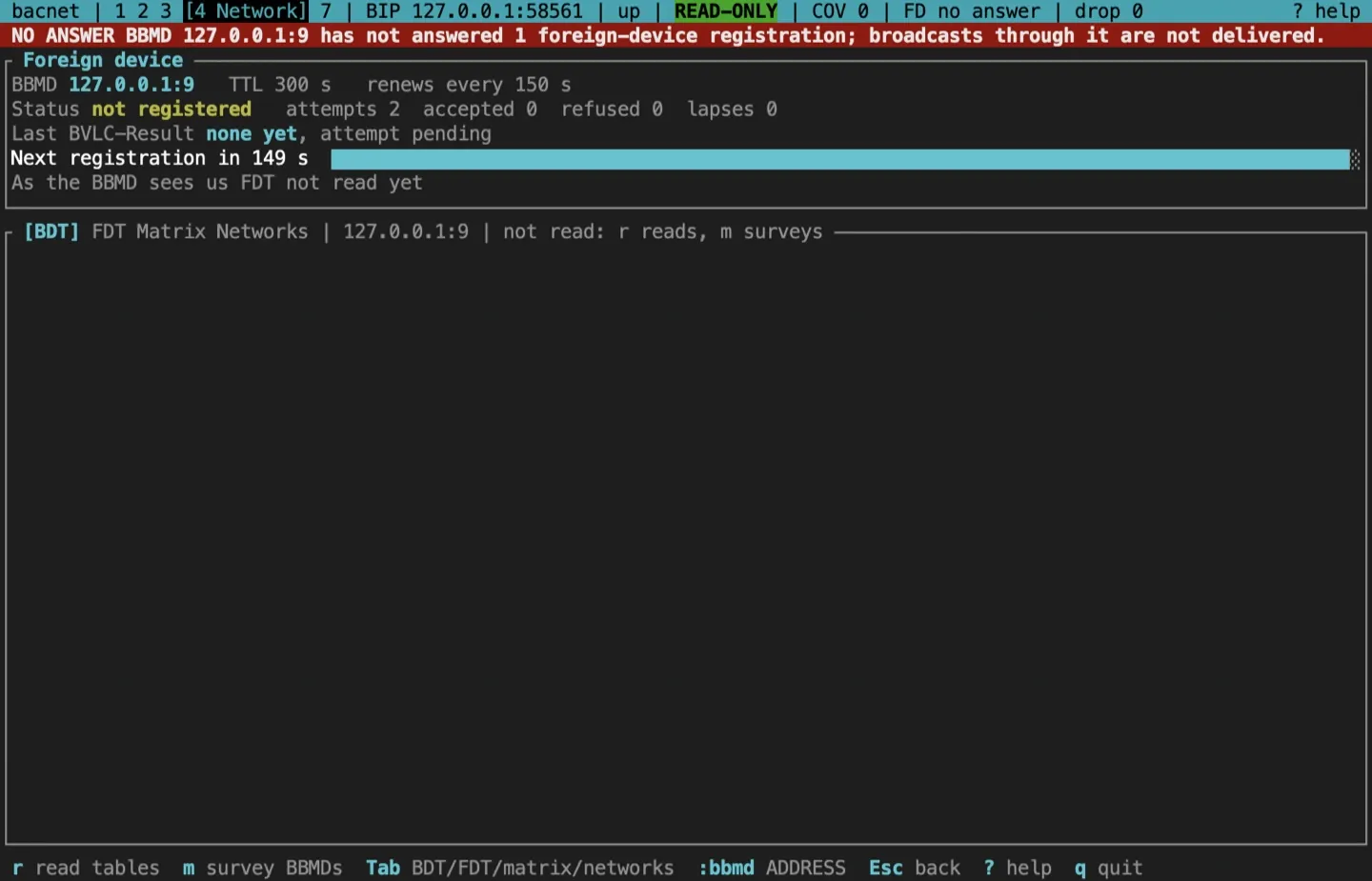
A BBMD that never answers leaves the status at not registered, with the attempt count rising. A refusal raises a red banner on every screen.
BDT and FDT
Section titled “BDT and FDT”Below the panel, tabs show one BBMD’s tables. Tab and Shift-Tab move between BDT, FDT, Matrix and Networks; r reads the tables again. The title names the BBMD and how long ago it was read.
- BDT, the broadcast distribution table: each peer BBMD with its mask, and what that mask means for forwarding. An all-ones mask means peers send to that BBMD, which then rebroadcasts on its own subnet (two hops). Other masks mean a directed broadcast (Annex J.4.5).
- FDT, the foreign-device table: each registered foreign device with its TTL and the seconds left. This client’s own entry is marked. An entry with under 30 seconds left has outlived its TTL without registering again:
!comes before its seconds, andexpiringafter them.
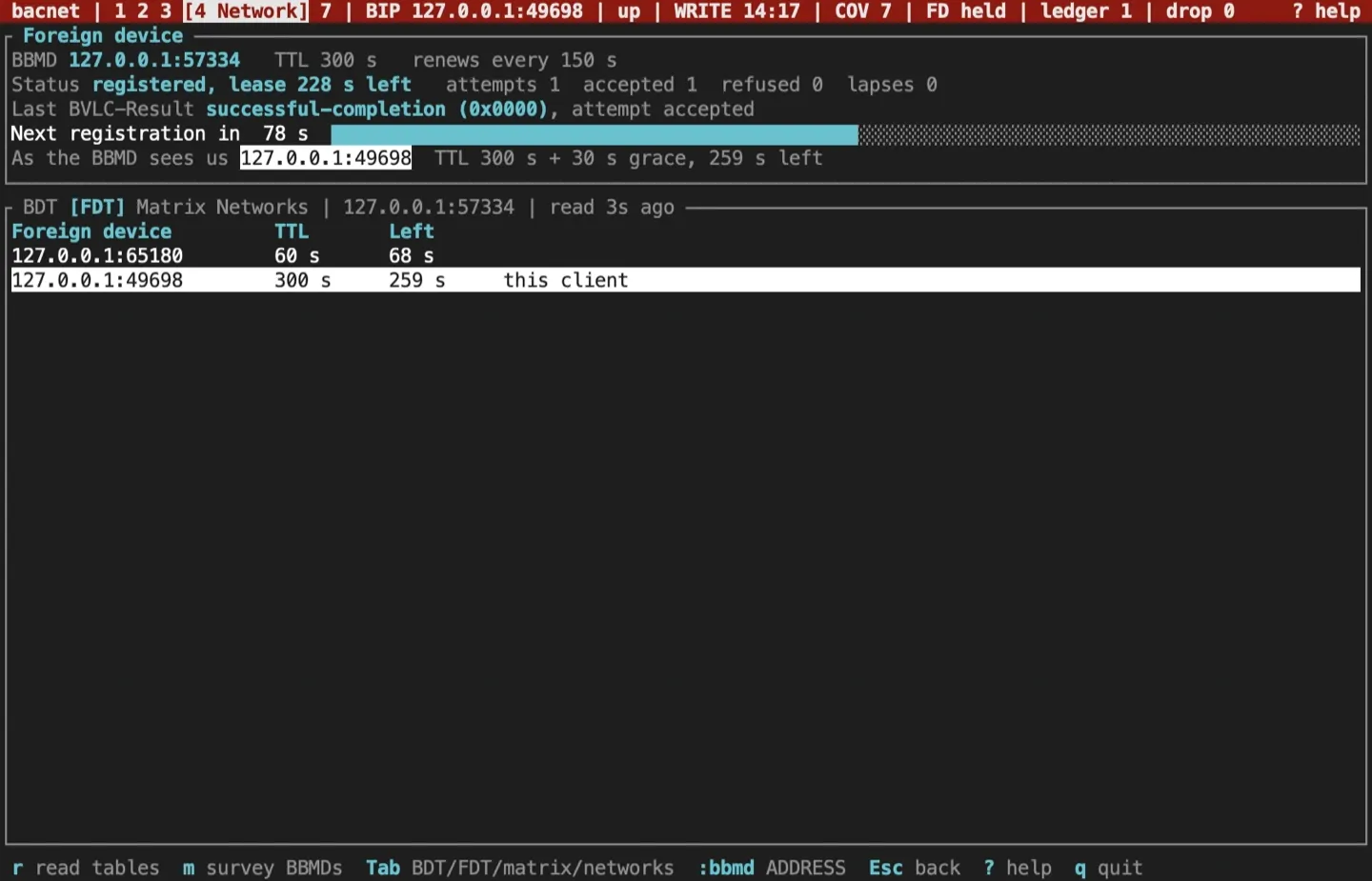
To read another BBMD’s tables, run :bbmd ADDRESS (ip or ip:port, port 47808 by default). The tabs then show that BBMD, and the footer offers :bbmd alone, which goes back to the tables of the BBMD you register with.
The consistency matrix
Section titled “The consistency matrix”Every BBMD in a site should list every other one, the same way each time. m surveys them: it reads the BDT of every BBMD the tables lead to, up to 16, and shows which lists which.
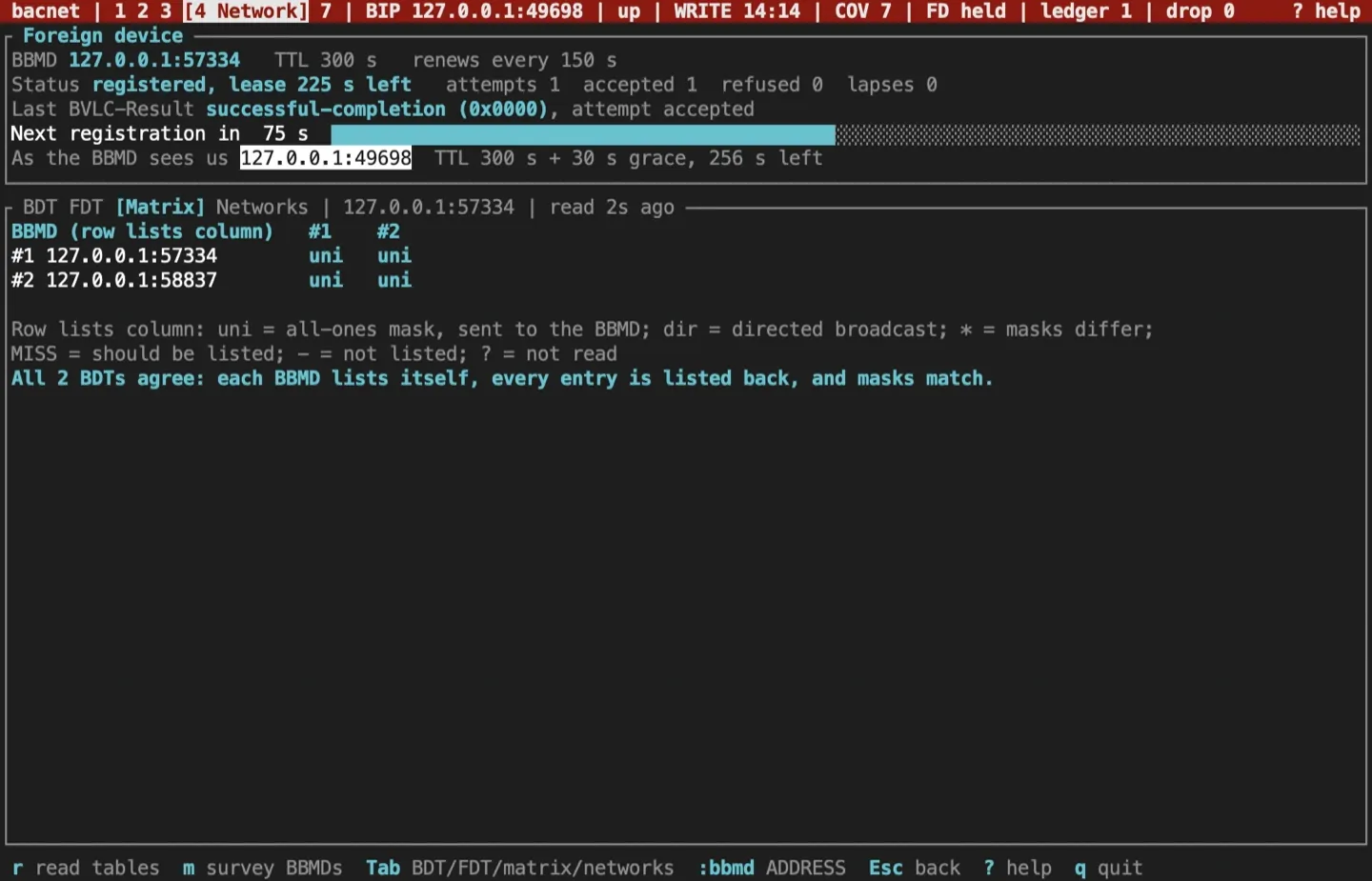
Each cell says how the row BBMD lists the column BBMD: uni for an all-ones mask, dir for a directed broadcast, * when the masks differ, MISS where an entry should be, - for not listed and ? for not read. The survey flags:
- a peer listed one way only;
- a BDT without its own entry;
- a BBMD listed with different masks;
- BBMDs that refuse the read or don’t answer.
Some BDT entries are never read: unresolved or unspecified addresses, broadcast, directed broadcast and multicast addresses, loopback, and this client’s own address. They take no row or column; a list under the findings names each one, the BBMD that listed it and the reason, as not read on purpose rather than as a failure. When a survey finds more than 32 BBMDs, the screen says how many the grid leaves out.
The matrix matches BBMDs by address. A BBMD reached at an address other than its own BDT entry, behind NAT for example, shows as two rows, one flagged with no entry for itself.
Routers and networks
Section titled “Routers and networks”The Networks tab lists routers and the networks they reach. r clears the map and asks every router, by broadcasting Who-Is-Router-To-Network. Every router that announces itself, asked or not, is listed against its networks, with how long ago it was heard.
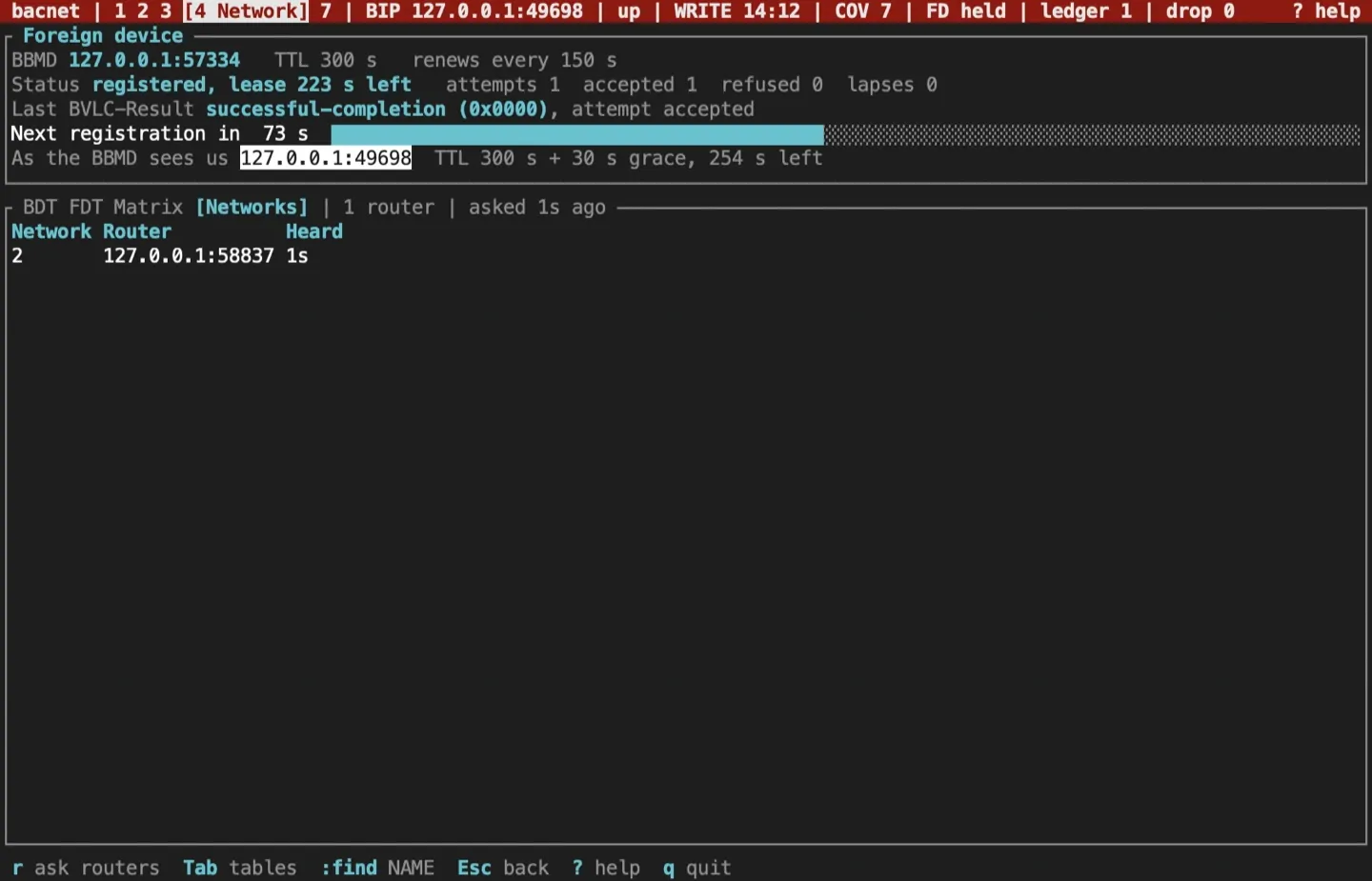
A network number that more than one router claims is flagged DUPLICATE: two networks may share the number, the routers may form a loop, or the route may have moved since the last search. The tab’s title shows the local network number once a Network-Number-Is is heard. A router’s Reject-Message-To-Network for a message the TUI sent shows in the footer with the network and the reason.
Sources and release scope
Section titled “Sources and release scope”These pages describe v0.15.0. Source review is not a claim of hardware qualification. BBMD and foreign-device behaviour is in ASHRAE 135 Annex J.
Network screen reference · Consistency matrix · Router map.
CONTINUEDiagnose BACnet/SCCheck the hub connection, certificates and the connection doctor.Release v0.15.0 ·Build and integrate. Pre-1.0 APIs; partial conformance.Support & limitations