Bring your own sequence
An engineer gives Muse Spark a written sequence of operations: pasted text, a PDF, or a photo of the sheet. From there it goes through the same gate as our own specs.
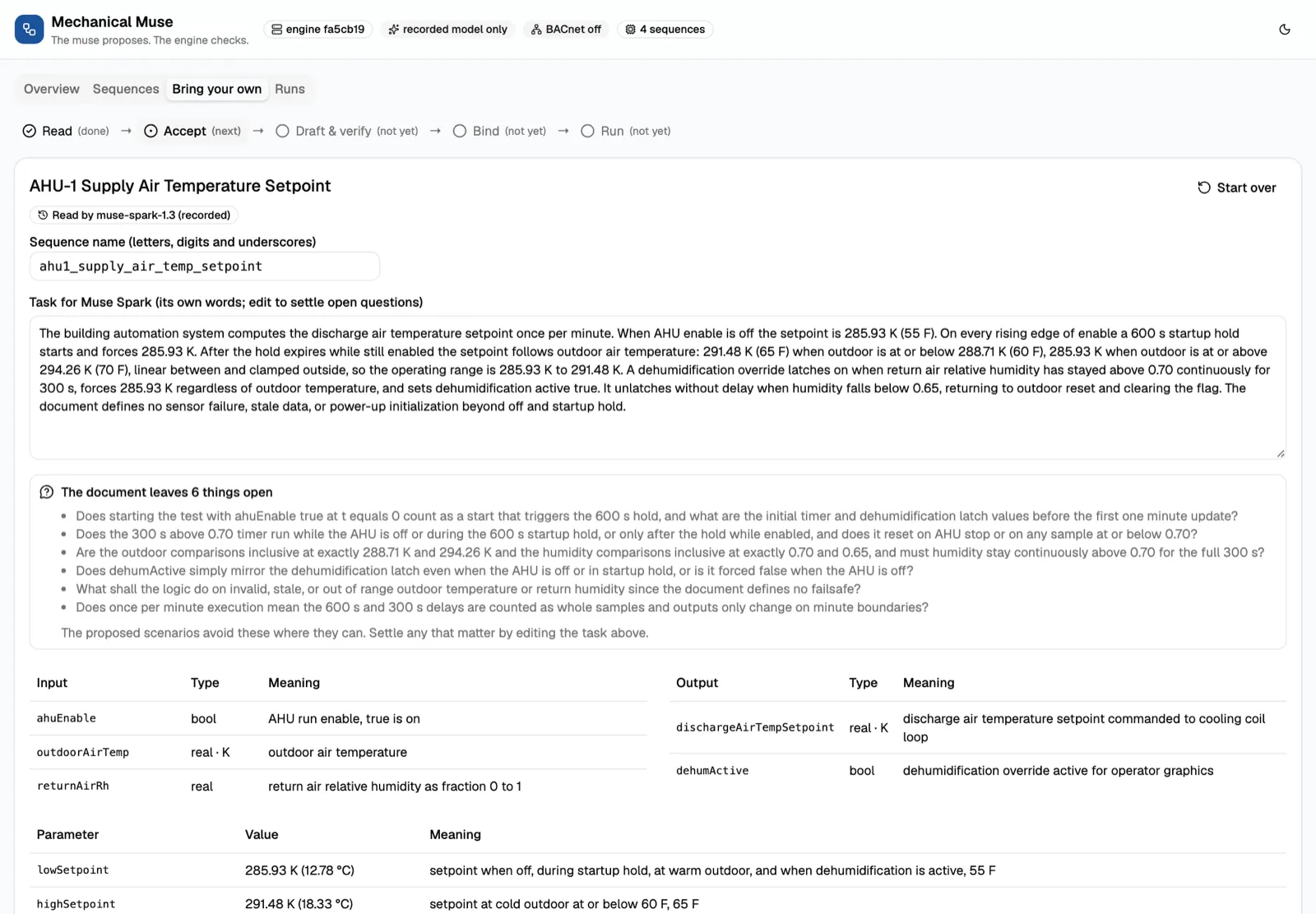
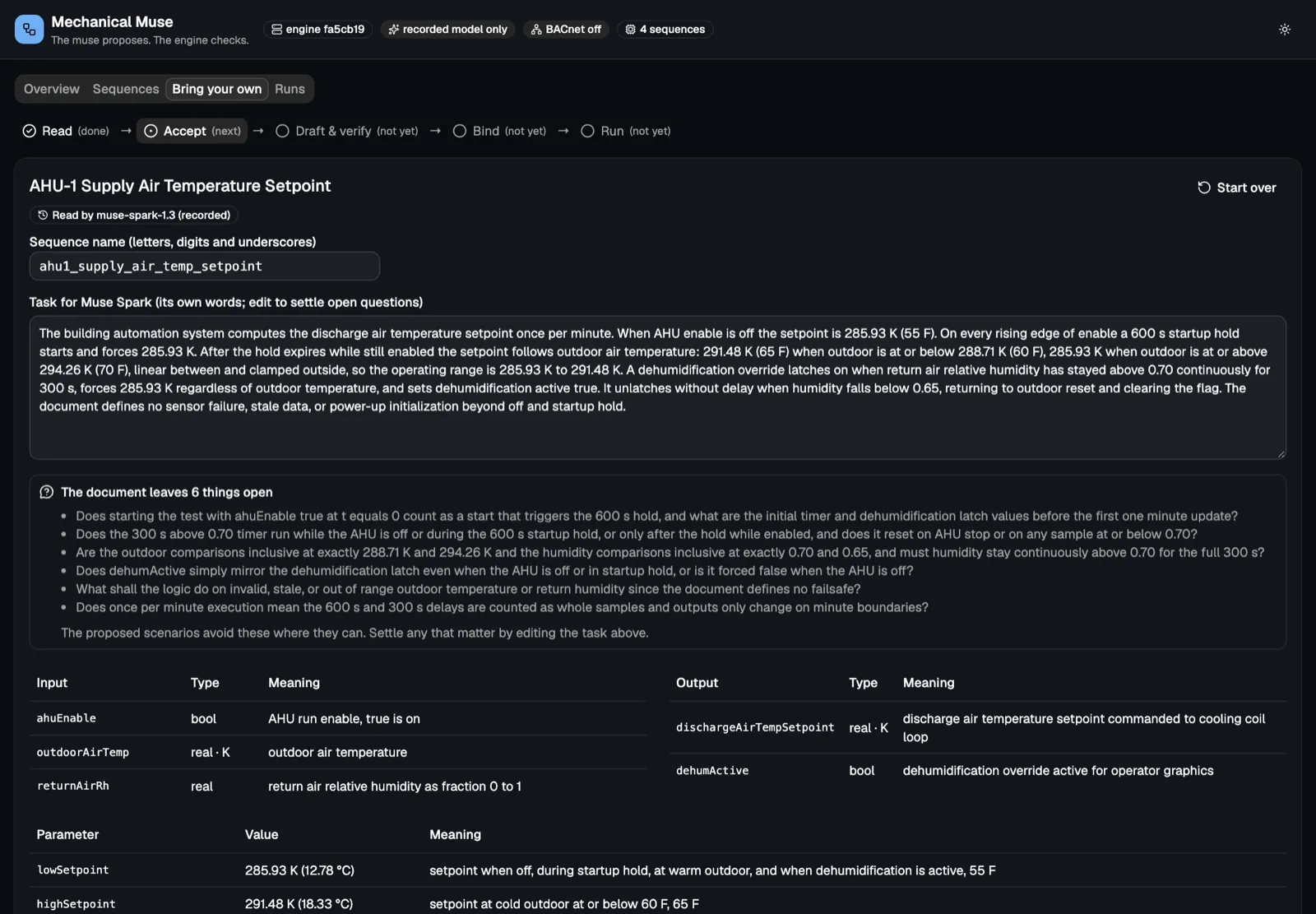
The flow
Section titled “The flow”- Read. Spark turns the document into our task format, proposes test scenarios, and lists what the document leaves open (exact-threshold behavior, start-up values, a lost sensor) as open questions instead of deciding silently.
- Accept. The proposed expected values are model output. They become the gate only after the engineer reviews them. Each scenario shows as a timeline beside an editable table, and any scenario can be corrected or turned off. Checks refuse scenarios that cannot run fairly (unknown points, missing inputs, steps off the clock grid, wrong types, check windows outside the run). They cannot tell whether an expected value is right; that is the engineer’s call.
- Draft. Spark drafts a block graph against the accepted scenarios, with the usual repair loop. A verified draft downloads as CXF.
- Bind. Spark proposes which BOPTEST reading feeds each input and which setpoint each output writes, within what limits. The server checks the proposal (points exist and are the right kind, every input bound once, limits finite and inside the setpoint’s range, nothing written twice). The engineer edits and confirms it.
- Run. The verified draft runs on BOPTEST beside our own sequences. Its scenarios are replayed again before it loads, and the runtime’s fail-safe applies.
A workbench sequence has no hand-built reference graph, and the UI says so.
What it found
Section titled “What it found”The sample sheet (an AHU supply-air temperature reset we wrote for the demo) ran safely and did what it says. Revision A’s dehumidification thresholds latched its override on in this building, so its reset never acted. Revision B raised them, went through the whole flow again live, and saved energy in spring and fall but not in summer. The numbers and their caveats are on Runtime results.
Without a key
Section titled “Without a key”make demo plays the whole flow back from committed recordings (Spark’s reading, drafting
session and binding), labeled recorded. Every check still runs.
Learn more
Section titled “Learn more”- docs/workbench.md: API, binding rules and full results.