Mechanical Muse
The muse proposes. The engine checks.
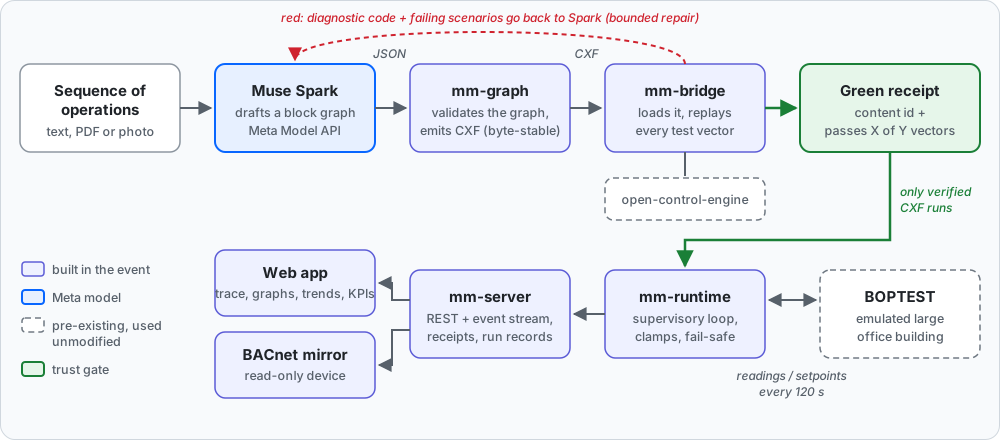
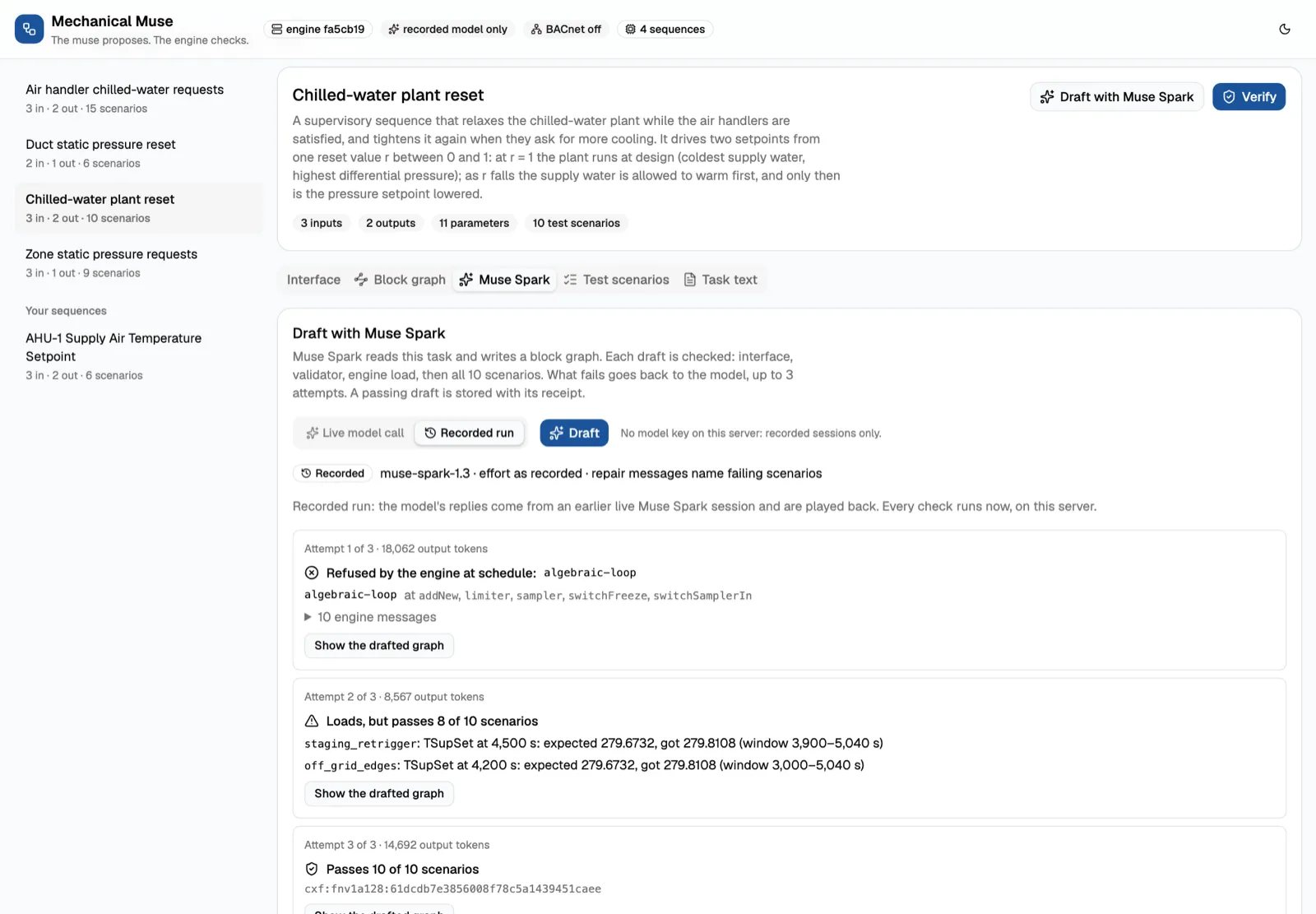
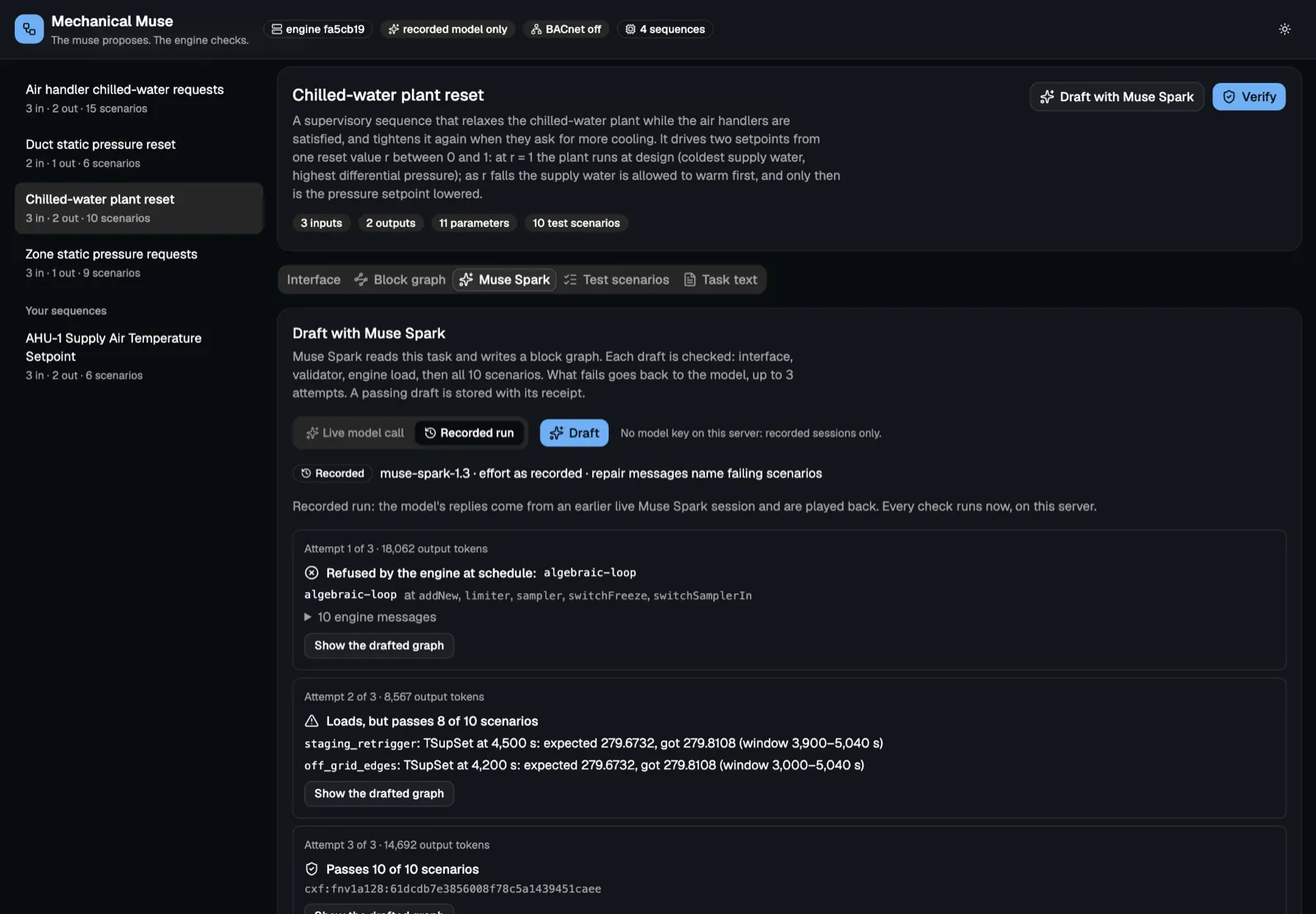
Mechanical Muse is an agent built on Meta’s Muse Spark. It turns a written sequence of operations into running building control logic, and that logic may run only once it passes its tests. Muse Spark drafts the logic as a block graph. A deterministic control engine replays test vectors against every draft, and failures go back to Spark for repair. Only a draft with a green verification receipt runs on an emulated building: BOPTEST’s large office, or its heat pump house on spot electricity prices.
Built solo by Justin Scott for the Meta Global AI Developer Hackathon (Indie track), October 26 to November 4, 2026.
Why it matters
Section titled “Why it matters”Engineers write building control sequences as prose. A controls contractor programs them by hand for each building, and they are rarely tested against the written intent before they run. Language models can draft control logic, but nobody should let unchecked model output drive a building. Mechanical Muse puts a gate in between:
- Model output is untrusted. Nothing Spark writes reaches the building or the BACnet mirror without a recorded green receipt: a content id plus “passes X of Y” test vectors, replayed on a deterministic engine.
- Failures are specific. A refused draft comes back with the engine’s typed diagnostic code, or the scenario and instant where an output went wrong. Spark repairs against that, within a fixed budget.
- Engineers stay in charge. Bring your own sequence as text, a PDF or a photo. Spark proposes test scenarios and point bindings; the engineer accepts or corrects them before they count.
The pipeline
Section titled “The pipeline”| Step | What happens | Who built it |
|---|---|---|
| Draft | Muse Spark (Meta Model API, structured output) reads a spec and drafts a compact block-graph JSON | Agent mm-agent: built in the event. Model: Meta’s Muse Spark |
| Emit | A catalog-backed validator and a deterministic emitter turn the graph into CXF (CDL as JSON-LD) | mm-graph: built in the event |
| Verify | The CXF is loaded with typed diagnostics and the spec’s test vectors are replayed | Bridge mm-bridge: built in the event. Engine: open-control-engine, used unmodified |
| Repair | Diagnostics and failing scenarios go back to Spark until the vectors pass or the budget runs out | mm-agent: built in the event |
| Run | A verified sequence runs in a supervisory loop against an emulated large office or a heat pump house | Runtime mm-runtime: built in the event. Emulator: BOPTEST, used unmodified |
| Mirror | Live points are served read-only as one BACnet/IP device | mm-bacnet: built in the event. Protocol stack: rusty-bacnet, used unmodified |
| Show | A React web app shows authoring, receipts, live trends, KPIs and explanations | mm-server and web/: built in the event |
The Provenance page lists every pre-existing component with its pinned commit and license.