CHW-0005 — Chiller condenser approach high
| Status | verified — engine e2ff2f8, cxf:fnv1a128:85a781d555bacb1fd1cd2bc048597f1e, 2026-08-18 |
| Severity | 3 |
| Method | rule |
| Phase | 2 |
| Category | EFFICIENCY_LOSS |
| Confidence | MEDIUM |
| Estimation | PROXY_ESTIMATION |
| G36 | — |
| Clusters | CLU-06, CLU-10 |
| Suppresses | — |
| Suppressed by | — |
| Related | CHW-0001, CHW-0004, CHW-0007, TOWER-0001, TOWER-0005, HP-0004 |
| Playbooks | cooling-tower-performance, chiller-efficiency |
| Source | BEE/Devki Energy Consultancy, Best Practice Manual: HVAC Chillers (2006), §3.8 — condenser approach design bands by heat-exchanger type (plate 1-5 °C, shell-and-tube 5-10 °C), the anchor for the shipped clean_approach; §3.10 — tube fouling and non-condensable gas as the two mechanisms, with a 4x-design fouling factor associated with roughly 20% energy loss; §2.5.2 — the 2-4% per °C of lift thumb-rule; DOE/PNNL, O&M Best Practices Guide Release 3.0 (2010) §9.4, and PNNL-13890 (2002) §7.4 — fouling described as requiring an enlarged temperature difference between water and refrigerant, the mechanism this rule detects, plus the compressor-type-split lift sensitivity (1.7%/°F centrifugal, 1.2%/°F reciprocating) used in the energy model; HVAC FDD Reference v1.0, Remediation Playbooks (pp. 161-163), carried in playbooks/chiller-efficiency.md: an approach more than 2x design indicates fouling on that side — the only fault-side rule of thumb behind approach_fault_multiple; tools/simharness/README.md, ‘Tower groundwork (condenser-loop stats)’ — this library’s 4-climate simulation study, source of the batch’s 2x-design band shape; its healthy envelope measures the tower’s water-to-wet-bulb approach, not this card’s refrigerant-to-water approach (see Deviations); ASHRAE RP-1043 — PENDING primary source for a fault-grade condenser approach threshold, named in faults/chw/README.md; Sibling precedent: CHW-0004 (graph shape, two-parameter trip line, yLoadOk evaluability output), HP-0001 (commissioning-placeholder contract); Library extension: the HVAC FDD Reference v1.0 ch.13 specifies CHW-0001 through 053 only |
| Operating states | Chiller running and loaded above min_load_for_eval, settled after a start or a capacity step — one instance per machine, each carrying that machine’s commissioned clean approach. The rule’s yLoadOk covers the load half of that state; running and settled are the host’s to enforce. |
Preconditions (host-enforced): cond_sat_temp and cwst must describe the same machine at the same moment, in °C, and cwst must be the WARM water leaving the condenser on its way to the tower. The point dictionary flags this as the entry’s main hazard: trade usage often calls the cold tower-leaving water ‘CW supply’, and binding that instead adds the condenser range — commonly 3-5 K — to every reading, which is most of a shipped 10 K band and alarms permanently on a clean machine (pinned by entering_condenser_water_bound_by_mistake). cond_sat_temp is host-derived: either the saturated condensing temperature the chiller controller already publishes, which is the cheaper and safer source, or a P-T lookup the host runs against the machine’s own refrigerant. A lookup against the wrong refrigerant biases the approach by whole kelvin in either direction, and the graph cannot see the derivation. clean_approach must be this machine’s commissioned clean-condenser approach measured at a load comparable to the evaluation window, not the shipped 5.0 K, and re-measured after any tube cleaning; until it is, the rule ships a deliberately silent placeholder rather than a threshold (see Deviations). Sensor calibration decides marginal findings — a 0.5 K offset on the shipped 10 K line is 5% of the decision, and much more of it once a site commissions a tighter band. Condenser water flow must be at or near design: an approach widened by low flow is a real finding but a different repair, and nothing in the rule separates the two. Evaluability is signalled in-rule by yLoadOk; when it is false the verdict is NO_EVAL, not a clean condenser.
Points: cond_sat_temp, cwst, chiller_load
Outputs:
yFault— True while the condenser approach has stayed above clean_approach × approach_fault_multiple with the chiller loaded above min_load_for_eval, continuously for at least alarm_delayyLoadOk— Evaluability signal — true when chiller_load is above min_load_for_eval, the load below which approach says nothing about the condenser because the heat flux driving it is small. False means NO_EVAL and the host must ignore yFault
Parameters:
| Name | Default | Unit | CXF path | Description |
|---|---|---|---|---|
clean_approach | 5.0 | °C | cleanApproach.k | The machine’s commissioned clean-condenser approach — saturated condensing temperature minus leaving condenser water temperature with clean tubes at a load comparable to the evaluation window. PER-MACHINE SITE CONFIGURATION, and the parameter this card exists to be retuned on: BEE 2006 §3.8’s shell-and-tube design band is 5-10 °C while a plate condenser sits at 1-5 °C and the reference’s own remediation playbook quotes 1-2 °F for a chiller condenser, so the shipped 5.0 spans an order of magnitude of real machines (see Deviations). Measure it, do not adopt it. |
approach_fault_multiple | 2.0 | 1 | approachLimit.k | Multiple of the clean approach at which the condenser is called fouled. 2.0 is the reference’s remediation-playbook rule of thumb — an approach more than 2x design indicates fouling on that side — and is the same band shape batch 18’s tower cards adopt. Kept separate from clean_approach so a site can retune the tolerance and the commissioned baseline independently. |
min_load_for_eval | 40.0 | % | loadOk.t | Chiller load below which approach is not evaluated. Approach scales with the heat flux across the tubes, so a lightly loaded machine makes a small approach whether its condenser is clean or fouled. ADOPTED from CHW-0004’s floor for the same chiller_load point; the sources supply no load gate of their own. |
alarm_delay | 3600.0 | s | persist.delayTime | Continuous high approach at load required before the alarm asserts (60 min). ADOPTED from CHW-0004; fouling is a condition of the tubes, not an event, and an hour rides out a capacity step or a condenser water reset. |
Description
A condenser rejects heat through a temperature difference. Saturated condensing temperature sits above the water leaving the condenser by an approach a clean machine holds nearly constant at a given load, and everything that gets between refrigerant and water widens it: scale and biofilm on the tubes, non-condensables collected in the shell, oil carryover, condenser water flow below design. None of it looks like a breakdown — the chiller still makes its chilled water setpoint, it just lifts further to do it, and the compressor pays for the extra lift at roughly 2-4% of its power per degree. This rule watches the approach while the machine is loaded and alarms when it stays above that machine’s commissioned band.
Detection Logic
approach   = cond_sat_temp − cwst
band_limit = clean_approach × approach_fault_multiple   (5.0 × 2.0 = 10.0 K)

yLoadOk = chiller_load > min_load_for_eval        (false ⇒ host reports NO_EVAL)
yFault  = approach > band_limit AND yLoadOk,
          sustained continuously for alarm_delay
Block graph (rule.cxf.jsonld):
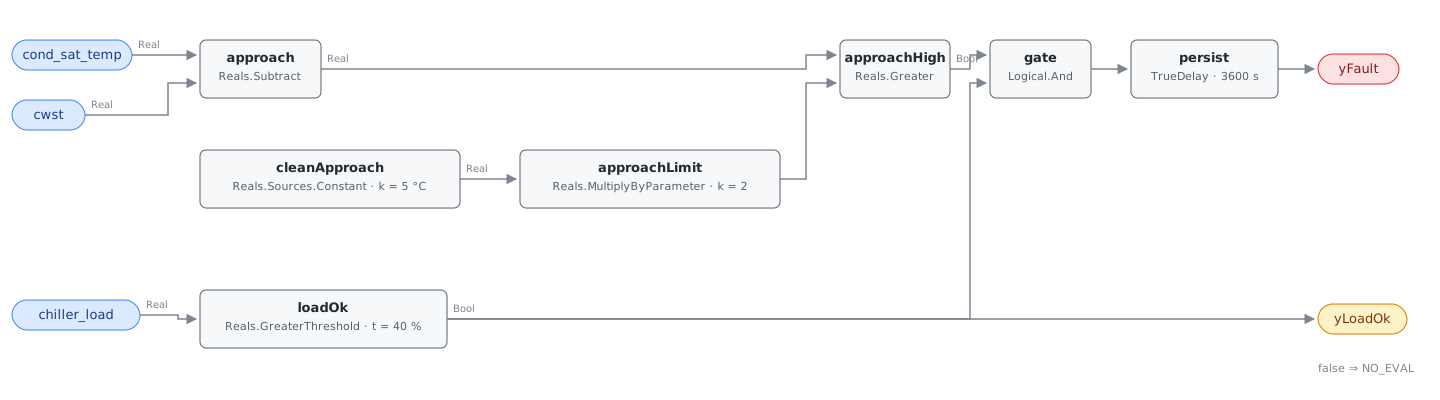
cleanApproach and approachLimit assemble the band inside the graph rather
than shipping a pre-multiplied 10.0: the commissioned approach is measured on the
machine and the multiple is a tolerance, and they are retuned separately.
approachHigh is strict, and the boundary is bit-exact — 5.0 doubled is exactly
10.0, which a realistic temperature pair reaches exactly — so a machine sitting
on the band reads healthy by the strictness rather than by rounding. loadOk is
the whole NO_EVAL story: approach scales with heat flux, so at 20% load a fouled
condenser and a clean one both look fine, and yLoadOk is what lets a host tell
that silence from a verdict. persist requires 60 continuous minutes and carries
delayOnInit = true.
Being differential is what makes this rule worth having next to the tower cards: warm condenser water raises condensing temperature and leaving water together, so a tower that cannot make its setpoint is TOWER-0001’s finding, not this one.
Possible Diagnoses
- Condenser tube fouling — scale, biofilm, or silt on the water side, the mechanism both cited sources name first, and the one a tube cleaning fixes
- Non-condensable gas in the shell, from a leaking seal or an evacuation that was cut short; it raises condensing pressure and separately degrades the heat-transfer coefficient, and on this signal alone it is indistinguishable from fouling (BEE 2006 §3.10). A purge unit that runs constantly is the tell
- Condenser water flow below design — a throttled or failing pump, a fouled strainer, a mis-positioned balancing or isolation valve. Same symptom, a different repair, and CHW-0004’s low delta-T sibling on the condenser side
- Oil carried over into the condenser, coating tubes; no point observes it
- Water treatment lapsed — the cause behind cause 1, and the one that decides how soon the tubes foul again after cleaning
- Neither: a wrong-refrigerant P-T lookup, a mis-bound cwst, or a drifting sensor. Rule this out first, because it costs nothing and it is common
Energy Impact
EFFICIENCY_LOSS, MEDIUM confidence, PROXY_ESTIMATION. The estimator is
waste_kw ≈ chiller_kw × lift_sensitivity × (approach − clean_approach): the
share of compressor power spent lifting across a resistance that should not be
there. A machine 5 K past its commissioned approach spends roughly 11-16% of its
compressor power on it, which brackets BEE 2006 §3.10’s report of about 20% at
four times the design fouling factor. MEDIUM because the sensitivity ratio is
well corroborated while the excess it multiplies is only as good as the
commissioned baseline. Cooling-dominant, worst on design days.
Emissions Impact
Scope 2, PROXY_EMISSIONS, MEDIUM confidence; the same order as CHW-0001’s 1,000-10,000 kg CO₂e/yr, since both findings are compressor electricity on one machine, and toward the lower end of it because this rule accuses one heat exchanger rather than the whole machine. Marginal operating emissions rate basis. The timing works against the building: condenser fouling costs most on hot afternoons, which are also the hours the dirtiest generator is dispatched.
Deviations
- The band is a commissioning placeholder, not a threshold. Three deep-read
sources — BEE 2006, PNNL-13890, and the DOE/PNNL O&M Best Practices Guide 3.0 —
corroborate the mechanism and supply no fault-grade approach magnitude for a
chiller condenser; ASHRAE RP-1043 is the pending primary source for that number.
Until a site commissions
clean_approach, this rule runs against a placeholder in the same sense HP-0001’s shipped regression coefficients do. - The shipped 5.0 K spans an order of magnitude of real machines. BEE §3.8 gives shell-and-tube condensers a 5-10 °C approach and plate condensers 1-5 °C, while the reference’s remediation playbook quotes 1-2 °F design for a chiller condenser; neither defines the difference precisely enough to reconcile them, and the playbook writes it in the order that cannot be right physically. The shipped pair reproduces BEE’s shell-and-tube band (5 K clean, 10 K trip) and is therefore biased toward silence: on a machine whose true clean approach is 1 K, an uncommissioned instance never alarms. That is the intended direction.
approach_fault_multiple = 2.0is the one fault-side number any source supplies. The reference’s remediation playbook states that an approach more than 2x design indicates fouling on that side; the deep-read literature offers nothing to compare it against. It is also the band shape batch 18’s tower cards adopt, so the condenser side and the tower side read the same way — a design consistency choice, not a second derivation.- The simulation study grounds the band’s shape, not its magnitude. The
4-climate healthy envelope committed in
tools/simharness/README.mdmeasures a tower’s leaving-water-to-wet-bulb approach (healthy p50 1.6-11.5 °C, fan-speed dependent). This card’s approach is refrigerant-to-water inside the chiller barrel — a different quantity that the study does not bound — so the honest claim is the 2x band form the study argued for, and nothing numeric. - The energy model applies an evaporator-side sensitivity to the condenser
side. The DOE/PNNL guide’s 1.7%/°F centrifugal and 1.2%/°F reciprocating split
is stated for chilled-water supply temperature; both sources argue lift
symmetrically and BEE §2.5.2 states the symmetric form directly, so the split
crosses over as a lift sensitivity — an approximation, which is why
runtime_estimationwrites it as one. - The same document family’s condenser-side numbers disagree by about 2x. Its chiller chapter puts condenser water lowered 2-3 °F at 2-3% efficiency; its cooling-tower chapter puts 2.5-3.5% per °F of condenser temperature. Neither cites a derivation. This card uses the chiller-chapter figure, which is consistent with BEE’s independent 2-4%/°C band, and treats the tower-chapter number as a loose ceiling rather than a second measurement.
min_load_for_evalis entirely adopted; no source gates this test. 40% is CHW-0004’s floor on the samechiller_loadpoint, so the two chiller rules read the load axis identically. The gate matters more here than there: approach shrinks with heat flux, so a low-load machine hides a fouled condenser rather than faking one, and the failure it prevents is a host reading silence as health.- A fixed band across the whole load range is a simplification. Approach rises with load on a clean machine too, so one line evaluated anywhere above 40% is loose at 90% load and tight at 45%. A load-normalized band is the RP-1043-shaped successor; nothing in the sources says how approach should scale, so it is not expressible as a placeholder.
- Strict
>at the band and at the load floor. CDLRealshas noGreaterEqual; a machine exactly on the band reads healthy, one at exactly 40% load reads NO_EVAL. Both disagreements are measure-zero and err toward silence. yLoadOkis an evaluability output, not an echo of an input — a boundary input compared against a parameter, which is what SCHEMA.md asks. Same stance as CHW-0004’syLoadOkand HP-0001’syPowerOk.- Nothing guards the mis-binding in either direction. Bound to the entering
(cold) condenser water, the rule adds the condenser range to every reading and
alarms forever; fed a saturation temperature from the wrong refrigerant table,
it goes quiet on a fouled machine. Both are pinned as vectors and left to
preconditions, because the graph cannot see a derivation it does not perform. Commissioning check: read the approach once on a machine known clean and confirm it lands where the manufacturer’s data says it should. - Persistence stands in for averaging. The rule consumes instantaneous points, so an approach oscillating either side of the band never accumulates the hour. Fouling is steady and reads the same either way; a hunting condenser water valve does not, and is a finding this rule cannot make.
persist.delayOnInit = true(CDL defaultfalse), the library’s standing choice: a machine already above its band at controller restart waits out the full hour rather than alarming on the first tick.clusters: [CLU-06, CLU-10]with CLU-06 the obvious candidate.clusters/clusters.jsongroups the chilled water plant syndrome behind CHW-0001 as trigger, and a fouled condenser drives kW/ton up exactly as that cluster describes. Membership is the cluster owner’s edit.playbookscites two and only one names this card back.cooling-tower-performance’s Applies-To row already carries CHW-0005 and its Step 1 describes this test correctly;chiller-efficiency’s row does not yet, and that edit belongs to the index owner — the sequencing CHW-0004 and HW-0004 both recorded.- No published test vectors exist. No source specifies cases for this test, so
every scenario in
vectors.jsonis authored from the equation and replayed against the pinned engine rev. - Operating states and preconditions are declared in frontmatter for host
enforcement, not encoded in the block graph. Severity 3 and
method: ruleare this card’s own, matching the CHW chapter’s efficiency-loss cards.
Notes
Read yLoadOk before yFault, and read this rule next to CHW-0001. A fouled
condenser raises kW/ton, so the efficiency alarm usually fires first and says
only that the machine costs more than it should; the approach says which heat
exchanger to open. If both are quiet and kW/ton is still high, the evaporator
side is the remaining candidate and no card covers it — the evap_sat_temp
route HP-0004 takes on packaged equipment. Trend approach against load for a
week before scheduling a cleaning: an approach that widens with load points at
fouling or at flow, while one flat and wide across the range points at
non-condensables or at a mis-set clean_approach.
Test Vectors
15 scenarios, clock step 60 s over 7200 s.
| Scenario | Description |
|---|---|
clean_condenser_at_load | NO_FAULT: 36 °C saturated condensing against 30 °C leaving condenser water is a 6 K approach, inside the shipped 10 K band, at 60% load. The approach conjunct blocks alone — the machine is evaluable and silent. |
fouled_condenser_at_load | FAULT: 42 °C condensing against 30 °C leaving water is a 12 K approach at 60% load. The alarm lands at exactly alarm_delay because delayOnInit holds the condition from the first tick. |
high_approach_at_low_load | NO_EVAL: the same 12 K approach at 20% load. The load conjunct blocks alone, and yLoadOk = false is what tells the host that the silence is not a healthy verdict — at part load a clean machine and a fouled one both make small approaches. |
approach_exactly_at_the_band | Boundary, bit-exact: 40.0 − 30.0 is exactly 10.0 and 5.0 × 2.0 is the same double, so the approach sits exactly on the band. Reals.Greater is strict, so exactly-at-the-band reads healthy. |
approach_just_above_the_band | Boundary from above: 40.01 − 30.0 clears the strict comparison by 10 mK and alarms on the normal schedule. |
approach_just_below_the_band | Boundary from below: 39.99 − 30.0 is 10 mK inside the band and never alarms, however marginal the machine’s condenser is. |
load_exactly_at_the_evaluability_floor | Boundary on the other conjunct: load is exactly min_load_for_eval (40%) with a 12 K approach. Reals.GreaterThreshold is strict, so exactly-at-the-floor is NO_EVAL. |
load_just_below_the_evaluability_floor | 39.9% load with the same widened approach: still NO_EVAL. |
load_just_above_the_evaluability_floor | 40.1% load with the same widened approach: evaluable, and the alarm lands at exactly alarm_delay. One tenth of a percent of chiller load is the whole difference between this scenario and the previous one. |
approach_widens_mid_run | A machine holding a 6 K approach loses it at t = 1800 s — condenser water flow falling away, or non-condensables released into the shell. The alarm lands at exactly 5400 s: the mid-run rising edge carries the same T + delayTime arithmetic as the init case. |
approach_recovers_after_alarm | Recovery: the alarm asserts at 3600 s and the condenser is cleaned — or the purge unit runs — at t = 5400 s. TrueDelay passes the falling edge with no delay, so yFault drops on that tick. |
load_drops_after_alarm | The evaluability release: an alarming machine unloads to 20% at t = 5400 s with the widened approach unchanged. yFault and yLoadOk fall on the same tick, and only the pair tells the host that the chiller unloaded rather than that the condenser recovered. |
intermittent_high_approach_never_alarms | Approach alternating between 12 K and 6 K every 1200 s — a condenser water valve hunting, or a machine cycling between capacity steps. No single episode reaches alarm_delay, so nothing fires. Persistence is not averaging: a machine spending half its day at 12 K is a real finding this rule cannot make. |
entering_condenser_water_bound_by_mistake | Blind spot, pinned: cwst is bound to the cold tower-leaving water entering the condenser instead of the warm water leaving it. The measured difference then carries the condenser range as well as the approach — 38.0 − 26.5 = 11.5 K on a machine whose real approach is 8 K — and the rule alarms permanently on a healthy condenser. This is the loop-side error the point dictionary’s cwst note warns about. |
saturation_lookup_biased_low_hides_the_fault | The opposite blind spot, pinned: a P-T lookup run against the wrong refrigerant biases cond_sat_temp several kelvin low, so a machine at a true 13 K approach reports 9 K and reads healthy for as long as the mis-binding lasts. Nothing in the graph can see the derivation, so the failure is silent in the false-negative direction. |
vectors.json
{
  "schema": "cxf-library/vectors/v1",
  "clock": {
    "step_s": 60,
    "horizon_s": 7200
  },
  "scenarios": [
    {
      "name": "clean_condenser_at_load",
      "description": "NO_FAULT: 36 \u00b0C saturated condensing against 30 \u00b0C leaving condenser water is a 6 K approach, inside the shipped 10 K band, at 60% load. The approach conjunct blocks alone \u2014 the machine is evaluable and silent.",
      "inputs": {
        "cond_sat_temp": 36.0,
        "cwst": 30.0,
        "chiller_load": 60.0
      },
      "expect": [
        {
          "output": "yFault",
          "from_s": 0,
          "to_s": 7200,
          "equals": false
        },
        {
          "output": "yLoadOk",
          "from_s": 0,
          "to_s": 7200,
          "equals": true
        }
      ]
    },
    {
      "name": "fouled_condenser_at_load",
      "description": "FAULT: 42 \u00b0C condensing against 30 \u00b0C leaving water is a 12 K approach at 60% load. The alarm lands at exactly alarm_delay because delayOnInit holds the condition from the first tick.",
      "inputs": {
        "cond_sat_temp": 42.0,
        "cwst": 30.0,
        "chiller_load": 60.0
      },
      "expect": [
        {
          "output": "yFault",
          "from_s": 0,
          "to_s": 3540,
          "equals": false
        },
        {
          "output": "yFault",
          "from_s": 3600,
          "to_s": 7200,
          "equals": true
        },
        {
          "output": "yLoadOk",
          "from_s": 0,
          "to_s": 7200,
          "equals": true
        }
      ]
    },
    {
      "name": "high_approach_at_low_load",
      "description": "NO_EVAL: the same 12 K approach at 20% load. The load conjunct blocks alone, and yLoadOk = false is what tells the host that the silence is not a healthy verdict \u2014 at part load a clean machine and a fouled one both make small approaches.",
      "inputs": {
        "cond_sat_temp": 42.0,
        "cwst": 30.0,
        "chiller_load": 20.0
      },
      "expect": [
        {
          "output": "yFault",
          "from_s": 0,
          "to_s": 7200,
          "equals": false
        },
        {
          "output": "yLoadOk",
          "from_s": 0,
          "to_s": 7200,
          "equals": false
        }
      ]
    },
    {
      "name": "approach_exactly_at_the_band",
      "description": "Boundary, bit-exact: 40.0 \u2212 30.0 is exactly 10.0 and 5.0 \u00d7 2.0 is the same double, so the approach sits exactly on the band. Reals.Greater is strict, so exactly-at-the-band reads healthy.",
      "inputs": {
        "cond_sat_temp": 40.0,
        "cwst": 30.0,
        "chiller_load": 60.0
      },
      "expect": [
        {
          "output": "yFault",
          "from_s": 0,
          "to_s": 7200,
          "equals": false
        },
        {
          "output": "yLoadOk",
          "from_s": 0,
          "to_s": 7200,
          "equals": true
        }
      ]
    },
    {
      "name": "approach_just_above_the_band",
      "description": "Boundary from above: 40.01 \u2212 30.0 clears the strict comparison by 10 mK and alarms on the normal schedule.",
      "inputs": {
        "cond_sat_temp": 40.01,
        "cwst": 30.0,
        "chiller_load": 60.0
      },
      "expect": [
        {
          "output": "yFault",
          "from_s": 0,
          "to_s": 3540,
          "equals": false
        },
        {
          "output": "yFault",
          "from_s": 3600,
          "to_s": 7200,
          "equals": true
        },
        {
          "output": "yLoadOk",
          "from_s": 0,
          "to_s": 7200,
          "equals": true
        }
      ]
    },
    {
      "name": "approach_just_below_the_band",
      "description": "Boundary from below: 39.99 \u2212 30.0 is 10 mK inside the band and never alarms, however marginal the machine's condenser is.",
      "inputs": {
        "cond_sat_temp": 39.99,
        "cwst": 30.0,
        "chiller_load": 60.0
      },
      "expect": [
        {
          "output": "yFault",
          "from_s": 0,
          "to_s": 7200,
          "equals": false
        },
        {
          "output": "yLoadOk",
          "from_s": 0,
          "to_s": 7200,
          "equals": true
        }
      ]
    },
    {
      "name": "load_exactly_at_the_evaluability_floor",
      "description": "Boundary on the other conjunct: load is exactly min_load_for_eval (40%) with a 12 K approach. Reals.GreaterThreshold is strict, so exactly-at-the-floor is NO_EVAL.",
      "inputs": {
        "cond_sat_temp": 42.0,
        "cwst": 30.0,
        "chiller_load": 40.0
      },
      "expect": [
        {
          "output": "yFault",
          "from_s": 0,
          "to_s": 7200,
          "equals": false
        },
        {
          "output": "yLoadOk",
          "from_s": 0,
          "to_s": 7200,
          "equals": false
        }
      ]
    },
    {
      "name": "load_just_below_the_evaluability_floor",
      "description": "39.9% load with the same widened approach: still NO_EVAL.",
      "inputs": {
        "cond_sat_temp": 42.0,
        "cwst": 30.0,
        "chiller_load": 39.9
      },
      "expect": [
        {
          "output": "yFault",
          "from_s": 0,
          "to_s": 7200,
          "equals": false
        },
        {
          "output": "yLoadOk",
          "from_s": 0,
          "to_s": 7200,
          "equals": false
        }
      ]
    },
    {
      "name": "load_just_above_the_evaluability_floor",
      "description": "40.1% load with the same widened approach: evaluable, and the alarm lands at exactly alarm_delay. One tenth of a percent of chiller load is the whole difference between this scenario and the previous one.",
      "inputs": {
        "cond_sat_temp": 42.0,
        "cwst": 30.0,
        "chiller_load": 40.1
      },
      "expect": [
        {
          "output": "yFault",
          "from_s": 0,
          "to_s": 3540,
          "equals": false
        },
        {
          "output": "yFault",
          "from_s": 3600,
          "to_s": 7200,
          "equals": true
        },
        {
          "output": "yLoadOk",
          "from_s": 0,
          "to_s": 7200,
          "equals": true
        }
      ]
    },
    {
      "name": "approach_widens_mid_run",
      "description": "A machine holding a 6 K approach loses it at t = 1800 s \u2014 condenser water flow falling away, or non-condensables released into the shell. The alarm lands at exactly 5400 s: the mid-run rising edge carries the same T + delayTime arithmetic as the init case.",
      "inputs": {
        "cond_sat_temp": [
          {
            "t": 0,
            "value": 36.0
          },
          {
            "t": 1800,
            "value": 42.0
          }
        ],
        "cwst": 30.0,
        "chiller_load": 60.0
      },
      "expect": [
        {
          "output": "yFault",
          "from_s": 0,
          "to_s": 5340,
          "equals": false
        },
        {
          "output": "yFault",
          "from_s": 5400,
          "to_s": 7200,
          "equals": true
        },
        {
          "output": "yLoadOk",
          "from_s": 0,
          "to_s": 7200,
          "equals": true
        }
      ]
    },
    {
      "name": "approach_recovers_after_alarm",
      "description": "Recovery: the alarm asserts at 3600 s and the condenser is cleaned \u2014 or the purge unit runs \u2014 at t = 5400 s. TrueDelay passes the falling edge with no delay, so yFault drops on that tick.",
      "inputs": {
        "cond_sat_temp": [
          {
            "t": 0,
            "value": 42.0
          },
          {
            "t": 5400,
            "value": 36.0
          }
        ],
        "cwst": 30.0,
        "chiller_load": 60.0
      },
      "expect": [
        {
          "output": "yFault",
          "from_s": 0,
          "to_s": 3540,
          "equals": false
        },
        {
          "output": "yFault",
          "from_s": 3600,
          "to_s": 5340,
          "equals": true
        },
        {
          "output": "yFault",
          "from_s": 5400,
          "to_s": 7200,
          "equals": false
        },
        {
          "output": "yLoadOk",
          "from_s": 0,
          "to_s": 7200,
          "equals": true
        }
      ]
    },
    {
      "name": "load_drops_after_alarm",
      "description": "The evaluability release: an alarming machine unloads to 20% at t = 5400 s with the widened approach unchanged. yFault and yLoadOk fall on the same tick, and only the pair tells the host that the chiller unloaded rather than that the condenser recovered.",
      "inputs": {
        "cond_sat_temp": 42.0,
        "cwst": 30.0,
        "chiller_load": [
          {
            "t": 0,
            "value": 60.0
          },
          {
            "t": 5400,
            "value": 20.0
          }
        ]
      },
      "expect": [
        {
          "output": "yFault",
          "from_s": 0,
          "to_s": 3540,
          "equals": false
        },
        {
          "output": "yFault",
          "from_s": 3600,
          "to_s": 5340,
          "equals": true
        },
        {
          "output": "yFault",
          "from_s": 5400,
          "to_s": 7200,
          "equals": false
        },
        {
          "output": "yLoadOk",
          "from_s": 0,
          "to_s": 5340,
          "equals": true
        },
        {
          "output": "yLoadOk",
          "from_s": 5400,
          "to_s": 7200,
          "equals": false
        }
      ]
    },
    {
      "name": "intermittent_high_approach_never_alarms",
      "description": "Approach alternating between 12 K and 6 K every 1200 s \u2014 a condenser water valve hunting, or a machine cycling between capacity steps. No single episode reaches alarm_delay, so nothing fires. Persistence is not averaging: a machine spending half its day at 12 K is a real finding this rule cannot make.",
      "inputs": {
        "cond_sat_temp": [
          {
            "t": 0,
            "value": 42.0
          },
          {
            "t": 1200,
            "value": 36.0
          },
          {
            "t": 2400,
            "value": 42.0
          },
          {
            "t": 3600,
            "value": 36.0
          },
          {
            "t": 4800,
            "value": 42.0
          },
          {
            "t": 6000,
            "value": 36.0
          }
        ],
        "cwst": 30.0,
        "chiller_load": 60.0
      },
      "expect": [
        {
          "output": "yFault",
          "from_s": 0,
          "to_s": 7200,
          "equals": false
        },
        {
          "output": "yLoadOk",
          "from_s": 0,
          "to_s": 7200,
          "equals": true
        }
      ]
    },
    {
      "name": "entering_condenser_water_bound_by_mistake",
      "description": "Blind spot, pinned: cwst is bound to the cold tower-leaving water entering the condenser instead of the warm water leaving it. The measured difference then carries the condenser range as well as the approach \u2014 38.0 \u2212 26.5 = 11.5 K on a machine whose real approach is 8 K \u2014 and the rule alarms permanently on a healthy condenser. This is the loop-side error the point dictionary's cwst note warns about.",
      "inputs": {
        "cond_sat_temp": 38.0,
        "cwst": 26.5,
        "chiller_load": 60.0
      },
      "expect": [
        {
          "output": "yFault",
          "from_s": 0,
          "to_s": 3540,
          "equals": false
        },
        {
          "output": "yFault",
          "from_s": 3600,
          "to_s": 7200,
          "equals": true
        },
        {
          "output": "yLoadOk",
          "from_s": 0,
          "to_s": 7200,
          "equals": true
        }
      ]
    },
    {
      "name": "saturation_lookup_biased_low_hides_the_fault",
      "description": "The opposite blind spot, pinned: a P-T lookup run against the wrong refrigerant biases cond_sat_temp several kelvin low, so a machine at a true 13 K approach reports 9 K and reads healthy for as long as the mis-binding lasts. Nothing in the graph can see the derivation, so the failure is silent in the false-negative direction.",
      "inputs": {
        "cond_sat_temp": 39.0,
        "cwst": 30.0,
        "chiller_load": 60.0
      },
      "expect": [
        {
          "output": "yFault",
          "from_s": 0,
          "to_s": 7200,
          "equals": false
        },
        {
          "output": "yLoadOk",
          "from_s": 0,
          "to_s": 7200,
          "equals": true
        }
      ]
    }
  ]
}