CHW-0006 — Chiller evaporator approach high
| Status | verified — engine e2ff2f8, cxf:fnv1a128:a48359dffe02c0f63f220d11df953eb4, 2026-08-18 |
| Severity | 3 |
| Method | rule |
| Phase | 2 |
| Category | EFFICIENCY_LOSS |
| Confidence | MEDIUM |
| Estimation | PROXY_ESTIMATION |
| G36 | — |
| Clusters | CLU-06 |
| Suppresses | — |
| Suppressed by | — |
| Related | CHW-0001, CHW-0005, CHW-0007 |
| Playbooks | chiller-efficiency |
| Source | HVAC FDD Reference v1.0, Remediation Playbooks (pp. 161-163), carried in playbooks/chiller-efficiency.md: Step 1.3 compares BOTH approaches to design and states that an approach more than 2x design indicates fouling on that side — the rule of thumb behind approach_fault_multiple; Step 3.2 names evaporator tube fouling and chilled-water flow as the evaporator-side repairs; its ‘design typically 1-2 °F’ is the only evaporator-specific approach magnitude any source in this card’s grounding states; BEE/Devki Energy Consultancy, Best Practice Manual: HVAC Chillers (2006), §2.5.2 and §3.2 (Table 3.2) — each 1 °C gained on the EVAPORATING side buys roughly 2-4% lower specific power, stated in this card’s own direction; §3.10 — fouling and oil carryover as heat-transfer mechanisms, with a 4x-design fouling factor associated with roughly 20% energy loss. §3.8 gives approach bands for condensers ONLY and states no evaporator equivalent (see Deviations); DOE/PNNL, O&M Best Practices Guide Release 3.0 (2010) §9.4, and PNNL-13890 (2002) §7.4 — fouling described as requiring an enlarged temperature difference between water and refrigerant, the mechanism this rule detects, plus the compressor-type-split sensitivity (1.7%/°F centrifugal, 1.2%/°F reciprocating) stated for chilled-water supply temperature, which is this card’s own side of the machine; ASHRAE RP-1043 — PENDING primary source for a fault-grade evaporator approach threshold, named in faults/chw/README.md; Sibling precedent: CHW-0005 (graph shape, in-graph band assembly, yLoadOk evaluability output, commissioning-placeholder contract), CHW-0004 (load floor and alarm delay on the same chiller_load point); Library extension: the HVAC FDD Reference v1.0 ch.13 specifies CHW-FC-050 through 053 only (this library’s CHW-0001 through CHW-0004), and its remediation playbook cites CHW-FC-008/009 without ever defining them (see Deviations) |
| Operating states | Chiller running and loaded above min_load_for_eval, settled after a start or a capacity step — one instance per machine, each carrying that machine’s commissioned clean approach. The rule’s yLoadOk covers the load half of that state; running and settled are the host’s to enforce. |
Preconditions (host-enforced): chwst and evap_sat_temp must describe the same machine at the same moment, in °C, and chwst must be the COLD water LEAVING the evaporator on its way to the loop. Binding the return (chiller-entering) water instead adds the evaporator range — commonly 5-6 K — to every reading, which is most of a shipped 10 K band and alarms permanently on a clean barrel (pinned by chilled_water_return_bound_by_mistake); it is the evaporator-side twin of the mis-binding CHW-0005’s cwst note warns about. evap_sat_temp is host-derived: either the saturated suction temperature the chiller controller already publishes, which is the cheaper and safer source, or a P-T lookup the host runs against the machine’s own refrigerant. A lookup against the wrong refrigerant biases the approach by whole kelvin in either direction, and the graph cannot see the derivation. clean_approach must be this machine’s commissioned clean-evaporator approach measured at a load comparable to the evaluation window, not the shipped 5.0 K, and re-measured after any tube cleaning; until it is, the rule ships a deliberately silent placeholder rather than a threshold (see Deviations). The shipped band is looser here than on the condenser side: a real evaporator approach is a few kelvin, so an uncommissioned instance is silent by construction. Chilled water flow must be at or near design: an approach widened by low flow is a real finding but a different repair, and nothing in the rule separates the two. On a glycol or process machine the band still applies, but its commissioned baseline is that machine’s, not a water chiller’s. Evaluability is signalled in-rule by yLoadOk; when it is false the verdict is NO_EVAL, not a clean evaporator.
Points: chwst, evap_sat_temp, chiller_load
Outputs:
yFault— True while the evaporator approach has stayed above clean_approach × approach_fault_multiple with the chiller loaded above min_load_for_eval, continuously for at least alarm_delayyLoadOk— Evaluability signal — true when chiller_load is above min_load_for_eval, the load below which approach says nothing about the evaporator because the heat flux driving it is small. False means NO_EVAL and the host must ignore yFault
Parameters:
| Name | Default | Unit | CXF path | Description |
|---|---|---|---|---|
clean_approach | 5.0 | °C | cleanApproach.k | The machine’s commissioned clean-evaporator approach — leaving chilled water temperature minus saturated evaporating temperature with clean tubes, full charge, and design flow at a load comparable to the evaluation window. PER-MACHINE SITE CONFIGURATION, and the parameter this card exists to be retuned on: no source in this card’s grounding states an evaporator design band, so the shipped 5.0 is CHW-0005’s condenser number carried across for symmetry (see Deviations). A flooded barrel typically runs a few kelvin. Measure it, do not adopt it. |
approach_fault_multiple | 2.0 | 1 | approachLimit.k | Multiple of the clean approach at which the evaporator is called fouled. 2.0 is the reference’s remediation-playbook rule of thumb — an approach more than 2x design indicates fouling on that side — applied to the evaporator half of the same sentence CHW-0005 applies to the condenser half. Kept separate from clean_approach so a site can retune the tolerance and the commissioned baseline independently. |
min_load_for_eval | 40.0 | % | loadOk.t | Chiller load below which approach is not evaluated. Approach scales with the heat flux across the tubes, so a lightly loaded machine makes a small approach whether its evaporator is clean or fouled. ADOPTED from CHW-0004 and CHW-0005’s floor on the same chiller_load point; the sources supply no load gate of their own. |
alarm_delay | 3600.0 | s | persist.delayTime | Continuous high approach at load required before the alarm asserts (60 min). ADOPTED from CHW-0005; fouling and a lost charge are conditions of the machine, not events, and an hour rides out a capacity step or a chilled-water reset. |
Description
An evaporator absorbs heat through a temperature difference. Refrigerant boils below the water leaving the barrel by an approach a clean machine holds nearly constant at a given load, and everything that gets between water and refrigerant widens it: scale and biofilm on the tubes, oil that has drained out of the compressor and coats them, a charge too low to wet the bundle, chilled water flow below design. The machine still makes its chilled water setpoint — it just boils colder to do it, and the compressor pays for the extra lift at roughly 2-4% of its power per degree. This rule watches the approach while the machine is loaded and alarms when it stays above that machine’s commissioned band. It is the evaporator half of the pair CHW-0005 opens on the condenser side.
Detection Logic
approach   = chwst − evap_sat_temp
band_limit = clean_approach × approach_fault_multiple   (5.0 × 2.0 = 10.0 K)

yLoadOk = chiller_load > min_load_for_eval        (false ⇒ host reports NO_EVAL)
yFault  = approach > band_limit AND yLoadOk,
          sustained continuously for alarm_delay
Block graph (rule.cxf.jsonld):
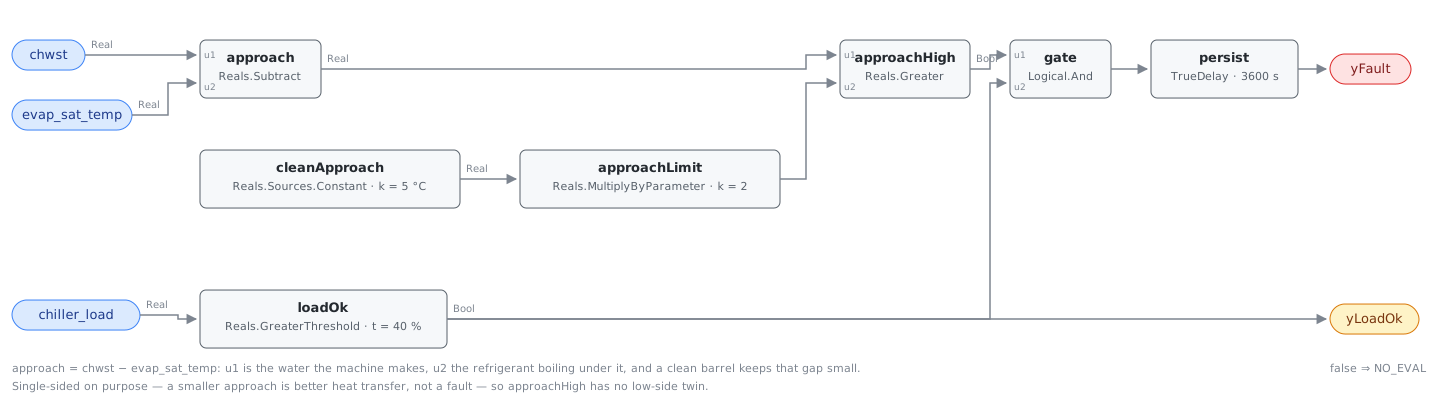
The subtraction is water-minus-refrigerant, so a working chiller makes a positive approach and a widening one moves toward the trip. The test is single-sided: an approach smaller than commissioned is better heat transfer, not a fault.
cleanApproach and approachLimit assemble the band inside the graph rather than
shipping a pre-multiplied 10.0 — the commissioned approach is measured on the
machine, the multiple is a tolerance, and they are retuned separately.
approachHigh is strict and the boundary is bit-exact (5.0 doubled is exactly
10.0), so a machine sitting on the band reads healthy. loadOk is the whole
NO_EVAL story: approach scales with heat flux, so at 20% load a fouled evaporator
and a clean one both look fine, and yLoadOk is what lets a host tell that silence
from a verdict. persist requires 60 continuous minutes and carries
delayOnInit = true.
Possible Diagnoses
- Evaporator tube fouling — scale, biofilm, or silt on the water side; the playbook’s evaporator-side branch, and the one a tube cleaning fixes
- Low refrigerant charge — undercharge starves the barrel, leaving tube surface dry and pulling suction pressure down, which reads here as a widened approach. The playbook’s own “most common root cause” behind an expensive chiller, and BEE 2006’s case study 1 is the same fault at plant scale
- Chilled water flow below design — a throttled or failing pump, a fouled strainer, a mis-positioned balancing valve. Same symptom, a different repair, and the sibling reading of CHW-0004’s low delta-T on the same loop
- Excess oil in the evaporator, drained out of the compressor and filming the tubes; no point observes it (BEE 2006 §3.10)
- Water treatment lapsed — the cause behind cause 1, and the one that decides how soon the tubes foul again after cleaning
- Neither: a wrong-refrigerant P-T lookup, chwst bound to the return water, or a drifting sensor. Rule this out first, because it costs nothing and it is common
Energy Impact
EFFICIENCY_LOSS, MEDIUM confidence, PROXY_ESTIMATION. The estimator is
waste_kw ≈ chiller_kw × lift_sensitivity × (approach − clean_approach): the share
of compressor power spent boiling colder than the machine should have to. A machine
5 K past its commissioned approach spends roughly 11-16% of its compressor power on
it, bracketing BEE 2006 §3.10’s report of about 20% at four times the design
fouling factor. Both source families state the sensitivity for this side of the
machine, so the ratio is firmer here than on the condenser side; MEDIUM stands
because the excess it multiplies is only as good as the commissioned baseline.
Cooling-dominant, worst on design days.
Emissions Impact
Scope 2, PROXY_EMISSIONS, MEDIUM confidence; the same order as CHW-0001’s 1,000-10,000 kg CO₂e/yr, since both findings are compressor electricity on one machine, and toward the lower end of it because this rule accuses one heat exchanger rather than the whole machine. Marginal operating emissions rate basis. The timing works against the building: the approach costs most at high load, which is when the dirtiest generator on the grid is dispatched.
Deviations
- This card resolves half of a dangling reference. The HVAC FDD Reference
v1.0’s chiller-efficiency playbook (pp. 161-163) has the technician compare both
approaches to design and cites rule IDs CHW-FC-008/009 for them, but its ch.13
rule set defines CHW-FC-050 through 053 only — those two IDs are named and never
specified anywhere in the reference. This library resolves the pair as CHW-0005
(condenser) plus this card (evaporator), in its own
{EQUIP}-{NNNN}namespace rather than adopting the dangling legacy codes. - The band is a commissioning placeholder, not a threshold — and more so than on
the condenser side. BEE 2006 §3.8 gives approach bands for condensers by
heat-exchanger type (plate 1-5 °C, shell-and-tube 5-10 °C) and states no
evaporator equivalent anywhere; symmetry is engineering judgment, not something
that text supports. ASHRAE RP-1043 is the pending primary source. Until a
site commissions
clean_approach, this rule runs against a placeholder in the same sense HP-0001’s shipped regression coefficients do. - The shipped 5.0 K is CHW-0005’s condenser number carried across, and it is deliberately silent. The one evaporator-specific magnitude in the grounding is the reference playbook’s “design typically 1-2 °F”, which would put the trip near 2 K and alarm on healthy barrels that run 2-3 K. Rather than ship a line that fires on clean machines, this card ships the sibling’s baseline: a 10 K evaporator approach is past where a water chiller’s own freeze protection would have tripped it, so an uncommissioned instance says nothing at all.
approach_fault_multiple = 2.0is the one fault-side number any source supplies, and it is literally the same sentence CHW-0005 cites — the playbook states it for whichever side the approach was measured on. Shipping the same value on both cards is what makes the pair readable as a pair, not a second derivation.- The playbook’s sign order is corrected. It writes the evaporator approach as
“refrigerant evaporating temp − chilled water leaving temp”, which is negative on
every working chiller; this card computes
chwst − evap_sat_temp. Same correction CHW-0005 made to the condenser half of the same paragraph, which is written backwards in the same way. - Single-sided, and the low side is not a fault. A smaller-than-commissioned
approach is better heat transfer — a cleaned barrel, a machine below the load its
baseline was taken at, a conservative
clean_approach. Pinned bylow_approach_is_never_a_fault. The corollary is a real blind spot: an approach reported negative is thermodynamically impossible and can only be a bad derivation, and this rule reads it as healthy (negative_approach_reads_healthy). A host wanting that check reads the approach itself, notyFault. - The energy model uses its sensitivity in the native direction. BEE §2.5.2 states the 2-4%/°C rule for the evaporating side and the DOE/PNNL split (1.7%/°F centrifugal, 1.2%/°F reciprocating) is stated for chilled-water supply temperature, so this card borrows nothing across the machine the way CHW-0005 had to — a firmer ratio at the same MEDIUM confidence.
min_load_for_evalis entirely adopted; no source gates this test. 40% is CHW-0004’s and CHW-0005’s floor on the samechiller_loadpoint, so the three chiller rules read the load axis identically. Approach shrinks with heat flux, so a low-load machine hides a fouled evaporator rather than faking one, and the failure the gate prevents is a host reading silence as health.- A fixed band across the whole load range is a simplification. Evaporator approach rises with load on a clean machine too, so one line evaluated anywhere above 40% is loose at 90% load and tight at 45%. A load-normalized band is the RP-1043-shaped successor; nothing in the sources says how approach should scale, so it is not expressible as a placeholder.
- Strict
>at the band and at the load floor. CDLRealshas noGreaterEqual; a machine exactly on the band reads healthy, one at exactly 40% load reads NO_EVAL. Both disagreements are measure-zero and err toward silence. yLoadOkis an evaluability output, not an echo of an input — a boundary input compared against a parameter, which is what SCHEMA.md asks. Same stance as CHW-0004’s and CHW-0005’syLoadOk.- Nothing guards the mis-binding in either direction. Bound to the chilled
water return, the rule adds the evaporator range to every reading and alarms
forever; fed a saturation temperature from the wrong refrigerant table, it goes
quiet on a starved barrel. Both are pinned as vectors and left to
preconditions, because the graph cannot see a derivation it does not perform. Commissioning check: read the approach once on a machine known clean and confirm it lands where the manufacturer’s data says it should. related: [CHW-0001, CHW-0005]. CHW-0001 is the symptom this rule explains (kW/ton up, one heat exchanger named) and CHW-0005 is the other half of the pair; no suppression either way, because both approach rules can be true at once and each names a different repair.- Persistence stands in for averaging. The rule consumes instantaneous points, so an approach oscillating either side of the band never accumulates the hour. Fouling and a lost charge are steady and read the same either way; a hunting expansion device does not, and is a finding this rule cannot make.
persist.delayOnInit = true(CDL defaultfalse), the library’s standing choice: a machine already above its band at controller restart waits out the full hour rather than alarming on the first tick.clusters: [CLU-06], and CLU-10 is deliberately not mirrored from CHW-0005. CLU-06 (chilled water plant inefficiency, trigger CHW-0001) fits: a fouled evaporator drives kW/ton up exactly as that cluster describes. CLU-10 is named Condenser-Side Degradation and its trigger is TOWER-0001 — an evaporator finding shares neither its causes nor its investigation path, so claiming membership would be a false lead. Membership is the cluster owner’s edit either way.playbooks: [chiller-efficiency]and its Applies-To row names this card only as one of “the reference’s CHW-FC-008/009, not yet authored”. Step 3.2 is already the correct remediation branch for this finding; updating the row to the authored IDs belongs to the index owner — the sequencing CHW-0004, CHW-0005, and HW-0004 each recorded.- No published test vectors exist. No source specifies cases for this test, so
every scenario in
vectors.jsonis authored from the equation and replayed against the pinned engine rev. - Operating states and preconditions are declared in frontmatter for host
enforcement, not encoded in the block graph. Severity 3,
method: rule, and MEDIUM confidence match CHW-0005 and the CHW chapter’s other efficiency-loss cards.
Notes
Read yLoadOk before yFault, and read this card next to CHW-0005 and CHW-0001.
When kW/ton is high, the two approach rules are the split — condenser, evaporator,
or neither — and “neither” is the playbook’s cue to check the charge and the
compressor. Even then the split is not clean: an undercharged machine widens the
evaporator approach too. To commission clean_approach, trend approach against
load for a week on a machine known clean, take the baseline at the load the alarm
will be evaluated at, and re-measure after every tube cleaning.
Test Vectors
17 scenarios, clock step 60 s over 7200 s.
| Scenario | Description |
|---|---|
clean_evaporator_at_load | NO_FAULT: 7 °C leaving chilled water against 5 °C saturated suction is a 2 K approach — a healthy flooded barrel — at 60% load. The approach conjunct blocks alone, and the machine is evaluable and silent. |
fouled_evaporator_at_load | FAULT: the same 7 °C leaving water against −5 °C saturated suction is a 12 K approach at 60% load — the machine is pulling its suction 12 K below the water it makes. The alarm lands at exactly alarm_delay because delayOnInit holds the condition from the first tick. |
high_approach_at_low_load | NO_EVAL: the same 12 K approach at 20% load. The load conjunct blocks alone, and yLoadOk = false is what tells the host that the silence is not a healthy verdict — at part load a clean barrel and a fouled one both make small approaches. |
approach_exactly_at_the_band | Boundary, bit-exact: 7.0 − (−3.0) is exactly 10.0 and 5.0 × 2.0 is the same double, so the approach sits exactly on the band. Reals.Greater is strict, so exactly-at-the-band reads healthy. |
approach_just_above_the_band | Boundary from above: −3.01 °C saturated suction clears the strict comparison by 10 mK and alarms on the normal schedule. |
approach_just_below_the_band | Boundary from below: −2.99 °C saturated suction is 10 mK inside the band and never alarms, however marginal the machine’s evaporator is. |
load_exactly_at_the_evaluability_floor | Boundary on the other conjunct: load is exactly min_load_for_eval (40%) with a 12 K approach. Reals.GreaterThreshold is strict, so exactly-at-the-floor is NO_EVAL. |
load_just_below_the_evaluability_floor | 39.9% load with the same widened approach: still NO_EVAL. |
load_just_above_the_evaluability_floor | 40.1% load with the same widened approach: evaluable, and the alarm lands at exactly alarm_delay. One tenth of a percent of chiller load is the whole difference between this scenario and the previous one. |
low_approach_is_never_a_fault | Single-sidedness pinned: a 0.5 K approach — better heat transfer than the commissioned barrel, or a lightly fouled machine after a tube cleaning — is silent at full evaluability. The rule has no low-side comparison, by design. |
negative_approach_reads_healthy | Blind spot, pinned: saturated suction reported ABOVE the leaving chilled water is thermodynamically impossible in steady state and can only be a bad P-T lookup or a mis-calibrated sensor. The rule is single-sided, so it reads healthy and says nothing. A host wanting that check reads the approach itself. |
approach_widens_mid_run | A machine holding a 2 K approach loses it at t = 1800 s — chilled water flow falling away, or refrigerant charge migrating out of the barrel. The alarm lands at exactly 5400 s: the mid-run rising edge carries the same T + delayTime arithmetic as the init case. |
approach_recovers_after_alarm | Recovery: the alarm asserts at 3600 s and the evaporator is cleaned — or the charge is restored, or the pump comes back — at t = 5400 s. TrueDelay passes the falling edge with no delay, so yFault drops on that tick. |
load_drops_after_alarm | The evaluability release: an alarming machine unloads to 20% at t = 5400 s with the widened approach unchanged. yFault and yLoadOk fall on the same tick, and only the pair tells the host that the chiller unloaded rather than that the evaporator recovered. |
intermittent_high_approach_never_alarms | Approach alternating between 12 K and 2 K every 1200 s — a hunting expansion device, or a machine cycling between capacity steps. No single episode reaches alarm_delay, so nothing fires. Persistence is not averaging: a machine spending half its day at 12 K is a real finding this rule cannot make. |
chilled_water_return_bound_by_mistake | Blind spot, pinned: chwst is bound to the return (chiller-entering, warm) water instead of the leaving water. The measured difference then carries the evaporator range as well as the approach — 12.0 − 1.0 = 11.0 K on a machine whose real approach is 6 K — and the rule alarms permanently on an evaporator inside its band. The mirror of CHW-0005’s condenser-side mis-binding, and the same repair: check which side of the barrel the point is bound to. |
saturation_lookup_biased_high_hides_the_fault | The opposite blind spot, pinned: a P-T lookup run against the wrong refrigerant biases evap_sat_temp several kelvin high, so a machine at a true 12 K approach reports 7 K and reads healthy for as long as the mis-binding lasts. Nothing in the graph can see the derivation, so the failure is silent in the false-negative direction. |
vectors.json
{
  "schema": "cxf-library/vectors/v1",
  "clock": {
    "step_s": 60,
    "horizon_s": 7200
  },
  "scenarios": [
    {
      "name": "clean_evaporator_at_load",
      "description": "NO_FAULT: 7 \u00b0C leaving chilled water against 5 \u00b0C saturated suction is a 2 K approach \u2014 a healthy flooded barrel \u2014 at 60% load. The approach conjunct blocks alone, and the machine is evaluable and silent.",
      "inputs": {
        "chwst": 7.0,
        "evap_sat_temp": 5.0,
        "chiller_load": 60.0
      },
      "expect": [
        {
          "output": "yFault",
          "from_s": 0,
          "to_s": 7200,
          "equals": false
        },
        {
          "output": "yLoadOk",
          "from_s": 0,
          "to_s": 7200,
          "equals": true
        }
      ]
    },
    {
      "name": "fouled_evaporator_at_load",
      "description": "FAULT: the same 7 \u00b0C leaving water against \u22125 \u00b0C saturated suction is a 12 K approach at 60% load \u2014 the machine is pulling its suction 12 K below the water it makes. The alarm lands at exactly alarm_delay because delayOnInit holds the condition from the first tick.",
      "inputs": {
        "chwst": 7.0,
        "evap_sat_temp": -5.0,
        "chiller_load": 60.0
      },
      "expect": [
        {
          "output": "yFault",
          "from_s": 0,
          "to_s": 3540,
          "equals": false
        },
        {
          "output": "yFault",
          "from_s": 3600,
          "to_s": 7200,
          "equals": true
        },
        {
          "output": "yLoadOk",
          "from_s": 0,
          "to_s": 7200,
          "equals": true
        }
      ]
    },
    {
      "name": "high_approach_at_low_load",
      "description": "NO_EVAL: the same 12 K approach at 20% load. The load conjunct blocks alone, and yLoadOk = false is what tells the host that the silence is not a healthy verdict \u2014 at part load a clean barrel and a fouled one both make small approaches.",
      "inputs": {
        "chwst": 7.0,
        "evap_sat_temp": -5.0,
        "chiller_load": 20.0
      },
      "expect": [
        {
          "output": "yFault",
          "from_s": 0,
          "to_s": 7200,
          "equals": false
        },
        {
          "output": "yLoadOk",
          "from_s": 0,
          "to_s": 7200,
          "equals": false
        }
      ]
    },
    {
      "name": "approach_exactly_at_the_band",
      "description": "Boundary, bit-exact: 7.0 \u2212 (\u22123.0) is exactly 10.0 and 5.0 \u00d7 2.0 is the same double, so the approach sits exactly on the band. Reals.Greater is strict, so exactly-at-the-band reads healthy.",
      "inputs": {
        "chwst": 7.0,
        "evap_sat_temp": -3.0,
        "chiller_load": 60.0
      },
      "expect": [
        {
          "output": "yFault",
          "from_s": 0,
          "to_s": 7200,
          "equals": false
        },
        {
          "output": "yLoadOk",
          "from_s": 0,
          "to_s": 7200,
          "equals": true
        }
      ]
    },
    {
      "name": "approach_just_above_the_band",
      "description": "Boundary from above: \u22123.01 \u00b0C saturated suction clears the strict comparison by 10 mK and alarms on the normal schedule.",
      "inputs": {
        "chwst": 7.0,
        "evap_sat_temp": -3.01,
        "chiller_load": 60.0
      },
      "expect": [
        {
          "output": "yFault",
          "from_s": 0,
          "to_s": 3540,
          "equals": false
        },
        {
          "output": "yFault",
          "from_s": 3600,
          "to_s": 7200,
          "equals": true
        },
        {
          "output": "yLoadOk",
          "from_s": 0,
          "to_s": 7200,
          "equals": true
        }
      ]
    },
    {
      "name": "approach_just_below_the_band",
      "description": "Boundary from below: \u22122.99 \u00b0C saturated suction is 10 mK inside the band and never alarms, however marginal the machine's evaporator is.",
      "inputs": {
        "chwst": 7.0,
        "evap_sat_temp": -2.99,
        "chiller_load": 60.0
      },
      "expect": [
        {
          "output": "yFault",
          "from_s": 0,
          "to_s": 7200,
          "equals": false
        },
        {
          "output": "yLoadOk",
          "from_s": 0,
          "to_s": 7200,
          "equals": true
        }
      ]
    },
    {
      "name": "load_exactly_at_the_evaluability_floor",
      "description": "Boundary on the other conjunct: load is exactly min_load_for_eval (40%) with a 12 K approach. Reals.GreaterThreshold is strict, so exactly-at-the-floor is NO_EVAL.",
      "inputs": {
        "chwst": 7.0,
        "evap_sat_temp": -5.0,
        "chiller_load": 40.0
      },
      "expect": [
        {
          "output": "yFault",
          "from_s": 0,
          "to_s": 7200,
          "equals": false
        },
        {
          "output": "yLoadOk",
          "from_s": 0,
          "to_s": 7200,
          "equals": false
        }
      ]
    },
    {
      "name": "load_just_below_the_evaluability_floor",
      "description": "39.9% load with the same widened approach: still NO_EVAL.",
      "inputs": {
        "chwst": 7.0,
        "evap_sat_temp": -5.0,
        "chiller_load": 39.9
      },
      "expect": [
        {
          "output": "yFault",
          "from_s": 0,
          "to_s": 7200,
          "equals": false
        },
        {
          "output": "yLoadOk",
          "from_s": 0,
          "to_s": 7200,
          "equals": false
        }
      ]
    },
    {
      "name": "load_just_above_the_evaluability_floor",
      "description": "40.1% load with the same widened approach: evaluable, and the alarm lands at exactly alarm_delay. One tenth of a percent of chiller load is the whole difference between this scenario and the previous one.",
      "inputs": {
        "chwst": 7.0,
        "evap_sat_temp": -5.0,
        "chiller_load": 40.1
      },
      "expect": [
        {
          "output": "yFault",
          "from_s": 0,
          "to_s": 3540,
          "equals": false
        },
        {
          "output": "yFault",
          "from_s": 3600,
          "to_s": 7200,
          "equals": true
        },
        {
          "output": "yLoadOk",
          "from_s": 0,
          "to_s": 7200,
          "equals": true
        }
      ]
    },
    {
      "name": "low_approach_is_never_a_fault",
      "description": "Single-sidedness pinned: a 0.5 K approach \u2014 better heat transfer than the commissioned barrel, or a lightly fouled machine after a tube cleaning \u2014 is silent at full evaluability. The rule has no low-side comparison, by design.",
      "inputs": {
        "chwst": 7.0,
        "evap_sat_temp": 6.5,
        "chiller_load": 60.0
      },
      "expect": [
        {
          "output": "yFault",
          "from_s": 0,
          "to_s": 7200,
          "equals": false
        },
        {
          "output": "yLoadOk",
          "from_s": 0,
          "to_s": 7200,
          "equals": true
        }
      ]
    },
    {
      "name": "negative_approach_reads_healthy",
      "description": "Blind spot, pinned: saturated suction reported ABOVE the leaving chilled water is thermodynamically impossible in steady state and can only be a bad P-T lookup or a mis-calibrated sensor. The rule is single-sided, so it reads healthy and says nothing. A host wanting that check reads the approach itself.",
      "inputs": {
        "chwst": 7.0,
        "evap_sat_temp": 8.0,
        "chiller_load": 60.0
      },
      "expect": [
        {
          "output": "yFault",
          "from_s": 0,
          "to_s": 7200,
          "equals": false
        },
        {
          "output": "yLoadOk",
          "from_s": 0,
          "to_s": 7200,
          "equals": true
        }
      ]
    },
    {
      "name": "approach_widens_mid_run",
      "description": "A machine holding a 2 K approach loses it at t = 1800 s \u2014 chilled water flow falling away, or refrigerant charge migrating out of the barrel. The alarm lands at exactly 5400 s: the mid-run rising edge carries the same T + delayTime arithmetic as the init case.",
      "inputs": {
        "chwst": 7.0,
        "evap_sat_temp": [
          {
            "t": 0,
            "value": 5.0
          },
          {
            "t": 1800,
            "value": -5.0
          }
        ],
        "chiller_load": 60.0
      },
      "expect": [
        {
          "output": "yFault",
          "from_s": 0,
          "to_s": 5340,
          "equals": false
        },
        {
          "output": "yFault",
          "from_s": 5400,
          "to_s": 7200,
          "equals": true
        },
        {
          "output": "yLoadOk",
          "from_s": 0,
          "to_s": 7200,
          "equals": true
        }
      ]
    },
    {
      "name": "approach_recovers_after_alarm",
      "description": "Recovery: the alarm asserts at 3600 s and the evaporator is cleaned \u2014 or the charge is restored, or the pump comes back \u2014 at t = 5400 s. TrueDelay passes the falling edge with no delay, so yFault drops on that tick.",
      "inputs": {
        "chwst": 7.0,
        "evap_sat_temp": [
          {
            "t": 0,
            "value": -5.0
          },
          {
            "t": 5400,
            "value": 5.0
          }
        ],
        "chiller_load": 60.0
      },
      "expect": [
        {
          "output": "yFault",
          "from_s": 0,
          "to_s": 3540,
          "equals": false
        },
        {
          "output": "yFault",
          "from_s": 3600,
          "to_s": 5340,
          "equals": true
        },
        {
          "output": "yFault",
          "from_s": 5400,
          "to_s": 7200,
          "equals": false
        },
        {
          "output": "yLoadOk",
          "from_s": 0,
          "to_s": 7200,
          "equals": true
        }
      ]
    },
    {
      "name": "load_drops_after_alarm",
      "description": "The evaluability release: an alarming machine unloads to 20% at t = 5400 s with the widened approach unchanged. yFault and yLoadOk fall on the same tick, and only the pair tells the host that the chiller unloaded rather than that the evaporator recovered.",
      "inputs": {
        "chwst": 7.0,
        "evap_sat_temp": -5.0,
        "chiller_load": [
          {
            "t": 0,
            "value": 60.0
          },
          {
            "t": 5400,
            "value": 20.0
          }
        ]
      },
      "expect": [
        {
          "output": "yFault",
          "from_s": 0,
          "to_s": 3540,
          "equals": false
        },
        {
          "output": "yFault",
          "from_s": 3600,
          "to_s": 5340,
          "equals": true
        },
        {
          "output": "yFault",
          "from_s": 5400,
          "to_s": 7200,
          "equals": false
        },
        {
          "output": "yLoadOk",
          "from_s": 0,
          "to_s": 5340,
          "equals": true
        },
        {
          "output": "yLoadOk",
          "from_s": 5400,
          "to_s": 7200,
          "equals": false
        }
      ]
    },
    {
      "name": "intermittent_high_approach_never_alarms",
      "description": "Approach alternating between 12 K and 2 K every 1200 s \u2014 a hunting expansion device, or a machine cycling between capacity steps. No single episode reaches alarm_delay, so nothing fires. Persistence is not averaging: a machine spending half its day at 12 K is a real finding this rule cannot make.",
      "inputs": {
        "chwst": 7.0,
        "evap_sat_temp": [
          {
            "t": 0,
            "value": -5.0
          },
          {
            "t": 1200,
            "value": 5.0
          },
          {
            "t": 2400,
            "value": -5.0
          },
          {
            "t": 3600,
            "value": 5.0
          },
          {
            "t": 4800,
            "value": -5.0
          },
          {
            "t": 6000,
            "value": 5.0
          }
        ],
        "chiller_load": 60.0
      },
      "expect": [
        {
          "output": "yFault",
          "from_s": 0,
          "to_s": 7200,
          "equals": false
        },
        {
          "output": "yLoadOk",
          "from_s": 0,
          "to_s": 7200,
          "equals": true
        }
      ]
    },
    {
      "name": "chilled_water_return_bound_by_mistake",
      "description": "Blind spot, pinned: chwst is bound to the return (chiller-entering, warm) water instead of the leaving water. The measured difference then carries the evaporator range as well as the approach \u2014 12.0 \u2212 1.0 = 11.0 K on a machine whose real approach is 6 K \u2014 and the rule alarms permanently on an evaporator inside its band. The mirror of CHW-0005's condenser-side mis-binding, and the same repair: check which side of the barrel the point is bound to.",
      "inputs": {
        "chwst": 12.0,
        "evap_sat_temp": 1.0,
        "chiller_load": 60.0
      },
      "expect": [
        {
          "output": "yFault",
          "from_s": 0,
          "to_s": 3540,
          "equals": false
        },
        {
          "output": "yFault",
          "from_s": 3600,
          "to_s": 7200,
          "equals": true
        },
        {
          "output": "yLoadOk",
          "from_s": 0,
          "to_s": 7200,
          "equals": true
        }
      ]
    },
    {
      "name": "saturation_lookup_biased_high_hides_the_fault",
      "description": "The opposite blind spot, pinned: a P-T lookup run against the wrong refrigerant biases evap_sat_temp several kelvin high, so a machine at a true 12 K approach reports 7 K and reads healthy for as long as the mis-binding lasts. Nothing in the graph can see the derivation, so the failure is silent in the false-negative direction.",
      "inputs": {
        "chwst": 7.0,
        "evap_sat_temp": 0.0,
        "chiller_load": 60.0
      },
      "expect": [
        {
          "output": "yFault",
          "from_s": 0,
          "to_s": 7200,
          "equals": false
        },
        {
          "output": "yLoadOk",
          "from_s": 0,
          "to_s": 7200,
          "equals": true
        }
      ]
    }
  ]
}