TOWER-0001 — Tower approach high at fan capacity
| Status | verified — engine e2ff2f8, cxf:fnv1a128:31a206719e4e4a6f656dca426369d9d2, 2026-08-18 |
| Severity | 3 |
| Method | rule |
| Phase | 2 |
| Category | EFFICIENCY_LOSS |
| Confidence | LOW |
| Estimation | PROXY_ESTIMATION |
| G36 | — |
| Clusters | CLU-10 |
| Suppresses | — |
| Suppressed by | — |
| Related | TOWER-0002, TOWER-0003, TOWER-0004, TOWER-0005, CHW-0005 |
| Playbooks | cooling-tower-performance |
| Source | Library-authored: no reference chapter covers cooling towers — the TOWER family opens with this card (see faults/tower/README.md); cxf-library simulation study — tools/simharness/README.md, ‘Tower groundwork (condenser-loop stats)’: 4-climate healthy-operation approach envelope; the fan-at-capacity gate is that study’s design result and the band’s only quantitative grounding; BEE Best Practice Manual: HVAC Chillers (2006) §2.8 — approach and range defined and ranked, one worked design point (26 °C wet-bulb, 3 °C approach); design guidance, no fault band (paraphrased); DOE FEMP/PNNL, O&M Best Practices Guide Release 3.0 §9.5 and PNNL-13890 §7.5 — causes of poor tower performance (scale, clogged nozzles, poor airflow); fouling’s symptom named as a larger water-to-refrigerant temperature difference, with no magnitude attached (paraphrased); Sibling precedent: HP-0001 (commissioning-placeholder parameters, y…Ok evaluability output), HW-0004 (library-extension framing) |
| Operating states | Cooling season, tower rejecting heat: condenser water pumps running and the fan cell(s) serving the sensed water commanded on. The at-capacity half of that state is in-rule (tower_fan_speed); the tower-on half is host-enforced, and a tower that has just started needs its loop to turn over before approach means anything. |
Preconditions (host-enforced): tower_leaving_temp must be the COLD water leaving the tower basin, the water that goes on to enter the chiller condenser — which is why the dictionary grounds it as brick:Entering_Condenser_Water_Temperature_Sensor. Bind the warm return instead (tower_entering_temp, or the chw dictionary’s cwst, the same physical stream) and approach reads several degrees high forever: a permanently faulted tower that looks like a working rule. oa_wetbulb is the weak input. Almost no site has a wet-bulb sensor, so it is a host psychrometric derivation from dry-bulb, humidity and station pressure — a multivariable calculation, least accurate near saturation, which is exactly when a tower matters most. Its error passes into approach one-for-one against a 5 K band, so the host must document the routine and its accuracy, and must not resample stale humidity into a live derivation. tower_fan_speed must be a real variable-speed feedback for the cell(s) whose water is being measured: a single- or two-speed fan reads 100% whenever it runs, the gate then admits every part-load hour, and the rule degenerates into the un-gated form the simulation study rejects. On a multi-cell tower sensed only at the common headers, all cells must be staged together and the speed bound must be the least-loaded cell’s — one cell off or ramping makes the header approach a mixture that belongs to no tower. approach_high_band must be set from this tower’s commissioned design approach before any verdict means anything; the shipped 5.0 K is a placeholder (see Deviations). Finally, check what the fans are chasing: a condenser-water setpoint below wet-bulb plus design approach pins the fans at capacity against a target no tower can reach, and this rule fires correctly on a tower that is not degraded. Evaluability of the wet-bulb input is signalled in-rule by yWetBulbOk; when it is false the verdict is NO_EVAL, not a healthy tower.
Points: tower_leaving_temp, oa_wetbulb, tower_fan_speed
Outputs:
yFault— True while the tower’s approach has stayed above approach_high_band with the fan above fan_capacity_threshold, continuously for at least alarm_delayyWetBulbOk— Evaluability signal — true while the computed approach is positive, the thermodynamic floor evaporative cooling cannot cross. False means the wet-bulb derivation (or a water temperature sensor) is wrong and the verdict is NO_EVAL; the host must ignore yFault
Parameters:
| Name | Default | Unit | CXF path | Description |
|---|---|---|---|---|
approach_high_band | 5.0 | °C | appHigh.t | Approach above which a tower at capacity is judged degraded. PER-TOWER SITE CONFIGURATION AND A COMMISSIONING PLACEHOLDER — no literature fault band exists (see Deviations). Retune to roughly 2 × this tower’s commissioned design approach, measured at full fan with the design flow; the shipped 5.0 K is 2 × the 2.5 K class of design approach a modern tower is selected for, and sits above the ~2.3 K healthy p95 the simulation study observed at design-like loaded conditions. |
fan_capacity_threshold | 95.0 | % | fanMax.t | Fan speed above which the tower is treated as out of capacity, so approach becomes diagnostic. 95% leaves a little headroom for a drive that never quite commands 100%; lower it toward 90% for a drive that tops out short, and never set it low enough to admit ordinary part-load operation — that is the whole design of the rule. |
alarm_delay | 1800.0 | s | persist.delayTime | Continuous high approach at capacity required before the alarm asserts (30 min). Shorter than the library’s usual hour because the fan gate already excludes transients and the at-capacity window itself may only last an hour or two on a shoulder-season peak. |
Description
A cooling tower pushes its leaving water down toward the ambient wet-bulb, and how close it gets — the approach — measures whether the fill, the water distribution and the airflow still do what they were bought to do. Scale, clogged spray nozzles, blocked air inlets and recirculated discharge air all read the same way: more air needed than before for the same water. A variable-speed fan hides every bit of that. At part load the drive backs off and approach rides wherever the control loop is satisfied, so a large approach usually means a lightly loaded tower rather than a dirty one. This rule asks the question only when the fan has nothing left to give: approach above the band while the fan is at capacity is the tower failing to deliver, and the chiller pays for it.
Detection Logic
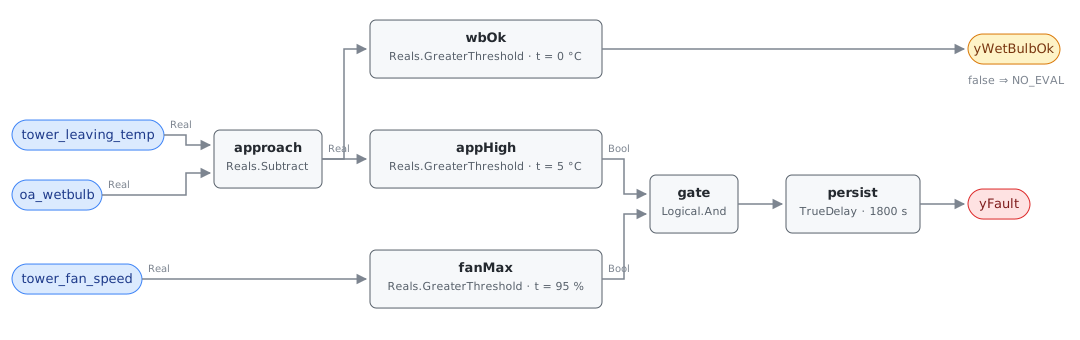
approach = tower_leaving_temp − oa_wetbulb

yWetBulbOk = approach > 0                            (false ⇒ host reports NO_EVAL)
yFault     = approach > approach_high_band
             AND tower_fan_speed > fan_capacity_threshold,
             sustained continuously for alarm_delay
Block graph (rule.cxf.jsonld):
The fan conjunct is not a data-quality gate but the rule’s premise: the study
behind this card measured healthy approach spanning 1.6–13.3 K across four
climates on nothing but fan modulation (tools/simharness README, “Tower
groundwork”). An ungated threshold inside that span alarms on healthy towers in
half the fleet, and one above it never fires anywhere. Both conjuncts compare
strictly, so a tower exactly on the band, or a drive exactly at 95%, reads
healthy.
wbOk tests the sign of the same difference: a tower cannot make water colder
than the wet-bulb, so a non-positive approach means the psychrometric derivation
or a water sensor is wrong and the silence underneath is NO_EVAL. It is a
boundary output only — it cannot change yFault, since a non-positive approach
already fails the high test.
persist requires 30 continuous minutes and carries delayOnInit = true; its
falling edge is immediate, and fans backing off at the end of the day is the
ordinary way this alarm clears with nothing fixed.
Possible Diagnoses
- Scale or biological fouling on the fill — the classic cause, and the one the O&M guides name first; usually accompanied by a water-treatment record that stopped being kept
- Clogged or broken spray nozzles, or a distribution basin flooding to one side — the fill only works where the water actually falls
- Air-side blockage: plugged inlet louvers, collapsed drift eliminators, debris screens, or a new structure that has put the tower into its own discharge
- Fan or drive not delivering the airflow the command implies — slipping belt, worn gearbox, blade pitch drifted, or a motor running backwards after service
- Condenser water flow above design, which raises approach as it lowers range (TOWER-0002 reads the other half of that pair, and flow is the first thing to check when both fire)
- A tower now undersized for the load on it — added chiller capacity, a changed process, or a derate the selection never carried
- Control chasing an unreachable condenser-water setpoint, which pins the fans at capacity on a perfectly clean tower (playbook step 2.2 — the fix is the setpoint, not the tower)
- A wet-bulb derivation reading low, which inflates approach with no physical
change at all;
yWetBulbOkonly catches the opposite error
Energy Impact
EFFICIENCY_LOSS, LOW confidence, PROXY_ESTIMATION. The fan is already at capacity, so the fault costs nothing extra on the tower side — the whole bill is the chiller’s, which sees warmer condenser water and lifts against it at roughly 2–4% more power per K (BEE 2006; the DOE/PNNL O&M guides’ chiller chapter gives 1.2–1.7%/°F split by compressor type). A tower 3 K off its commissioned approach therefore costs something like 6–12% of chiller power for as long as it stays at capacity, which is the hottest and most expensive hours of the year. Confidence is LOW for the same reason the band is a placeholder: the sensitivity ratio is well corroborated, but nothing in the literature says how much approach rise a given degree of fouling produces, so the trigger point of the estimate is a commissioning number rather than a published one.
Emissions Impact
Scope 2, PROXY_EMISSIONS, LOW confidence. All of it is chiller electricity, so the basis is the marginal operating emissions rate, and the fault concentrates in exactly the hours a summer-peaking grid is dirtiest — the avoided emissions are worth more than the annual-average kWh figure implies. No published emissions range exists for tower degradation; the estimate is the host’s chiller kW times its own factors.
Deviations
- The band is a commissioning placeholder and its fault-side corroboration is
pending. Three sources were read for a degraded-approach magnitude — BEE
2006, PNNL-13890, and DOE/PNNL O&M Best Practices 3.0 — and all three are
silent: they give design approach bands and named causes of poor performance,
never a number at which approach becomes a fault. The only quantitative
grounding under the shipped 5.0 K is this library’s own 4-climate simulation
envelope (
tools/simharness/README.md, “Tower groundwork”), which measures healthy operation, not faulted. A CTI or ASHRAE tower-chapter source is the outstanding gap; until it is read, treatapproach_high_bandthe way HP-0001 asks its baseline coefficients to be treated — as a value the site must set, not a value the library has established. - The fan-at-capacity conjunct is the study’s design result, not a
convenience. Healthy approach ran 1.6–13.3 K across Miami, Atlanta, Tucson
and Buffalo purely from VFD modulation, so no fixed ungated threshold is
defensible; at design-like loaded conditions healthy p95 was ~2.3 K, which is
what makes the gated form thresholdable at all. The vector
part_load_high_approach_stays_silentpins an 8 K healthy approach staying silent at 60% fan. fan_capacity_threshold = 95%is adopted, and it is what a two-speed tower breaks. The simulation ran variable-speed cells; the number is a judgment about drive headroom rather than a measured line. A single- or two-speed fan reads full speed whenever it runs, which silently restores the ungated rule — that limit ispreconditionstext because no block can see it.yWetBulbOkis an evaluability output that is deliberately not wired into the conjunction. With any positive band, a non-positive approach already fails the high test, so anAndterm would add a block and change no verdict. What the flag buys is the distinction a host cannot otherwise make: a quiet rule because the tower is fine, versus a quiet rule because the psychrometric input is nonsense.- That sign test only catches one direction of wet-bulb error. A derivation reading too high shrinks approach and, far enough, inverts it — caught. A derivation reading too low inflates approach and produces a false fault that looks exactly like fouling — not caught by anything in the graph, and the reason the derivation’s accuracy is a precondition rather than a footnote.
- The validity floor is 0 K and is not exposed as a card parameter. It is
the thermodynamic limit of evaporative cooling, not a tunable, and it is CDL’s
own
GreaterThresholddefault, which SCHEMA.md says to leave unwritten. A small negative tolerance for sensor noise would read better on a real site but would need a negative parameter, which this library ships only where a fitted sign demands it (HP-0001’s regression slope). alarm_delay = 1800 sdeparts from the hour its siblings use. CHW-0004 and HW-0004 require 60 minutes because their gates admit a lot of ordinary operation; here the fan gate has already excluded everything transient, and a full-capacity window on a shoulder-season afternoon can be shorter than the alarm delay itself. Thirty minutes still covers a staging transition and a load step.- There is no range or flow conjunct, so a flow fault reads as a tower fault. Condenser flow above design raises approach without any tower degradation (diagnosis 5), and the tower dictionary carries no flow point to test it with. TOWER-0002 measures the range half of that signature and the playbook orders flow before fill; folding both into one card would have produced a rule that alarms on neither cleanly.
- Severity 3,
method: ruleandphase: 2are library choices. No reference chapter or index covers cooling towers — there is nothing to transcribe and nothing whose severity column to follow. The classification follows the sibling condenser-side cards: a degradation that costs money continuously and threatens nothing. clusters: [CLU-10]. A condenser-side syndrome (this rule, TOWER-0002 and CHW-0005 all describe one plant lifting harder than it should) is a reasonable cluster and is the cluster owner’s edit, not this card’s.persist.delayOnInit = true(CDL defaultfalse), the library’s standing choice: a tower already over the band at controller restart waits out the full 30 minutes rather than alarming on the first tick.- No published test vectors exist for this fault — there is no published
algorithm — so every scenario in
vectors.jsonis authored from the equation and replayed against the pinned engine rev. - Operating states and preconditions are declared in frontmatter for host enforcement rather than encoded in the block graph, per the library’s design stance.
Notes
Read yWetBulbOk before yFault, and read the fan speed before either: this
alarm ends every evening when the load falls away and the fans back off, and
nothing about that is a repair. Trend approach against wet-bulb over a week of
full-capacity hours before dispatching anyone — a tower whose approach has
drifted up season over season at matched wet-bulb is fouling, while one that
only ever reads high at a particular setpoint is a controls finding.
Where CHW-0005 fires and this card does not, the fouling is on the condenser tubes rather than in the tower; where both fire, do the water treatment first, since the same water made both deposits.
Test Vectors
13 scenarios, clock step 60 s over 5400 s.
| Scenario | Description |
|---|---|
healthy_tower_at_full_fan | Design-like conditions: 24 °C wet-bulb, 26 °C leaving water, fans wide open. Approach 2.0 °C sits inside the loaded healthy envelope the simulation study observed (Miami July p95 ~2.3 °C), so the fan conjunct is true and the approach conjunct is what holds the alarm down. |
fouled_fill_at_full_fan | The fault: same 24 °C wet-bulb, but the tower can only make 30 °C leaving water with the fans at 100%. Approach 6.0 °C is past the band and the fan has nothing left to give, so the alarm matures one alarm_delay in. |
part_load_high_approach_stays_silent | The design result the fan gate exists for: approach 8.0 °C at 60% fan speed. That is a bigger approach than the fault scenario carries and it is healthy — the study found un-gated healthy approach spanning 1.6-13.3 °C, driven by nothing but VFD modulation at part load. The approach conjunct is true here and the fan conjunct alone blocks the alarm. |
approach_exactly_at_the_band | Threshold edge: 29.0 − 24.0 is exactly 5.0, the shipped band, and the comparison is a strict >, so a tower sitting precisely on the band reads healthy. Both operands and the difference are binary-exact, so this is a true boundary pin. |
approach_just_past_the_band | Threshold edge from the other side: a tenth of a degree more leaving-water temperature puts approach at 5.1 °C and the alarm matures. |
fan_exactly_at_the_capacity_threshold | Fan-gate edge: approach is 6.0 °C and clearly faulted, but the drive reads exactly fan_capacity_threshold (95.0%). The gate is a strict >, so the rule stays silent — a tower with a drive still holding a hair of headroom is not at capacity. |
fan_just_past_the_capacity_threshold | Fan-gate edge from the other side: 95.1% clears the gate and the identical approach now alarms. The two scenarios differ by a tenth of a percent of fan speed and disagree completely. |
brief_peak_never_alarms | A load step, not a fault: approach jumps to 6.0 °C at t = 600 s with the fans already at 100% and recovers at t = 1800 s, 20 minutes short of alarm_delay. The timer resets on the recovery and nothing is reported. |
capacity_reached_late_starts_the_clock | Delay edge: approach is 6.0 °C from t = 0 but the fan only reaches capacity at t = 1200 s, so the alarm lands at 3000 s — alarm_delay is measured from the conjunction’s rising edge, not from when the approach went high. |
alarm_clears_when_the_fans_back_off | Recovery has two readings and this is the one that is not a repair: the tower is still making 30 °C water, but the load falls away at t = 3600 s and the fans throttle to 70%. yFault drops on that same tick — TrueDelay only delays the rising edge — and the tower is no more clean than it was a minute earlier. |
negative_approach_is_no_eval | The wet-bulb input fails its own sanity check: 24 °C wet-bulb against 22 °C leaving water is an approach of −2 °C, which evaporative cooling cannot produce. yWetBulbOk goes false and the host must read NO_EVAL rather than a well-performing tower. |
approach_exactly_zero_is_no_eval | Validity-floor edge: leaving water exactly at the wet-bulb. The floor is a strict >, so a 0.0 °C approach reads NO_EVAL — it is the thermodynamic limit, not an achievable steady state, and a tower reporting it is reporting a derivation or a sensor. |
approach_just_above_zero_is_evaluable | Validity-floor edge from the other side: a tenth of a degree of approach is physically extraordinary but not impossible, so the rule is willing to issue a verdict — and the verdict is healthy, since 0.1 °C is far below the band. |
vectors.json
{
  "schema": "cxf-library/vectors/v1",
  "clock": {
    "step_s": 60,
    "horizon_s": 5400
  },
  "scenarios": [
    {
      "name": "healthy_tower_at_full_fan",
      "description": "Design-like conditions: 24 \u00b0C wet-bulb, 26 \u00b0C leaving water, fans wide open. Approach 2.0 \u00b0C sits inside the loaded healthy envelope the simulation study observed (Miami July p95 ~2.3 \u00b0C), so the fan conjunct is true and the approach conjunct is what holds the alarm down.",
      "inputs": {
        "tower_leaving_temp": 26.0,
        "oa_wetbulb": 24.0,
        "tower_fan_speed": 100.0
      },
      "expect": [
        {
          "output": "yFault",
          "from_s": 0,
          "to_s": 5400,
          "equals": false
        },
        {
          "output": "yWetBulbOk",
          "from_s": 0,
          "to_s": 5400,
          "equals": true
        }
      ]
    },
    {
      "name": "fouled_fill_at_full_fan",
      "description": "The fault: same 24 \u00b0C wet-bulb, but the tower can only make 30 \u00b0C leaving water with the fans at 100%. Approach 6.0 \u00b0C is past the band and the fan has nothing left to give, so the alarm matures one alarm_delay in.",
      "inputs": {
        "tower_leaving_temp": 30.0,
        "oa_wetbulb": 24.0,
        "tower_fan_speed": 100.0
      },
      "expect": [
        {
          "output": "yWetBulbOk",
          "from_s": 0,
          "to_s": 5400,
          "equals": true
        },
        {
          "output": "yFault",
          "from_s": 0,
          "to_s": 1740,
          "equals": false
        },
        {
          "output": "yFault",
          "from_s": 1860,
          "to_s": 5400,
          "equals": true
        }
      ]
    },
    {
      "name": "part_load_high_approach_stays_silent",
      "description": "The design result the fan gate exists for: approach 8.0 \u00b0C at 60% fan speed. That is a bigger approach than the fault scenario carries and it is healthy \u2014 the study found un-gated healthy approach spanning 1.6-13.3 \u00b0C, driven by nothing but VFD modulation at part load. The approach conjunct is true here and the fan conjunct alone blocks the alarm.",
      "inputs": {
        "tower_leaving_temp": 32.0,
        "oa_wetbulb": 24.0,
        "tower_fan_speed": 60.0
      },
      "expect": [
        {
          "output": "yFault",
          "from_s": 0,
          "to_s": 5400,
          "equals": false
        },
        {
          "output": "yWetBulbOk",
          "from_s": 0,
          "to_s": 5400,
          "equals": true
        }
      ]
    },
    {
      "name": "approach_exactly_at_the_band",
      "description": "Threshold edge: 29.0 \u2212 24.0 is exactly 5.0, the shipped band, and the comparison is a strict `>`, so a tower sitting precisely on the band reads healthy. Both operands and the difference are binary-exact, so this is a true boundary pin.",
      "inputs": {
        "tower_leaving_temp": 29.0,
        "oa_wetbulb": 24.0,
        "tower_fan_speed": 100.0
      },
      "expect": [
        {
          "output": "yFault",
          "from_s": 0,
          "to_s": 5400,
          "equals": false
        }
      ]
    },
    {
      "name": "approach_just_past_the_band",
      "description": "Threshold edge from the other side: a tenth of a degree more leaving-water temperature puts approach at 5.1 \u00b0C and the alarm matures.",
      "inputs": {
        "tower_leaving_temp": 29.1,
        "oa_wetbulb": 24.0,
        "tower_fan_speed": 100.0
      },
      "expect": [
        {
          "output": "yFault",
          "from_s": 0,
          "to_s": 1740,
          "equals": false
        },
        {
          "output": "yFault",
          "from_s": 1860,
          "to_s": 5400,
          "equals": true
        }
      ]
    },
    {
      "name": "fan_exactly_at_the_capacity_threshold",
      "description": "Fan-gate edge: approach is 6.0 \u00b0C and clearly faulted, but the drive reads exactly fan_capacity_threshold (95.0%). The gate is a strict `>`, so the rule stays silent \u2014 a tower with a drive still holding a hair of headroom is not at capacity.",
      "inputs": {
        "tower_leaving_temp": 30.0,
        "oa_wetbulb": 24.0,
        "tower_fan_speed": 95.0
      },
      "expect": [
        {
          "output": "yFault",
          "from_s": 0,
          "to_s": 5400,
          "equals": false
        }
      ]
    },
    {
      "name": "fan_just_past_the_capacity_threshold",
      "description": "Fan-gate edge from the other side: 95.1% clears the gate and the identical approach now alarms. The two scenarios differ by a tenth of a percent of fan speed and disagree completely.",
      "inputs": {
        "tower_leaving_temp": 30.0,
        "oa_wetbulb": 24.0,
        "tower_fan_speed": 95.1
      },
      "expect": [
        {
          "output": "yFault",
          "from_s": 0,
          "to_s": 1740,
          "equals": false
        },
        {
          "output": "yFault",
          "from_s": 1860,
          "to_s": 5400,
          "equals": true
        }
      ]
    },
    {
      "name": "brief_peak_never_alarms",
      "description": "A load step, not a fault: approach jumps to 6.0 \u00b0C at t = 600 s with the fans already at 100% and recovers at t = 1800 s, 20 minutes short of alarm_delay. The timer resets on the recovery and nothing is reported.",
      "inputs": {
        "oa_wetbulb": 24.0,
        "tower_fan_speed": 100.0,
        "tower_leaving_temp": [
          {
            "t": 0,
            "value": 26.0
          },
          {
            "t": 600,
            "value": 30.0
          },
          {
            "t": 1800,
            "value": 26.0
          }
        ]
      },
      "expect": [
        {
          "output": "yFault",
          "from_s": 0,
          "to_s": 5400,
          "equals": false
        }
      ]
    },
    {
      "name": "capacity_reached_late_starts_the_clock",
      "description": "Delay edge: approach is 6.0 \u00b0C from t = 0 but the fan only reaches capacity at t = 1200 s, so the alarm lands at 3000 s \u2014 alarm_delay is measured from the conjunction's rising edge, not from when the approach went high.",
      "inputs": {
        "tower_leaving_temp": 30.0,
        "oa_wetbulb": 24.0,
        "tower_fan_speed": [
          {
            "t": 0,
            "value": 80.0
          },
          {
            "t": 1200,
            "value": 100.0
          }
        ]
      },
      "expect": [
        {
          "output": "yFault",
          "from_s": 0,
          "to_s": 2940,
          "equals": false
        },
        {
          "output": "yFault",
          "from_s": 3060,
          "to_s": 5400,
          "equals": true
        }
      ]
    },
    {
      "name": "alarm_clears_when_the_fans_back_off",
      "description": "Recovery has two readings and this is the one that is not a repair: the tower is still making 30 \u00b0C water, but the load falls away at t = 3600 s and the fans throttle to 70%. yFault drops on that same tick \u2014 TrueDelay only delays the rising edge \u2014 and the tower is no more clean than it was a minute earlier.",
      "inputs": {
        "tower_leaving_temp": 30.0,
        "oa_wetbulb": 24.0,
        "tower_fan_speed": [
          {
            "t": 0,
            "value": 100.0
          },
          {
            "t": 3600,
            "value": 70.0
          }
        ]
      },
      "expect": [
        {
          "output": "yFault",
          "from_s": 0,
          "to_s": 1740,
          "equals": false
        },
        {
          "output": "yFault",
          "from_s": 1860,
          "to_s": 3540,
          "equals": true
        },
        {
          "output": "yFault",
          "from_s": 3660,
          "to_s": 5400,
          "equals": false
        }
      ]
    },
    {
      "name": "negative_approach_is_no_eval",
      "description": "The wet-bulb input fails its own sanity check: 24 \u00b0C wet-bulb against 22 \u00b0C leaving water is an approach of \u22122 \u00b0C, which evaporative cooling cannot produce. yWetBulbOk goes false and the host must read NO_EVAL rather than a well-performing tower.",
      "inputs": {
        "tower_leaving_temp": 22.0,
        "oa_wetbulb": 24.0,
        "tower_fan_speed": 100.0
      },
      "expect": [
        {
          "output": "yWetBulbOk",
          "from_s": 0,
          "to_s": 5400,
          "equals": false
        },
        {
          "output": "yFault",
          "from_s": 0,
          "to_s": 5400,
          "equals": false
        }
      ]
    },
    {
      "name": "approach_exactly_zero_is_no_eval",
      "description": "Validity-floor edge: leaving water exactly at the wet-bulb. The floor is a strict `>`, so a 0.0 \u00b0C approach reads NO_EVAL \u2014 it is the thermodynamic limit, not an achievable steady state, and a tower reporting it is reporting a derivation or a sensor.",
      "inputs": {
        "tower_leaving_temp": 24.0,
        "oa_wetbulb": 24.0,
        "tower_fan_speed": 100.0
      },
      "expect": [
        {
          "output": "yWetBulbOk",
          "from_s": 0,
          "to_s": 5400,
          "equals": false
        },
        {
          "output": "yFault",
          "from_s": 0,
          "to_s": 5400,
          "equals": false
        }
      ]
    },
    {
      "name": "approach_just_above_zero_is_evaluable",
      "description": "Validity-floor edge from the other side: a tenth of a degree of approach is physically extraordinary but not impossible, so the rule is willing to issue a verdict \u2014 and the verdict is healthy, since 0.1 \u00b0C is far below the band.",
      "inputs": {
        "tower_leaving_temp": 24.1,
        "oa_wetbulb": 24.0,
        "tower_fan_speed": 100.0
      },
      "expect": [
        {
          "output": "yWetBulbOk",
          "from_s": 0,
          "to_s": 5400,
          "equals": true
        },
        {
          "output": "yFault",
          "from_s": 0,
          "to_s": 5400,
          "equals": false
        }
      ]
    }
  ]
}