CHW-0001 — Chiller efficiency (kW/ton) degradation
| Status | verified — engine e2ff2f8, cxf:fnv1a128:86abcc0abe758ffcc575e7dff93afc03, 2026-08-17 |
| Severity | 3 |
| Method | statistical |
| Phase | 2 |
| Category | EFFICIENCY_LOSS |
| Confidence | HIGH |
| Estimation | BASELINE_COMPARISON |
| G36 | — |
| Clusters | CLU-06 |
| Suppresses | — |
| Suppressed by | — |
| Related | CHW-0002, CHW-0004, CHW-0005, CHW-0007, CHW-0009, HP-0001 |
| Playbooks | chiller-efficiency |
| Source | HVAC FDD Reference v1.0 §13 (ch. ‘Chilled Water Plants’, pdf pp. 118-119), CHW-0001; PNNL retuning; PNNL EEM-26; Chen et al. 2024 |
| Operating states | chiller running and loaded above min_chiller_load, past the start transient — one rule instance per chiller, each carrying that machine’s fitted coefficients |
Preconditions (host-enforced): The host owns the baseline. It runs the learning_period_days (30 d) Ridge regression of kW/ton against load, CWST and CHWST for THIS machine, confirms the fit is good enough to hold the plant to, and writes the four coefficients in with set_param; until it has, the rule is comparing against the shipped placeholders and means nothing (see Deviations). chiller_tons MUST be bound in refrigeration tons — the point dictionary flags this as its main hazard, because kW/ton and the fitted coefficients go wrong together and silently if the host feeds kW thermal instead. On most plants chiller_tons is a host-computed virtual point (flow × delta-T × cp), so its provenance is part of the baseline precondition rather than separate from it: a tons figure derived from a drifting flow meter moves the quotient and the fit together. The chiller must also have settled after a start or a capacity step before the quotient means anything; a machine still pulling down reads degraded on physics. The regressors must lie inside the range the fit was taken over — the graph extrapolates the plane forever and knows nothing about where the fit stops being physical. Evaluability is signalled in-rule by two outputs: yLoadOk (the reference’s min_chiller_load gate) and yTonsOk (the divide guard). When either is false the verdict is NO_EVAL, not healthy.
Points: chiller_kw, chiller_tons, chiller_load, cwst, chwst
Outputs:
yFault— True while the measured kW/ton has stayed above degradation_ratio_threshold × the fitted baseline for the current load and water temperatures, continuously for at least alarm_delayyLoadOk— Evaluability signal — true when chiller_load is above min_chiller_load, the load below which kW/ton is not comparable to the baseline. False means NO_EVAL and the host must ignore yFaultyTonsOk— Evaluability signal — true when chiller_tons is above min_chiller_tons, the floor below which the kW/ton quotient is meaningless or undefined. False means NO_EVAL and the host must ignore yFault
Parameters:
| Name | Default | Unit | CXF path | Description |
|---|---|---|---|---|
kw_per_ton_load_coeff | 0.0025 | kW/ton per % | loadTerm.k | Load coefficient of the host-fitted kW/ton baseline. PER-MACHINE SITE CONFIGURATION — the reference supplies a Ridge regression, not a number, and the shipped value is a placeholder describing a generic water-cooled centrifugal machine. Meaningful only together with the other three coefficients. |
kw_per_ton_cwst_coeff | 0.01 | kW/ton per °C | cwstTerm.k | Condenser water supply temperature coefficient of the same fit — the condenser-lift term, positive because warmer condenser water costs more kW per ton. PER-MACHINE SITE CONFIGURATION on the same terms. |
kw_per_ton_chwst_coeff | -0.015 | kW/ton per °C | chwstTerm.k | Chilled water supply temperature coefficient of the same fit. Inherently negative for a normal machine — raising the evaporator temperature reduces lift and improves kW/ton — which is why this parameter is signed (see Deviations). PER-MACHINE SITE CONFIGURATION. |
kw_per_ton_intercept | 0.25 | kW/ton | expected.p | Intercept of the same fit: the expected kW/ton at zero load, 0 °C condenser water and 0 °C chilled water, which is a fitting artefact rather than an operating point. PER-MACHINE SITE CONFIGURATION; the four coefficients are only meaningful as a set. |
degradation_ratio_threshold | 1.1 | 1 | allowed.k | Multiple of the baseline kW/ton the machine must stay below. 1.1 is the reference’s 10% degradation_threshold written as a multiplier: fault when measured > 1.1 × expected. It is a multiplier, not a percentage — writing 10 here silences the rule (see Deviations). |
min_chiller_load | 30.0 | % | loadOk.t | Chiller load below which kW/ton is not evaluated. The reference’s min_chiller_load: a lightly loaded chiller is inefficient on physics, and the baseline was not fitted down there. |
min_chiller_tons | 10.0 | tons | tonsOk.t | Cooling output below which the kW/ton quotient is not evaluated. Guards the division — at zero tons the quotient is infinite or NaN. PER-MACHINE SITE CONFIGURATION: set it from the machine’s real minimum output, not from zero (see Deviations). The shipped 10 tons suits a mid-size machine and is arbitrary on a 3,000-ton one. |
alarm_delay | 3600.0 | s | persist.delayTime | Continuous degradation required before the alarm asserts (60 min). The reference’s AlarmDelay, renamed to the library’s convention |
Description
Kilowatts per ton is the chiller trade’s efficiency number, and on its own it diagnoses nothing: the machine that turns in 0.45 kW/ton on a mild morning with cold condenser water turns in 0.75 on a design afternoon, and both can be perfectly healthy. A fixed threshold alarms all summer or never alarms at all. What is stable is the relationship — for a given machine kW/ton is close to a plane in three variables (load, condenser water temperature, chilled water temperature). The host fits that plane (the reference specifies a Ridge regression retrained periodically over 30 days) and writes the four coefficients in as parameters; the graph asks whether today’s reading is more than 10% above what the plane predicts. The fault it finds best is the one nobody notices — condenser tube fouling, which develops over months and never trips the chiller’s own panel. The reference’s yardstick: 0.1 kW/ton above baseline is roughly 15% excess chiller energy.
Detection Logic
measured_kw_per_ton = chiller_kw / chiller_tons
expected_kw_per_ton = kw_per_ton_load_coeff  × chiller_load
                    + kw_per_ton_cwst_coeff  × cwst
                    + kw_per_ton_chwst_coeff × chwst
                    + kw_per_ton_intercept
allowed_kw_per_ton  = degradation_ratio_threshold × expected_kw_per_ton

yLoadOk = chiller_load > min_chiller_load       (false ⇒ host reports NO_EVAL)
yTonsOk = chiller_tons > min_chiller_tons       (false ⇒ host reports NO_EVAL)
yFault  = measured_kw_per_ton > allowed_kw_per_ton AND yLoadOk AND yTonsOk,
          sustained continuously for alarm_delay
Block graph (rule.cxf.jsonld):
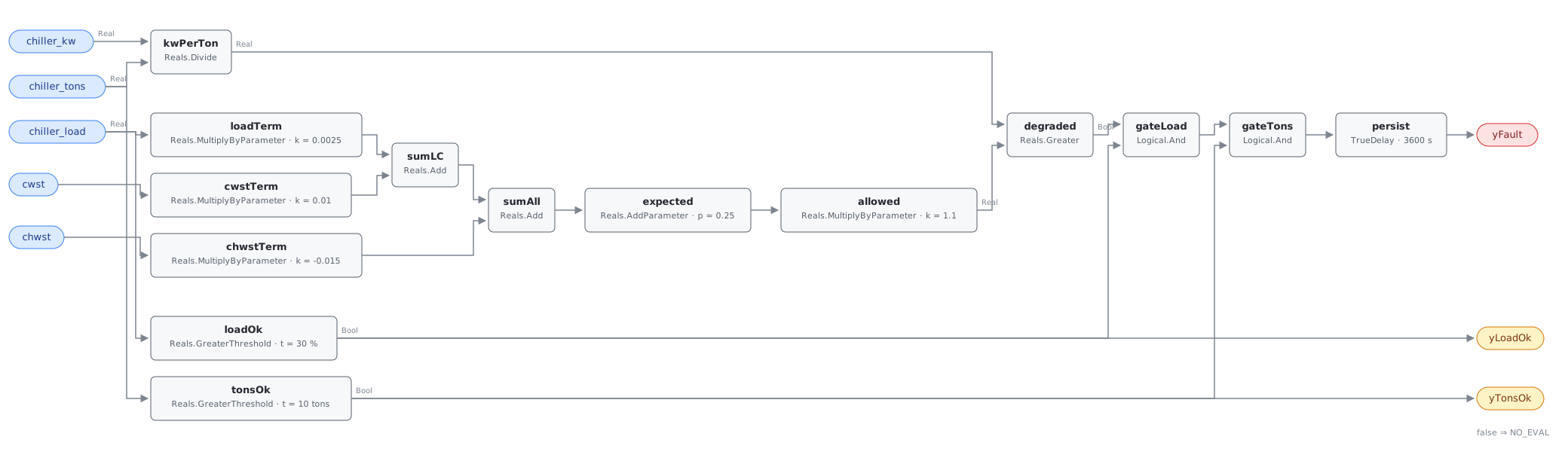
loadTerm, cwstTerm, chwstTerm, the two Reals.Add blocks and expected
are the fitted plane — the whole statistical content of the rule at runtime.
allowed scales it by the tolerance, so the comparison is against a second plane
parallel to the first rather than against a number: at the shipped placeholders a
machine at 50% load with 30 °C condenser water making 6 °C chilled water is
expected at 0.585 kW/ton and allowed 0.6435, and identical power and tonnage
give opposite verdicts once the regressors move.
kwPerTon is the only division and its denominator goes to zero whenever the
machine unloads or the tons calculation fails; with tons at zero the quotient is
infinite and the comparison is true, so without tonsOk a dead flow meter would
produce a permanent alarm. tonsOk and loadOk each drive a boundary output and
a gate, so a machine below either floor holds yFault down and the host reads
the silence as “not evaluated”. The load floor is about comparability rather than
arithmetic: at 20% load a chiller is inefficient because it is a chiller at 20%
load.
The comparison at the allowance is strict, so a machine exactly on the allowed
plane reads healthy. persist requires 60 continuous minutes — enough to ride
out a capacity step, a condenser water reset or a stage change — and carries
delayOnInit = true.
Possible Diagnoses
Transcribed from the reference’s CHW-0001 card:
- Condenser tube fouling — scale, biofilm or silt from an open tower loop. The most common cause and the one this rule is really for; the condenser approach widens long before anything else complains
- Evaporator tube fouling — rarer, the loop being closed, and usually a water treatment or an opened-for-work story
- Low refrigerant charge — degrades kW/ton across the whole operating range without producing a single reading that looks wrong on its own
- Compressor degradation: worn bearings, damaged impellers, failing unloaders — elevated draw for the same delivered capacity
- Non-condensable gases raising condensing pressure; on a low-pressure machine the purge unit’s runtime usually tells the story first
The discriminator between 1 and 2 is the approach temperature on each side, which this rule does not read — a plant that trends both approaches alongside this alarm separates the two causes for free. The chapter’s introduction promises approach-temperature analysis, but none of its specified rules performs it and neither does this library.
Energy Impact
EFFICIENCY_LOSS, HIGH confidence, BASELINE_COMPARISON. The estimator is the
ratio the rule already computes:
waste_kw = chiller_kw × (1 − expected_kw_per_ton / measured_kw_per_ton) — a
machine drawing 358 kW at 0.70 kW/ton against a 0.585 baseline spends about
59 kW on the degradation. The reference’s range is 5–15% of chiller energy, and
its 0.1 kW/ton ≈ 15% yardstick is the one to quote to an operator because it is
in the units the plant’s trend screen already shows. HIGH confidence carries the
caveat every self-learned baseline has: the fit is this machine’s own recent
history, so a chiller with fouled tubes at commissioning learns a fouled
baseline and reads healthy forever. Cooling-dominant, and largest on the hottest
days.
Emissions Impact
Scope 2, PROXY_EMISSIONS, HIGH confidence; the reference’s typical range is 1,000–10,000 kg CO₂e/yr on a marginal operating emissions rate basis. All of it is purchased electricity at the compressor. The range is wide because it spans a small machine with a slight charge loss and a large one with fouled tubes, and because the marginal rate in the hours a chiller runs hardest is well above the annual average — a cooling peak is when the dirtiest generator on the system is dispatched.
Deviations
- All four baseline coefficients ship as documented PLACEHOLDERS. The
reference specifies a model, not numbers
(
baseline_model.predict([chiller_load, cwst, chwst]), sklearn Ridge,learning_period_days = 30), and this library’s split puts the fitting in the host and the fitted plane in the graph asset_paramtargets. The shipped set describes a generic water-cooled centrifugal machine and exists so the document is runnable as delivered. They are not site values, and a wrong set fails silently in both directions — fit the plane 15% high and nothing ever alarms, fit it low and every hour does. Precedent: HP-0001’s COP line, VAV-0001’sventilation_requirement. - The reference publishes no fit-quality bar for this fault, and this card
does not invent one. HP-0001’s chapter specifies
R² > 0.6; chapter 13 specifies only “retrained periodically” over 30 days, so the precondition asks the host to confirm the fit is good enough to hold the plant to. A site adopting 0.6 by analogy is making a defensible choice, not following the reference. kw_per_ton_chwst_coeffis negative — the documented exception to the library’s no-negative-parameters convention. A regression coefficient is inherently signed (raising the evaporator temperature reduces lift and improves kW/ton), and a host re-fitting on odd data could get any sign on any of the three; forcing signs into the topology would mean a different graph per machine. Same reasoning as HP-0001’scop_baseline_slope.- The degradation test is a multiplier, not the reference’s fraction. The
reference writes
(measured − expected)/expected > degradation_thresholdat 10%; this rule computesmeasured > 1.1 × expected, the same predicate for any positiveexpected, and it avoids a second division by a fitted plane that can cross zero. The units consequence bites:degradation_ratio_thresholdis a multiplier (1.1), not a percentage (10), and writing 10 silences the rule because no machine draws ten times its baseline. HP-0001 carries the mirror image, where the same mistake alarms permanently. min_chiller_tonsandyTonsOkare adopted, not transcribed. The reference’s only evaluability gate ismin_chiller_load, but the graph divides by a live signal, and per SCHEMA.md a test computable from the rule’s own inputs belongs in the graph as a boundary output. Same stance as HP-0001’syPowerOk.- The tonnage floor guards zero, not a wrong reading. A tons signal that has
collapsed to a small non-zero value — a flow meter reading 5% of actual, a
delta-T using a failed sensor — produces a believable quotient and a false
alarm on a healthy machine. Set
min_chiller_tonsfrom the machine’s real minimum output rather than from zero, and readyFaultbeside the plant’s own tonnage trend. - The tons unit hazard is the biggest single way to deploy this rule wrong. The kW/ton convention uses refrigeration tons while most BAS trend kW thermal or derive tons from flow × delta-T; feeding kW thermal scales the quotient by 3.517, and because the host fits the coefficients against the same wrong signal the baseline scales with it — the rule keeps working while every number in it is meaningless to a human reading the alarm. Nothing in the graph can detect this; it is a binding-time check.
- Strict
>at the allowance and at both floors. CDLRealshas noGreaterEqual, and the reference’s degradation test is strict too. The load floor is a different case —min_chiller_loadappears only in the reference’s tunables table, never in its equation — so the operator is this card’s choice and strict is the conservative one: exactly at a floor is NO_EVAL, and a machine exactly on the allowed plane reads healthy. learning_period_days(30 d) stays a host precondition, and re-fitting is the dangerous part. The fit happens offline, outside anything the graph can see. Whatever schedules it must refuse to re-fit while this fault is active: re-fitting a degraded machine bakes the degradation in as the new normal, and it matters more here than on HP-0001 because the reference asks for periodic retraining rather than a one-time fit.- The fitted plane is extrapolated without limit. Nothing in the graph knows
the range the regression was fitted over. Far enough outside it — and with the
negative CHWST coefficient —
expectedcan be driven non-positive, at which point every measured quotient exceedsallowedand the rule alarms permanently rather than going quiet (the opposite failure from HP-0001’s, because the comparison runs the other way). The block set has no domain guard, so it is a precondition; a host can clamp the regressors withReals.Limiterupstream. - One instance per chiller. The reference’s points are per-machine and so is the fit; a plant with three chillers runs three instances with three coefficient sets. The library has no plant-level aggregate rule, and averaging machines would hide exactly the one that is degraded.
method: statisticaldescribes the baseline’s provenance, not the runtime. The graph performs one division, four multiplies, three adds, three comparisons and a delay; the classification is honest because the coefficients come from a regression. HP-0001 and RTU-0002 carry the same note.AlarmDelayis renamedalarm_delay, matching every other card and unchanged at 60 min.persist.delayOnInit = true(CDL defaultfalse), the library’s standing choice: a machine already above its plane at controller restart waits out the full hour.- The reference publishes no test vectors for this fault, so every scenario
in
vectors.jsonis authored from the equation and replayed against the pinned engine rev. - The chapter’s Notes line for this fault is truncated in the source
extract. It reads “Chen et al. (2024) showed data-driven chiller FDD
degrades under” and stops. The missing clause is presumably about
generalisation to unseen conditions, but this card does not transcribe what it
cannot read:
sourcecites the paper and the extrapolation deviation states the blind spot in terms this rule supports. clusters: [CLU-06]is the existing cluster set’s membership, not this card’s authorship —clusters/clusters.jsonalready names this fault as the trigger of “Chilled Water Plant Inefficiency” with CHW-0002, 052 and 053 as members, and itsplaybookslug resolves to the reference’s transcribedplaybooks/chiller-efficiency.md.playbooksciteschiller-efficiency, the reference’s own playbook for this fault; its Applies-To row names CHW-0001 and CLU-06 directly.- Operating states and preconditions are declared in frontmatter for host
enforcement rather than encoded in the block graph, per the library’s design
stance. Severity 3,
method: statistical,confidence: HIGHand the fault name are the reference’s chapter 13 card.
Notes
Read yLoadOk and yTonsOk before yFault. A cleaned condenser, a chiller
that unloaded and a dead tonnage signal all drop yFault on the same tick and
mean completely different things, so a host that treats the falling edge as a
repair will close this fault every time the plant stages down.
Pull the condenser approach temperature first: it is free, it is already on the chiller’s panel, and a widening approach with a rising kW/ton is tube fouling with enough confidence to schedule a cleaning. A normal approach on both sides puts the loss inside the machine — charge, compressor or non-condensables — and purge runtime is the cheapest test for the last of those.
Check CHW-0004 when both fire: low delta-T forces early staging, so a plant running two machines where one would do has a kW/ton problem whose cause is in neither machine. And raising the chilled water setpoint moves this rule’s expected line down, so a site switching CHW-0002’s reset on mid-baseline should re-fit rather than let the old plane judge the new regime.
Test Vectors
21 scenarios, clock step 60 s over 7200 s.
| Scenario | Description |
|---|---|
healthy_chiller_at_baseline | The shipped-placeholder baseline evaluated at its own conditions: 50% load, 30 °C condenser water, 6 °C chilled water gives an expected 0.585 kW/ton and an allowance of 0.6435. The machine draws 299.52 kW for 512 tons — exactly 0.585 kW/ton — and is silent. All numbers are placeholder-relative; a host that has fitted its own coefficients gets a different line. |
degraded_chiller_alarms_at_60_min | 358.4 kW for 512 tons is 0.70 kW/ton against a 0.6435 allowance — roughly the 0.1 kW/ton the reference calls 15% excess. delayOnInit holds the condition from the first tick, so the alarm lands at exactly alarm_delay. |
measured_exactly_at_the_allowance | Boundary, bit-exact: 329.472 / 512 is the same double the graph computes for 1.1 × expected, because the divisor is a power of two and the numerator is that allowance scaled by it. Reals.Greater is strict, so a chiller sitting exactly on the allowance reads healthy. |
measured_just_above_the_allowance | Boundary from above: 329.984 kW is 0.001 kW/ton past the allowance and alarms on the normal schedule. |
measured_just_below_the_allowance | Boundary from below: 328.96 kW is 0.001 kW/ton short of the allowance and never alarms. |
same_kw_per_ton_is_a_fault_on_cool_condenser_water | 337.92 kW / 512 tons = 0.66 kW/ton at 30 °C condenser water, where the allowance is 0.6435. Fault. The companion scenario feeds the identical power and tonnage at 35 °C and reads healthy — the verdict is decided by the regressors, not by the quotient. |
same_kw_per_ton_is_healthy_on_warm_condenser_water | The same 0.66 kW/ton at 35 °C condenser water, where the placeholder line expects 0.635 and allows 0.6985. Silent. Five degrees of condenser lift is worth 0.05 kW/ton on this line, which is half the reference’s own 0.1 kW/ton degradation yardstick. |
raised_chwst_tightens_the_allowance | The third regressor, and the one whose placeholder coefficient is negative: at a 10 °C chilled water supply temperature the machine has less lift to do, so the line expects 0.525 and allows 0.5775. 307.2 kW / 512 tons = 0.60 kW/ton is a fault here. |
same_kw_per_ton_is_healthy_at_a_colder_chwst | The companion: the identical 0.60 kW/ton at a 6 °C supply temperature, where the allowance is 0.6435. Silent. A plant that has raised its CHWST for the reset savings this chapter’s CHW-0002 is about is held to a tighter efficiency line by this rule, which is the physics and not an interaction between the two rules. |
low_load_is_not_evaluated | The reference’s min_chiller_load gate: 20% load with a grossly degraded 0.70 kW/ton. yLoadOk is false, so the verdict is NO_EVAL rather than healthy — a lightly loaded chiller is inefficient on physics, and the reference declines to call that a fault. |
load_exactly_at_the_evaluability_floor | Boundary: load is exactly min_chiller_load (30%). Reals.GreaterThreshold is strict, so exactly-at-the-floor is NO_EVAL. |
load_just_below_the_evaluability_floor | 29.9% load: still NO_EVAL, with the same degraded quotient. |
load_just_above_the_evaluability_floor | 30.1% load: evaluable. The load regressor moves the expected line with it (0.5353 expected, 0.5888 allowed at these conditions), and 0.70 kW/ton clears that too, so the alarm lands at exactly alarm_delay. |
zero_tons_holds_the_quotient_down | The divide guard doing its job: a tonnage signal that has gone to zero while the meter still reads 299.52 kW. The quotient is +inf and the comparison against the allowance is true, so without yTonsOk gating the AND chain this would be a permanent alarm on a dead sensor. yTonsOk is false and yFault stays down. |
tons_exactly_at_the_divide_floor | Boundary on the guard: tonnage exactly at min_chiller_tons (10 tons). Strict GreaterThreshold again, so exactly-at-the-floor is NO_EVAL. |
tons_just_above_the_divide_floor_still_alarms | The guard’s documented limit: 10.1 tons against 20 kW is 1.98 kW/ton, three times any plausible allowance, and the rule alarms. The floor only guards the neighbourhood of zero — a tonnage signal that has collapsed to a small non-zero value produces a believable-looking division and a false alarm. Set min_chiller_tons from the machine’s real minimum output, not from zero. |
degradation_starts_mid_run | A healthy machine loses efficiency at t = 1800 s — a condenser tube bundle fouling far faster than it would in life, standing in for the slow version. The alarm lands at exactly 5400 s: mid-run rising edges carry the same T + delayTime arithmetic as the init case. |
degradation_clears_after_service | Recovery: the alarm asserts at 3600 s and the tubes are cleaned at t = 5400 s. TrueDelay passes the falling edge with no delay, so yFault drops on that tick and the accumulated time is discarded. |
tons_signal_drops_after_alarm | The evaluability release, and the reason to read both outputs: an alarming chiller loses its tonnage signal at t = 5400 s. yFault falls on that tick exactly as it does in degradation_clears_after_service, and only yTonsOk distinguishes a cleaned condenser from a dead flow meter. |
load_drops_after_alarm | The other evaluability release: an alarming chiller unloads to 20% at t = 5400 s with its power and tonnage unchanged. yFault and yLoadOk fall on the same tick, and the falling edge of yFault alone is indistinguishable from a repair. |
intermittent_degradation_never_alarms | Power alternating between 0.70 and 0.585 kW/ton every 1200 s — a machine hunting between compressor stages, or a tonnage calculation that jumps with flow noise. No single episode reaches alarm_delay, so nothing fires. Persistence is not averaging, and a chiller spending half its hours above the line is a real finding this rule cannot make. |
vectors.json
{
"schema": "cxf-library/vectors/v1",
"clock": {
"step_s": 60,
"horizon_s": 7200
},
"scenarios": [
{
"name": "healthy_chiller_at_baseline",
"description": "The shipped-placeholder baseline evaluated at its own conditions: 50% load, 30 \u00b0C condenser water, 6 \u00b0C chilled water gives an expected 0.585 kW/ton and an allowance of 0.6435. The machine draws 299.52 kW for 512 tons \u2014 exactly 0.585 kW/ton \u2014 and is silent. All numbers are placeholder-relative; a host that has fitted its own coefficients gets a different line.",
"inputs": {
"chiller_kw": 299.52,
"chiller_tons": 512.0,
"chiller_load": 50.0,
"cwst": 30.0,
"chwst": 6.0
},
"expect": [
{
"output": "yFault",
"from_s": 0,
"to_s": 7200,
"equals": false
},
{
"output": "yLoadOk",
"from_s": 0,
"to_s": 7200,
"equals": true
},
{
"output": "yTonsOk",
"from_s": 0,
"to_s": 7200,
"equals": true
}
]
},
{
"name": "degraded_chiller_alarms_at_60_min",
"description": "358.4 kW for 512 tons is 0.70 kW/ton against a 0.6435 allowance \u2014 roughly the 0.1 kW/ton the reference calls 15% excess. delayOnInit holds the condition from the first tick, so the alarm lands at exactly alarm_delay.",
"inputs": {
"chiller_kw": 358.4,
"chiller_tons": 512.0,
"chiller_load": 50.0,
"cwst": 30.0,
"chwst": 6.0
},
"expect": [
{
"output": "yFault",
"from_s": 0,
"to_s": 3540,
"equals": false
},
{
"output": "yFault",
"from_s": 3600,
"to_s": 7200,
"equals": true
},
{
"output": "yLoadOk",
"from_s": 0,
"to_s": 7200,
"equals": true
},
{
"output": "yTonsOk",
"from_s": 0,
"to_s": 7200,
"equals": true
}
]
},
{
"name": "measured_exactly_at_the_allowance",
"description": "Boundary, bit-exact: 329.472 / 512 is the same double the graph computes for 1.1 \u00d7 expected, because the divisor is a power of two and the numerator is that allowance scaled by it. Reals.Greater is strict, so a chiller sitting exactly on the allowance reads healthy.",
"inputs": {
"chiller_kw": 329.472,
"chiller_tons": 512.0,
"chiller_load": 50.0,
"cwst": 30.0,
"chwst": 6.0
},
"expect": [
{
"output": "yFault",
"from_s": 0,
"to_s": 7200,
"equals": false
},
{
"output": "yLoadOk",
"from_s": 0,
"to_s": 7200,
"equals": true
},
{
"output": "yTonsOk",
"from_s": 0,
"to_s": 7200,
"equals": true
}
]
},
{
"name": "measured_just_above_the_allowance",
"description": "Boundary from above: 329.984 kW is 0.001 kW/ton past the allowance and alarms on the normal schedule.",
"inputs": {
"chiller_kw": 329.984,
"chiller_tons": 512.0,
"chiller_load": 50.0,
"cwst": 30.0,
"chwst": 6.0
},
"expect": [
{
"output": "yFault",
"from_s": 0,
"to_s": 3540,
"equals": false
},
{
"output": "yFault",
"from_s": 3600,
"to_s": 7200,
"equals": true
},
{
"output": "yLoadOk",
"from_s": 0,
"to_s": 7200,
"equals": true
},
{
"output": "yTonsOk",
"from_s": 0,
"to_s": 7200,
"equals": true
}
]
},
{
"name": "measured_just_below_the_allowance",
"description": "Boundary from below: 328.96 kW is 0.001 kW/ton short of the allowance and never alarms.",
"inputs": {
"chiller_kw": 328.96,
"chiller_tons": 512.0,
"chiller_load": 50.0,
"cwst": 30.0,
"chwst": 6.0
},
"expect": [
{
"output": "yFault",
"from_s": 0,
"to_s": 7200,
"equals": false
},
{
"output": "yLoadOk",
"from_s": 0,
"to_s": 7200,
"equals": true
},
{
"output": "yTonsOk",
"from_s": 0,
"to_s": 7200,
"equals": true
}
]
},
{
"name": "same_kw_per_ton_is_a_fault_on_cool_condenser_water",
"description": "337.92 kW / 512 tons = 0.66 kW/ton at 30 \u00b0C condenser water, where the allowance is 0.6435. Fault. The companion scenario feeds the identical power and tonnage at 35 \u00b0C and reads healthy \u2014 the verdict is decided by the regressors, not by the quotient.",
"inputs": {
"chiller_kw": 337.92,
"chiller_tons": 512.0,
"chiller_load": 50.0,
"cwst": 30.0,
"chwst": 6.0
},
"expect": [
{
"output": "yFault",
"from_s": 0,
"to_s": 3540,
"equals": false
},
{
"output": "yFault",
"from_s": 3600,
"to_s": 7200,
"equals": true
},
{
"output": "yLoadOk",
"from_s": 0,
"to_s": 7200,
"equals": true
},
{
"output": "yTonsOk",
"from_s": 0,
"to_s": 7200,
"equals": true
}
]
},
{
"name": "same_kw_per_ton_is_healthy_on_warm_condenser_water",
"description": "The same 0.66 kW/ton at 35 \u00b0C condenser water, where the placeholder line expects 0.635 and allows 0.6985. Silent. Five degrees of condenser lift is worth 0.05 kW/ton on this line, which is half the reference's own 0.1 kW/ton degradation yardstick.",
"inputs": {
"chiller_kw": 337.92,
"chiller_tons": 512.0,
"chiller_load": 50.0,
"cwst": 35.0,
"chwst": 6.0
},
"expect": [
{
"output": "yFault",
"from_s": 0,
"to_s": 7200,
"equals": false
},
{
"output": "yLoadOk",
"from_s": 0,
"to_s": 7200,
"equals": true
},
{
"output": "yTonsOk",
"from_s": 0,
"to_s": 7200,
"equals": true
}
]
},
{
"name": "raised_chwst_tightens_the_allowance",
"description": "The third regressor, and the one whose placeholder coefficient is negative: at a 10 \u00b0C chilled water supply temperature the machine has less lift to do, so the line expects 0.525 and allows 0.5775. 307.2 kW / 512 tons = 0.60 kW/ton is a fault here.",
"inputs": {
"chiller_kw": 307.2,
"chiller_tons": 512.0,
"chiller_load": 50.0,
"cwst": 30.0,
"chwst": 10.0
},
"expect": [
{
"output": "yFault",
"from_s": 0,
"to_s": 3540,
"equals": false
},
{
"output": "yFault",
"from_s": 3600,
"to_s": 7200,
"equals": true
},
{
"output": "yLoadOk",
"from_s": 0,
"to_s": 7200,
"equals": true
},
{
"output": "yTonsOk",
"from_s": 0,
"to_s": 7200,
"equals": true
}
]
},
{
"name": "same_kw_per_ton_is_healthy_at_a_colder_chwst",
"description": "The companion: the identical 0.60 kW/ton at a 6 \u00b0C supply temperature, where the allowance is 0.6435. Silent. A plant that has raised its CHWST for the reset savings this chapter's CHW-0002 is about is held to a tighter efficiency line by this rule, which is the physics and not an interaction between the two rules.",
"inputs": {
"chiller_kw": 307.2,
"chiller_tons": 512.0,
"chiller_load": 50.0,
"cwst": 30.0,
"chwst": 6.0
},
"expect": [
{
"output": "yFault",
"from_s": 0,
"to_s": 7200,
"equals": false
},
{
"output": "yLoadOk",
"from_s": 0,
"to_s": 7200,
"equals": true
},
{
"output": "yTonsOk",
"from_s": 0,
"to_s": 7200,
"equals": true
}
]
},
{
"name": "low_load_is_not_evaluated",
"description": "The reference's min_chiller_load gate: 20% load with a grossly degraded 0.70 kW/ton. yLoadOk is false, so the verdict is NO_EVAL rather than healthy \u2014 a lightly loaded chiller is inefficient on physics, and the reference declines to call that a fault.",
"inputs": {
"chiller_kw": 358.4,
"chiller_tons": 512.0,
"chiller_load": 20.0,
"cwst": 30.0,
"chwst": 6.0
},
"expect": [
{
"output": "yFault",
"from_s": 0,
"to_s": 7200,
"equals": false
},
{
"output": "yLoadOk",
"from_s": 0,
"to_s": 7200,
"equals": false
},
{
"output": "yTonsOk",
"from_s": 0,
"to_s": 7200,
"equals": true
}
]
},
{
"name": "load_exactly_at_the_evaluability_floor",
"description": "Boundary: load is exactly min_chiller_load (30%). Reals.GreaterThreshold is strict, so exactly-at-the-floor is NO_EVAL.",
"inputs": {
"chiller_kw": 358.4,
"chiller_tons": 512.0,
"chiller_load": 30.0,
"cwst": 30.0,
"chwst": 6.0
},
"expect": [
{
"output": "yFault",
"from_s": 0,
"to_s": 7200,
"equals": false
},
{
"output": "yLoadOk",
"from_s": 0,
"to_s": 7200,
"equals": false
},
{
"output": "yTonsOk",
"from_s": 0,
"to_s": 7200,
"equals": true
}
]
},
{
"name": "load_just_below_the_evaluability_floor",
"description": "29.9% load: still NO_EVAL, with the same degraded quotient.",
"inputs": {
"chiller_kw": 358.4,
"chiller_tons": 512.0,
"chiller_load": 29.9,
"cwst": 30.0,
"chwst": 6.0
},
"expect": [
{
"output": "yFault",
"from_s": 0,
"to_s": 7200,
"equals": false
},
{
"output": "yLoadOk",
"from_s": 0,
"to_s": 7200,
"equals": false
},
{
"output": "yTonsOk",
"from_s": 0,
"to_s": 7200,
"equals": true
}
]
},
{
"name": "load_just_above_the_evaluability_floor",
"description": "30.1% load: evaluable. The load regressor moves the expected line with it (0.5353 expected, 0.5888 allowed at these conditions), and 0.70 kW/ton clears that too, so the alarm lands at exactly alarm_delay.",
"inputs": {
"chiller_kw": 358.4,
"chiller_tons": 512.0,
"chiller_load": 30.1,
"cwst": 30.0,
"chwst": 6.0
},
"expect": [
{
"output": "yFault",
"from_s": 0,
"to_s": 3540,
"equals": false
},
{
"output": "yFault",
"from_s": 3600,
"to_s": 7200,
"equals": true
},
{
"output": "yLoadOk",
"from_s": 0,
"to_s": 7200,
"equals": true
},
{
"output": "yTonsOk",
"from_s": 0,
"to_s": 7200,
"equals": true
}
]
},
{
"name": "zero_tons_holds_the_quotient_down",
"description": "The divide guard doing its job: a tonnage signal that has gone to zero while the meter still reads 299.52 kW. The quotient is +inf and the comparison against the allowance is true, so without yTonsOk gating the AND chain this would be a permanent alarm on a dead sensor. yTonsOk is false and yFault stays down.",
"inputs": {
"chiller_kw": 299.52,
"chiller_tons": 0.0,
"chiller_load": 50.0,
"cwst": 30.0,
"chwst": 6.0
},
"expect": [
{
"output": "yFault",
"from_s": 0,
"to_s": 7200,
"equals": false
},
{
"output": "yLoadOk",
"from_s": 0,
"to_s": 7200,
"equals": true
},
{
"output": "yTonsOk",
"from_s": 0,
"to_s": 7200,
"equals": false
}
]
},
{
"name": "tons_exactly_at_the_divide_floor",
"description": "Boundary on the guard: tonnage exactly at min_chiller_tons (10 tons). Strict GreaterThreshold again, so exactly-at-the-floor is NO_EVAL.",
"inputs": {
"chiller_kw": 299.52,
"chiller_tons": 10.0,
"chiller_load": 50.0,
"cwst": 30.0,
"chwst": 6.0
},
"expect": [
{
"output": "yFault",
"from_s": 0,
"to_s": 7200,
"equals": false
},
{
"output": "yLoadOk",
"from_s": 0,
"to_s": 7200,
"equals": true
},
{
"output": "yTonsOk",
"from_s": 0,
"to_s": 7200,
"equals": false
}
]
},
{
"name": "tons_just_above_the_divide_floor_still_alarms",
"description": "The guard's documented limit: 10.1 tons against 20 kW is 1.98 kW/ton, three times any plausible allowance, and the rule alarms. The floor only guards the neighbourhood of zero \u2014 a tonnage signal that has collapsed to a small non-zero value produces a believable-looking division and a false alarm. Set min_chiller_tons from the machine's real minimum output, not from zero.",
"inputs": {
"chiller_kw": 20.0,
"chiller_tons": 10.1,
"chiller_load": 50.0,
"cwst": 30.0,
"chwst": 6.0
},
"expect": [
{
"output": "yFault",
"from_s": 0,
"to_s": 3540,
"equals": false
},
{
"output": "yFault",
"from_s": 3600,
"to_s": 7200,
"equals": true
},
{
"output": "yLoadOk",
"from_s": 0,
"to_s": 7200,
"equals": true
},
{
"output": "yTonsOk",
"from_s": 0,
"to_s": 7200,
"equals": true
}
]
},
{
"name": "degradation_starts_mid_run",
"description": "A healthy machine loses efficiency at t = 1800 s \u2014 a condenser tube bundle fouling far faster than it would in life, standing in for the slow version. The alarm lands at exactly 5400 s: mid-run rising edges carry the same T + delayTime arithmetic as the init case.",
"inputs": {
"chiller_kw": [
{
"t": 0,
"value": 299.52
},
{
"t": 1800,
"value": 358.4
}
],
"chiller_tons": 512.0,
"chiller_load": 50.0,
"cwst": 30.0,
"chwst": 6.0
},
"expect": [
{
"output": "yFault",
"from_s": 0,
"to_s": 5340,
"equals": false
},
{
"output": "yFault",
"from_s": 5400,
"to_s": 7200,
"equals": true
},
{
"output": "yLoadOk",
"from_s": 0,
"to_s": 7200,
"equals": true
},
{
"output": "yTonsOk",
"from_s": 0,
"to_s": 7200,
"equals": true
}
]
},
{
"name": "degradation_clears_after_service",
"description": "Recovery: the alarm asserts at 3600 s and the tubes are cleaned at t = 5400 s. TrueDelay passes the falling edge with no delay, so yFault drops on that tick and the accumulated time is discarded.",
"inputs": {
"chiller_kw": [
{
"t": 0,
"value": 358.4
},
{
"t": 5400,
"value": 299.52
}
],
"chiller_tons": 512.0,
"chiller_load": 50.0,
"cwst": 30.0,
"chwst": 6.0
},
"expect": [
{
"output": "yFault",
"from_s": 0,
"to_s": 3540,
"equals": false
},
{
"output": "yFault",
"from_s": 3600,
"to_s": 5340,
"equals": true
},
{
"output": "yFault",
"from_s": 5400,
"to_s": 7200,
"equals": false
},
{
"output": "yLoadOk",
"from_s": 0,
"to_s": 7200,
"equals": true
},
{
"output": "yTonsOk",
"from_s": 0,
"to_s": 7200,
"equals": true
}
]
},
{
"name": "tons_signal_drops_after_alarm",
"description": "The evaluability release, and the reason to read both outputs: an alarming chiller loses its tonnage signal at t = 5400 s. yFault falls on that tick exactly as it does in degradation_clears_after_service, and only yTonsOk distinguishes a cleaned condenser from a dead flow meter.",
"inputs": {
"chiller_kw": 358.4,
"chiller_tons": [
{
"t": 0,
"value": 512.0
},
{
"t": 5400,
"value": 0.0
}
],
"chiller_load": 50.0,
"cwst": 30.0,
"chwst": 6.0
},
"expect": [
{
"output": "yFault",
"from_s": 0,
"to_s": 3540,
"equals": false
},
{
"output": "yFault",
"from_s": 3600,
"to_s": 5340,
"equals": true
},
{
"output": "yFault",
"from_s": 5400,
"to_s": 7200,
"equals": false
},
{
"output": "yLoadOk",
"from_s": 0,
"to_s": 7200,
"equals": true
},
{
"output": "yTonsOk",
"from_s": 0,
"to_s": 5340,
"equals": true
},
{
"output": "yTonsOk",
"from_s": 5400,
"to_s": 7200,
"equals": false
}
]
},
{
"name": "load_drops_after_alarm",
"description": "The other evaluability release: an alarming chiller unloads to 20% at t = 5400 s with its power and tonnage unchanged. yFault and yLoadOk fall on the same tick, and the falling edge of yFault alone is indistinguishable from a repair.",
"inputs": {
"chiller_kw": 358.4,
"chiller_tons": 512.0,
"chiller_load": [
{
"t": 0,
"value": 50.0
},
{
"t": 5400,
"value": 20.0
}
],
"cwst": 30.0,
"chwst": 6.0
},
"expect": [
{
"output": "yFault",
"from_s": 0,
"to_s": 3540,
"equals": false
},
{
"output": "yFault",
"from_s": 3600,
"to_s": 5340,
"equals": true
},
{
"output": "yFault",
"from_s": 5400,
"to_s": 7200,
"equals": false
},
{
"output": "yLoadOk",
"from_s": 0,
"to_s": 5340,
"equals": true
},
{
"output": "yLoadOk",
"from_s": 5400,
"to_s": 7200,
"equals": false
},
{
"output": "yTonsOk",
"from_s": 0,
"to_s": 7200,
"equals": true
}
]
},
{
"name": "intermittent_degradation_never_alarms",
"description": "Power alternating between 0.70 and 0.585 kW/ton every 1200 s \u2014 a machine hunting between compressor stages, or a tonnage calculation that jumps with flow noise. No single episode reaches alarm_delay, so nothing fires. Persistence is not averaging, and a chiller spending half its hours above the line is a real finding this rule cannot make.",
"inputs": {
"chiller_kw": [
{
"t": 0,
"value": 358.4
},
{
"t": 1200,
"value": 299.52
},
{
"t": 2400,
"value": 358.4
},
{
"t": 3600,
"value": 299.52
},
{
"t": 4800,
"value": 358.4
},
{
"t": 6000,
"value": 299.52
}
],
"chiller_tons": 512.0,
"chiller_load": 50.0,
"cwst": 30.0,
"chwst": 6.0
},
"expect": [
{
"output": "yFault",
"from_s": 0,
"to_s": 7200,
"equals": false
},
{
"output": "yLoadOk",
"from_s": 0,
"to_s": 7200,
"equals": true
},
{
"output": "yTonsOk",
"from_s": 0,
"to_s": 7200,
"equals": true
}
]
}
]
}