AHU-0039 — Supply fan proof-of-operation failure
| Status | verified — engine e2ff2f8, cxf:fnv1a128:96279d88150a6da7569a7b4e335f35f4, 2026-08-18 |
| Severity | 2 |
| Method | rule |
| Phase | 2 |
| Category | PROTECTIVE |
| Confidence | HIGH |
| Estimation | PROXY_ESTIMATION |
| G36 | — |
| Clusters | — |
| Suppresses | — |
| Suppressed by | — |
| Related | SYS-0008, AHU-0026, VFD-0001 |
| Playbooks | proof-of-operation, vfd-pump-faults |
| Source | Library-authored: HVAC FDD Reference v1.0 §9 carries no proof-of-operation card for the AHU family (its ch.9 range is transcribed in AHU-0001–0031), so the name, severity, category and both proof times are argued on this card; Buildings.Controls.OBC.CDL.Logical.Proof (Hu & Wetter, March 2023), read at engine pin e2ff2f8 from third_party/modelica-buildings-cdl/Buildings/Controls/OBC/CDL/Logical/Proof.mo — the standardized command-vs-status idiom and the vocabulary this card’s two directions inherit (yLocFal / yLocTru). The block is exported at the pin and is deliberately NOT used; see Deviations; ASHRAE Guideline 36-2021 §5.1.6 — the ‘proven’ definition (the equipment’s DI status point matches the state set by its DO command point) — and §5.16.13.2, this exact fault as the VAV AHU supply-fan alarm: status different from command for 15 s, commanded-on/status-off Level 2, commanded-off/status-on Level 4 (identical wording for the other air-handling classes at §5.17.3.2/§5.18.12.2/§5.19.2.2/§5.22.5.2). Clause numbers verified against the standard text after authoring; both proof times are transcribed from that 15 s window (see Deviations); points/ahu.points.json sf_cmd and sf_status — the command/status pair the dictionary already names for this rule, and the run-enable-not-speed-reference binding note that makes sf_cmd meaningful on a VFD-driven fan; Library precedent: SYS-0008 (two direction flags, each sustained on its own branch, joined by an Or), PMP-0001 (whose Deviations record the command/status mismatch as ‘nobody’s fault rule today’ — this card closes that hole for the AHU supply fan), VFD-0001 (command-versus-feedback on the drive’s analog pair) |
| Operating states | all — the pair is judged in every hour and every mode. A fan that will not start at 06:00 and a fan running at 03:00 are both findings, and there is no operating state in which command and status may disagree past their proof time. |
Preconditions (host-enforced): Bind sf_cmd to the run enable the BAS writes to the starter or drive, not to the speed reference (sf_speed carries that) — a percentage written into a boolean is either always-on or always-off. Bind sf_status to an INDEPENDENT proof of operation; a starter auxiliary contact or a software echo of the command makes the two inputs one input, and the start direction can then never fire while the card looks healthy. The status device TYPE decides what a passing proof means, and the rule cannot tell which device it is reading. A CURRENT SWITCH proves the motor is drawing current: a broken belt or a sheared coupling leaves the motor spinning at no load, so it is caught only where the switch’s trip point was field-set above that motor’s measured no-load current — a fixed-setpoint switch, or an adjustable one left at the factory minimum, reports ‘running’ with no air moving and this rule stays silent. A DIFFERENTIAL PRESSURE SWITCH across the fan proves air is moving and therefore catches the broken belt directly, but it can be held true by wind or stack pressure through an open OA damper on a stopped fan, which reads here as an unexpected run. On a VFD reporting its own run feedback, ‘running’ may mean ‘drive enabled’, which some configurations assert at zero speed. start_proof_time must exceed the drive’s accel ramp plus the status device’s own response; stop_proof_time must exceed coast-down plus whatever backdraft the status device can still see. One instance per fan — a dual-fan or fan-array AHU needs one per bound pair. Delivery quality is the host’s job and there is no in-rule evaluability output: the rule is evaluable whenever both booleans arrive fresh, and a stale status held at its last value either fakes a proof failure or hides one.
Outputs:
yFault— True while either proof direction has matured — the roll-up alarm, and the signal a host should treat as NO_EVAL pressure on every fan-gated ruleyFailToStart— Sub-condition flag — the fan has been commanded on with no run status for start_proof_time. Diagnostic direction only; false never means NO_EVALyUnexpectedRun— Sub-condition flag — the fan has proven running against an off command for stop_proof_time. Same kind as yFailToStart; the two are mutually exclusive by construction
Parameters:
| Name | Default | Unit | CXF path | Description |
|---|---|---|---|---|
start_proof_time | 15.0 | s | startHeld.delayTime | Continuous commanded-on-without-status required before the start direction alarms. TRANSCRIBED from G36 §5.16.13.2’s alarm window (15 s), which assumes a clean DI on a fast starter. RETUNE ON REAL DEVICES: a belt-drive fan on a 30–60 s accel ramp, or a status poll slower than the window, manufactures a self-clearing transient alarm on every start (slow_status_device_alarms_at_the_shipped_default pins it) — raise toward 120 s for belt-drive-on-VFD, 60 s for direct drive across the line. |
stop_proof_time | 15.0 | s | stopHeld.delayTime | Continuous proven-running-without-command required before the stop direction alarms. G36’s fan clause publishes ONE 15 s window for both directions (unlike its pump clauses, which give the commanded-off direction its own 60 s — the shape PMP-0003 transcribes), so both directions ship the fan clause’s number. The stop clock is coast-down: a large plenum wheel free-wheels past 15 s and a DP switch keeps seeing that air — raise this one on big plenum fans or behind a slow-closing OA damper. |
Description
Almost every AHU rule in this library opens with “while the supply fan is running.” This card checks whether that sentence is true. It compares the run command the BAS writes against the status the field reports and alarms in either direction: commanded on with nothing proving (broken belt, tripped overload, faulted drive, open disconnect), or proving running with no command behind it (a switch left in HAND, a welded contactor, a miswired output). The first means an air handler that is not handling air while its trend log looks scheduled; the second means fan energy and conditioned air nobody asked for. The finding is also structural — while these two points disagree, no rule gated on “fan on” is standing on solid ground.
Detection Logic
yFailToStart   = ( sf_cmd AND NOT sf_status ) sustained for start_proof_time
yUnexpectedRun = ( sf_status AND NOT sf_cmd ) sustained for stop_proof_time

yFault         = yFailToStart OR yUnexpectedRun
Block graph (rule.cxf.jsonld):
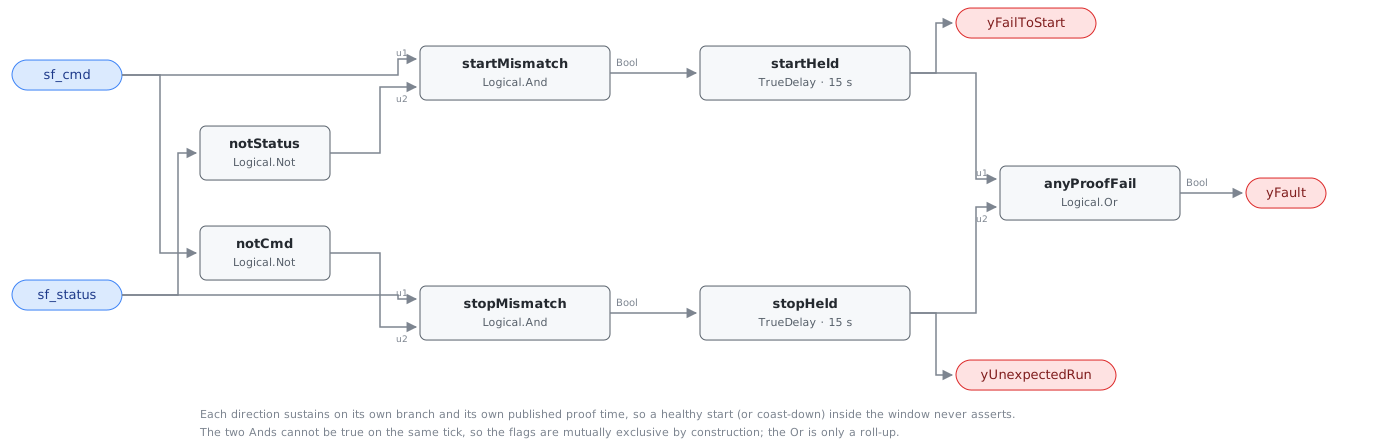
Seven blocks, two symmetric branches and a join. Each direction carries its own
published proof time so a healthy start and a healthy coast-down tune apart;
the Or is a roll-up holding no state. Every input is a boolean, so the
library’s strict-comparison caveat does not arise.
The proof times demand CONTINUOUS mismatch: a command withdrawn mid-window
restarts startHeld from zero rather than banking the elapsed seconds.
delayOnInit = true on both delays (CDL default false) makes a controller
restart into an already-broken fan serve the full window instead of alarming on
its first tick — the case that matters most here, since restarts and fan starts
arrive together at 06:00.
Both sub-condition flags are diagnostic. False on either never means NO_EVAL,
and the rule needs no evaluability output: it is evaluable whenever both points
are delivered, which is the host’s delivery-quality job. The one blind spot is
a status chattering faster than the proof window — no mismatch matures and both
flags stay false, which is deliberately the opposite of what CDL.Logical.Proof
does with that input (status_chatter_never_matures).
Possible Diagnoses
yFailToStart — commanded on, nothing proving:
- Broken belt or sheared coupling — the motor turns and no air moves.
Whether this card sees it at all depends on the status device: a DP switch
catches it, a current switch only if its trip point was set above the
motor’s no-load current (see
preconditions) - Tripped motor overload or a dropped-out starter — the most common single cause, and free to confirm at the starter door
- VFD in LOCAL/HAND at the keypad, or faulted — overcurrent, phase loss, DC bus, or a drive coasting on a fault-state default. The BAS output is correct and nobody downstream is listening
- Disconnect open, blown fuse, or phase loss — lockout-tagout left open after a service call is the classic version
- A hard-wired safety in the start circuit — smoke detector, freezestat, high-static cutout. The fan will not start and the sequence is working as designed; check the safeties before the fan
- The status device itself — failed current switch, DP switch with blown-off or plugged tubing, or a setpoint above the real signal. This card cannot tell that from a genuinely stopped fan
- Wiring — the BAS output landed on the wrong terminal, or the status input did
yUnexpectedRun — running with no command:
- HOA switch in HAND at the starter or drive keypad, left after a service call. The most common cause, and a $0 fix once found
- Welded starter contactor or stuck control relay — the fan cannot be stopped from the BAS at all, a safety finding as much as an energy one
- Drive running on a local reference or a fault-state default — SYS-0008’s diagnosis 5, reached here through the supply fan
- A second controller or a local timeclock writing the same output, or a BAS output miswired to a normally-closed contact
- The status device stuck true — a DP switch reading wind or stack draft through an open OA damper, or a current switch clamped on the wrong conductor
Energy Impact
PROTECTIVE, HIGH confidence, PROXY_ESTIMATION. The two directions do not share
an energy story. yUnexpectedRun wastes the whole fan — waste_kw = sf_rated_kw × (sf_speed/100)³, SYS-0008’s formula on host-supplied nameplate
and speed, plus the conditioning penalty on air nobody scheduled, which after
hours is usually the larger term. yFailToStart wastes nothing; it costs
comfort, and it costs the coverage of every fan-gated rule that quietly stops
meaning anything. PROXY rather than DIRECT because the rule reads two booleans
and borrows both terms of its formula from the host.
Emissions Impact
Scope 1 or 2, PROXY_EMISSIONS. The fan is electric everywhere, so its share is Scope 2 on a marginal operating emissions rate basis; where the air an unbidden fan pushes is conditioned by a fuel-fired plant, the larger term is Scope 1 and belongs to the heating rules that see it. No range is published — the quantity is set entirely by fan size and by how long the condition stood before somebody read the alarm.
Deviations
CDL.Logical.Proofis exported at the pin and was rejected on measured behavior, not on availability. Loaded through the harness at e2ff2f8 it alarms on the tick the command changes: with the status stably false, a command flip to true at t = 300 s assertedyLocFalat t = 300 s, and raisingfeedbackDelayfrom 120 s to 600 s did not move that edge. Its own documentation says why — verification begins when thefeedbackDelay + debouncetimer or thedebouncetimer lapses, “whichever is first” — so a fan with a settled status gets no spin-up grace and every morning start alarms.- Three further semantic gaps, any one disqualifying. Proof publishes a
single window (
feedbackDelay + debounce) for both directions where this family needs two independently tunable times, because spin-up and coast-down are different physics. It sets BOTH outputs true on an unstable measurement (its documented step 1) — the probe latchedyLocFalat t = 30 s andyLocTruat t = 210 s on a status chattering every 30 s — a third state this card’s mutual-exclusivity claim does not admit. And it latches rather than sustains: its outputs held until a rising edge of stable equality cleared them, 60 s (onedebounce) after agreement returned. - So the graph is composed from four verified export classes —
Logical.Not×2,Logical.And×2,Logical.TrueDelay×2,Logical.Or— in SYS-0008’s per-branch-sustain shape. The cost is that this library now owns proof semantics it would otherwise inherit from CDL; the benefit is two published times, flags that fall when the condition does, and flags that mean what the card says. - Mutual exclusivity is structural, not asserted.
startMismatchneedssf_cmdandstopMismatchneedsNOT sf_cmd, so they cannot be true on one tick, and aTrueDelayoutputs false whenever its input is false, so neither flag outlives its branch.direction_flip_never_asserts_bothpins the handover, including the real 120 s gap inyFaultbetween the two. - Both proof times ship at G36’s 15 s, transcribed, with the argued
device-physics numbers demoted to retune guidance. The card originally
argued 120 s from drive ramps and coast-down; the standard’s own number for
exactly this alarm exists (§5.16.13.2) and published beats argued — PMP-0003
set the family pattern by transcribing its pump clauses’ 15 s / 60 s pair.
The cost is pinned, not hidden:
slow_status_device_alarms_at_the_shipped_defaultshows the transient a 45 s ramp manufactures at the default. They remain two parameters so a site can move either clock alone. delayOnInit = trueon both delays (CDL defaultfalse) is the library’s standing choice and does real work here specifically: controller restarts cluster at the same hour as fan starts, and the default would turn every restart-into-a-starting-fan into an alarm.- No evaluability output; both extra outputs are direction flags.
SCHEMA.md’s two kinds are easy to confuse and these are SYS-0008’s kind. The
rule is evaluable whenever both booleans are delivered, so the only NO_EVAL
condition is a delivery failure — which the graph cannot see and the host
already owns. Hosts treating every non-
yFaultboolean as a gate will read this card backwards. - No
adjudicatesand nosuppresses, although this rule plainly casts doubt onsf_status.adjudicatesjudges a point’s DATA validity, and here the point is usually telling the truth: underyFailToStartthe fan really is stopped, and underyUnexpectedRunsf_statusis the honest half while the command is the lie — marking itinvalid_while_activewould tell AHU-0026 and SYS-0008 to discard a correct reading at the moment it matters. Suppression is wrong for the same reason: those rules are usually right and this one is naming their cause. Two of the twelve diagnoses do accuse the status device, and the rule cannot pick them out of the other ten — which is an argument for reading the list, not for adjudicating the point. So the consequence ships as prose: an activeyFaultmeans the fan-on precondition is contested and hosts should apply NO_EVAL pressure to fan-gated rules. - Severity 2 / PROTECTIVE, mirrored from PMP-0001 and VFD-0001, the shipped command-versus-status relatives, rather than from AHU-0018’s CRITICAL_WASTE. This card’s product is proof integrity; where the unexpected run is also after-hours waste, AHU-0018 fires on the same event with its own numbers.
- HIGH confidence claims the verdict, not the diagnosis; PROXY_ESTIMATION
splits the two directions. No model, no threshold, no derived quantity —
“these two booleans have disagreed for two minutes” is exactly what the graph
computes and reports, so the breadth lives in the twelve-item diagnosis list
rather than in the verdict (PMP-0001 chose MEDIUM for a rule whose flow
conjunct carries real measurement risk). On the energy side
DIRECT_MEASUREMENT would oversell
yFailToStart, which has no term at all, and QUALITATIVE_ONLY would undersellyUnexpectedRun. g36: nullwith verified clause citations insource. §5.1.6 defines ‘proven’ and §5.16.13.2 is this fault as G36’s own alarm (15 s, Level 2 / Level 4 by direction) — verified against the standard text. Theg36field carries transcribed-AFDD lineage, and G36’s AFDD routine has no command-vs-status fault, so the citations live insource(HW-0009’s family stance). The shipped windows ARE the alarm’s 15 s; outlasting real device latency and drive ramps is the params’ retune guidance, not the default.playbooks: [proof-of-operation, vfd-pump-faults]. The family playbook (authored with this batch) owns the HOA/overload/belt/contactor walk and the status-device-type question; vfd-pump-faults stays bound for its drive fault-code and command-tracking steps, which cover the VFD diagnoses.clusters: [].clusters/clusters.jsondefines no proof-of-operation cluster, and CLU-09 (Sensor Integrity Failure) is the wrong home for the reasons theadjudicatesbullet gives. The cluster set is orchestrator-maintained and this card does not edit it.- No published test vectors exist. Every scenario in
vectors.jsonis authored from the equation above and replayed against the pinned engine rev, including both proof-time edges at tick resolution.
Notes
Read this card before trusting any fan-gated verdict on the same air handler.
AHU-0026 asks whether the OA damper is open while the fan runs unoccupied and
SYS-0008 asks whether exhaust and supply move together; both take sf_status at
face value, and while yFault is active that face value is what is in dispute.
A proof failure poisons the precondition of the whole fan-gated family, which is
why it ships as a first-class rule rather than a data-quality note.
The gap worth naming: there is no proof-of-operation playbook. Someone standing
at the AHU needs the HOA-switch-and-overload walk, the belt check, and the
current-switch-versus-DP-switch question this card’s preconditions turns on.
Test Vectors
10 scenarios, clock step 5 s over 1800 s.
| Scenario | Description |
|---|---|
agreement_in_both_states_is_silent | Command and status agree through a full on-period and the stop at t = 900 lands on both points in the same tick. Neither direction ever sees a mismatch. |
fail_to_start_asserts_at_start_proof_time | Commanded on at t = 300 and the status never comes. The start branch matures exactly at start_proof_time: false through 310, true from 315 — G36 §5.16.13.2’s 15 s window, transcribed. |
unexpected_run_asserts_at_stop_proof_time | The mirror: status rises at t = 300 with the command held off — HAND at the starter or a welded contactor. The stop branch matures at the same 15 s. |
healthy_start_proves_inside_the_window | Status follows the command 10 s later — a clean DI on a fast starter. The mismatch dies before the 15 s window matures and nothing asserts. |
healthy_stop_coasts_down_inside_the_window | Command drops at t = 300 and the status follows 10 s later as the wheel spins down past the device’s threshold. Silent. |
command_flip_inside_the_window_restarts_the_timer | The command pulses off for one tick mid-proof and returns. TrueDelay starts over on the false gap: the alarm that would have landed at 315 lands at 335 instead. |
direction_flip_never_asserts_both | A standing fail-to-start becomes an unexpected run at t = 600 when command and status swap in one tick. The flags hand over with a real 15 s gap in yFault between them; both are never true together — the negated command term makes it structural. |
restart_into_an_unexpected_run_serves_the_full_window | The rule loads with status already on and command off — a controller restart into a fan someone left in HAND. delayOnInit = true serves the full window from init: false through 10, true from 15. |
status_chatter_never_matures | A current switch chattering on 10 s half-periods against a held-on command. No mismatch survives 15 s continuously, so nothing asserts — deliberately the opposite of Logical.Proof’s both-outputs-latch behavior on this trace. |
slow_status_device_alarms_at_the_shipped_default | A belt-drive fan on a 45 s accel ramp against the transcribed 15 s window: the start alarm fires at 315 and self-clears at 345 when the status finally latches. The shipped default manufactures this transient on every start of a slow device — the params say raise start_proof_time past the ramp; this vector pins what happens if nobody does. |
vectors.json
{
  "schema": "cxf-library/vectors/v1",
  "clock": {
    "step_s": 5,
    "horizon_s": 1800
  },
  "scenarios": [
    {
      "name": "agreement_in_both_states_is_silent",
      "description": "Command and status agree through a full on-period and the stop at t = 900 lands on both points in the same tick. Neither direction ever sees a mismatch.",
      "inputs": {
        "sf_cmd": [
          {
            "t": 0,
            "value": true
          },
          {
            "t": 900,
            "value": false
          }
        ],
        "sf_status": [
          {
            "t": 0,
            "value": true
          },
          {
            "t": 900,
            "value": false
          }
        ]
      },
      "expect": [
        {
          "output": "yFault",
          "from_s": 0,
          "to_s": 1800,
          "equals": false
        },
        {
          "output": "yFailToStart",
          "from_s": 0,
          "to_s": 1800,
          "equals": false
        },
        {
          "output": "yUnexpectedRun",
          "from_s": 0,
          "to_s": 1800,
          "equals": false
        }
      ]
    },
    {
      "name": "fail_to_start_asserts_at_start_proof_time",
      "description": "Commanded on at t = 300 and the status never comes. The start branch matures exactly at start_proof_time: false through 310, true from 315 \u2014 G36 \u00a75.16.13.2's 15 s window, transcribed.",
      "inputs": {
        "sf_cmd": [
          {
            "t": 0,
            "value": false
          },
          {
            "t": 300,
            "value": true
          }
        ],
        "sf_status": false
      },
      "expect": [
        {
          "output": "yFailToStart",
          "from_s": 0,
          "to_s": 310,
          "equals": false
        },
        {
          "output": "yFailToStart",
          "from_s": 315,
          "to_s": 1800,
          "equals": true
        },
        {
          "output": "yFault",
          "from_s": 315,
          "to_s": 1800,
          "equals": true
        },
        {
          "output": "yUnexpectedRun",
          "from_s": 0,
          "to_s": 1800,
          "equals": false
        }
      ]
    },
    {
      "name": "unexpected_run_asserts_at_stop_proof_time",
      "description": "The mirror: status rises at t = 300 with the command held off \u2014 HAND at the starter or a welded contactor. The stop branch matures at the same 15 s.",
      "inputs": {
        "sf_cmd": false,
        "sf_status": [
          {
            "t": 0,
            "value": false
          },
          {
            "t": 300,
            "value": true
          }
        ]
      },
      "expect": [
        {
          "output": "yUnexpectedRun",
          "from_s": 0,
          "to_s": 310,
          "equals": false
        },
        {
          "output": "yUnexpectedRun",
          "from_s": 315,
          "to_s": 1800,
          "equals": true
        },
        {
          "output": "yFault",
          "from_s": 315,
          "to_s": 1800,
          "equals": true
        },
        {
          "output": "yFailToStart",
          "from_s": 0,
          "to_s": 1800,
          "equals": false
        }
      ]
    },
    {
      "name": "healthy_start_proves_inside_the_window",
      "description": "Status follows the command 10 s later \u2014 a clean DI on a fast starter. The mismatch dies before the 15 s window matures and nothing asserts.",
      "inputs": {
        "sf_cmd": [
          {
            "t": 0,
            "value": false
          },
          {
            "t": 300,
            "value": true
          }
        ],
        "sf_status": [
          {
            "t": 0,
            "value": false
          },
          {
            "t": 310,
            "value": true
          }
        ]
      },
      "expect": [
        {
          "output": "yFault",
          "from_s": 0,
          "to_s": 1800,
          "equals": false
        },
        {
          "output": "yFailToStart",
          "from_s": 0,
          "to_s": 1800,
          "equals": false
        }
      ]
    },
    {
      "name": "healthy_stop_coasts_down_inside_the_window",
      "description": "Command drops at t = 300 and the status follows 10 s later as the wheel spins down past the device's threshold. Silent.",
      "inputs": {
        "sf_cmd": [
          {
            "t": 0,
            "value": true
          },
          {
            "t": 300,
            "value": false
          }
        ],
        "sf_status": [
          {
            "t": 0,
            "value": true
          },
          {
            "t": 310,
            "value": false
          }
        ]
      },
      "expect": [
        {
          "output": "yFault",
          "from_s": 0,
          "to_s": 1800,
          "equals": false
        },
        {
          "output": "yUnexpectedRun",
          "from_s": 0,
          "to_s": 1800,
          "equals": false
        }
      ]
    },
    {
      "name": "command_flip_inside_the_window_restarts_the_timer",
      "description": "The command pulses off for one tick mid-proof and returns. TrueDelay starts over on the false gap: the alarm that would have landed at 315 lands at 335 instead.",
      "inputs": {
        "sf_cmd": [
          {
            "t": 0,
            "value": false
          },
          {
            "t": 300,
            "value": true
          },
          {
            "t": 310,
            "value": false
          },
          {
            "t": 320,
            "value": true
          }
        ],
        "sf_status": false
      },
      "expect": [
        {
          "output": "yFailToStart",
          "from_s": 0,
          "to_s": 330,
          "equals": false
        },
        {
          "output": "yFailToStart",
          "from_s": 335,
          "to_s": 1800,
          "equals": true
        }
      ]
    },
    {
      "name": "direction_flip_never_asserts_both",
      "description": "A standing fail-to-start becomes an unexpected run at t = 600 when command and status swap in one tick. The flags hand over with a real 15 s gap in yFault between them; both are never true together \u2014 the negated command term makes it structural.",
      "inputs": {
        "sf_cmd": [
          {
            "t": 0,
            "value": true
          },
          {
            "t": 600,
            "value": false
          }
        ],
        "sf_status": [
          {
            "t": 0,
            "value": false
          },
          {
            "t": 600,
            "value": true
          }
        ]
      },
      "expect": [
        {
          "output": "yFailToStart",
          "from_s": 15,
          "to_s": 595,
          "equals": true
        },
        {
          "output": "yFailToStart",
          "from_s": 600,
          "to_s": 1800,
          "equals": false
        },
        {
          "output": "yUnexpectedRun",
          "from_s": 0,
          "to_s": 595,
          "equals": false
        },
        {
          "output": "yUnexpectedRun",
          "from_s": 615,
          "to_s": 1800,
          "equals": true
        },
        {
          "output": "yFault",
          "from_s": 15,
          "to_s": 595,
          "equals": true
        },
        {
          "output": "yFault",
          "from_s": 600,
          "to_s": 610,
          "equals": false
        },
        {
          "output": "yFault",
          "from_s": 615,
          "to_s": 1800,
          "equals": true
        }
      ]
    },
    {
      "name": "restart_into_an_unexpected_run_serves_the_full_window",
      "description": "The rule loads with status already on and command off \u2014 a controller restart into a fan someone left in HAND. delayOnInit = true serves the full window from init: false through 10, true from 15.",
      "inputs": {
        "sf_cmd": false,
        "sf_status": true
      },
      "expect": [
        {
          "output": "yUnexpectedRun",
          "from_s": 0,
          "to_s": 10,
          "equals": false
        },
        {
          "output": "yUnexpectedRun",
          "from_s": 15,
          "to_s": 1800,
          "equals": true
        }
      ]
    },
    {
      "name": "status_chatter_never_matures",
      "description": "A current switch chattering on 10 s half-periods against a held-on command. No mismatch survives 15 s continuously, so nothing asserts \u2014 deliberately the opposite of Logical.Proof's both-outputs-latch behavior on this trace.",
      "inputs": {
        "sf_cmd": true,
        "sf_status": [
          {
            "t": 0,
            "value": false
          },
          {
            "t": 10,
            "value": true
          },
          {
            "t": 20,
            "value": false
          },
          {
            "t": 30,
            "value": true
          },
          {
            "t": 40,
            "value": false
          },
          {
            "t": 50,
            "value": true
          },
          {
            "t": 60,
            "value": false
          },
          {
            "t": 70,
            "value": true
          }
        ]
      },
      "expect": [
        {
          "output": "yFault",
          "from_s": 0,
          "to_s": 1800,
          "equals": false
        },
        {
          "output": "yFailToStart",
          "from_s": 0,
          "to_s": 1800,
          "equals": false
        },
        {
          "output": "yUnexpectedRun",
          "from_s": 0,
          "to_s": 1800,
          "equals": false
        }
      ]
    },
    {
      "name": "slow_status_device_alarms_at_the_shipped_default",
      "description": "A belt-drive fan on a 45 s accel ramp against the transcribed 15 s window: the start alarm fires at 315 and self-clears at 345 when the status finally latches. The shipped default manufactures this transient on every start of a slow device \u2014 the params say raise start_proof_time past the ramp; this vector pins what happens if nobody does.",
      "inputs": {
        "sf_cmd": [
          {
            "t": 0,
            "value": false
          },
          {
            "t": 300,
            "value": true
          }
        ],
        "sf_status": [
          {
            "t": 0,
            "value": false
          },
          {
            "t": 345,
            "value": true
          }
        ]
      },
      "expect": [
        {
          "output": "yFailToStart",
          "from_s": 0,
          "to_s": 310,
          "equals": false
        },
        {
          "output": "yFailToStart",
          "from_s": 315,
          "to_s": 340,
          "equals": true
        },
        {
          "output": "yFailToStart",
          "from_s": 345,
          "to_s": 1800,
          "equals": false
        },
        {
          "output": "yFault",
          "from_s": 315,
          "to_s": 340,
          "equals": true
        },
        {
          "output": "yFault",
          "from_s": 345,
          "to_s": 1800,
          "equals": false
        }
      ]
    }
  ]
}