AHU-0038 — Cooling coil valve-position creep (fouling / authority loss)
| Status | verified — engine e2ff2f8, cxf:fnv1a128:13837aef4f6e04f01ba9f415abde75b1, 2026-08-18 |
| Severity | 3 |
| Method | statistical |
| Phase | 2 |
| Category | EFFICIENCY_LOSS |
| Confidence | MEDIUM |
| Estimation | QUALITATIVE_ONLY |
| G36 | — |
| Clusters | — |
| Suppresses | — |
| Suppressed by | — |
| Related | ERV-0001, HP-0001, CHW-0004, AHU-0033 |
| Playbooks | low-delta-t |
| Source | Patil, A. et al. (2022), Chemical Engineering Research and Design 180 — heat-exchanger fouling under temperature control: the loop compensates, the transferred heat rate stays essentially constant, and thermal-only detection fails. The insight this card is built on; Guelpa, E. & Verda, V. (2020), Applied Energy 259 — flow-and-temperature fouling flags on 325 district-heating substation heat exchangers, turned into a cleaning schedule worth about 1.6% of network primary energy. The field-scale precedent for maintenance-from-monitoring; Veronica, D.A. (2010), HVAC&R Research 16(5) — the cooling-coil fouling detection concept (NIST); Library-authored: the HVAC FDD Reference has no coil-fouling card. The name, severity, category, both thresholds and the in-control gate are argued here; this is the library’s first hydraulic-proxy fault; Library precedent: RTU-0007 (host-fitted baseline consumed as an ordinary Real, evaluability output, statistical method label), HP-0001 (commissioning parameters shipped as documented placeholders), AHU-0033 (the |
| Operating states | mechanical cooling, supply fan running, cooling coil under supply-air temperature control — one instance per AHU, each carrying its own fit |
Preconditions (host-enforced): clg_vlv_baseline must be this coil’s own fit, over a KNOWN-CLEAN window, against the same load condition it is published for (see points/ahu.points.json). A baseline fitted while the coil was already fouled learns the fouling as normal and the rule goes silent forever — the SYS-0006 training caveat, and the one failure this card cannot see from inside (baseline_fitted_on_a_fouled_coil_stays_silent pins it). Refit after any coil cleaning, valve or actuator replacement, and after any change to the supply-air setpoint strategy or the load the fit was indexed on; do NOT refit while this fault is active. The host owns the fan and mode gate: with the fan off the valve is driven shut and the fault term is false on arithmetic alone, so the gate suppresses output for a condition the graph already reads healthy. The coil must also be the only thing conditioning the air stream at the sensor — a heating valve leaking downstream, or an economizer doing part of the work, moves the valve for reasons that are not fouling. Evaluability is signalled in-rule by yInControlOk; when it is false the verdict is NO_EVAL, not a clean coil.
Points: clg_vlv_cmd, clg_vlv_baseline, sat, sat_sp
Outputs:
yFault— True while the cooling valve command has stayed more than creep_threshold above the host’s published baseline, with the supply-air loop holding inside its band, continuously for at least alarm_delayyInControlOk— Evaluability signal — true when |sat − sat_sp| is inside in_control_band, the condition under which the valve position means anything. False means NO_EVAL and the host must ignore yFault
Parameters:
| Name | Default | Unit | CXF path | Description |
|---|---|---|---|---|
creep_threshold | 10.0 | % | creep.t | Valve-position points above the fitted baseline that count as hydraulic excess. COMMISSIONING PLACEHOLDER: no source publishes a portable creep band, and the right value is a property of the fit — it must clear the baseline’s own residual scatter plus the amplitude the loop hunts at, both measured on this coil. 10 points is a starting number for a well-behaved modulating loop, not a finding. |
in_control_band | 1.0 | °C | inCtrl.t | Supply-air tracking error inside which the loop counts as compensating. COMMISSIONING PLACEHOLDER, and deliberately tighter than AHU-0033’s 1.7 K tracking-error alarm so the two rules do not both speak about the same operating point — see Deviations. Symmetric: the graph takes the magnitude, so overcooling leaves the band exactly as undercooling does. |
alarm_delay | 3600.0 | s | persist.delayTime | Continuous excess-at-control required before the alarm asserts (60 min). Fouling develops over months, so latency is free; the hour is what a modulating loop can realistically hold continuously inside the band, and every excursion outside it restarts the timer. |
Description
A cooling coil under supply-air temperature control hides its own fouling. As the fins load up and the tubes scale, heat transfer falls — and the loop answers by opening the valve. Supply air arrives at setpoint, the heat rate is unchanged (Patil et al. 2022), and every thermal test in this library reads a healthy unit: SAT tracks, the SAT-to-MAT drop is normal, nothing is high or low. What has changed is hydraulic. The coil is buying the same duty with more water, and the excess shows up as valve position — the one signal the control loop is not holding constant. This rule reads that excess against a baseline fitted when the coil was clean, and only while the loop is genuinely compensating: a coil that has stopped meeting its setpoint is a louder, different fault.
Detection Logic
excess       = clg_vlv_cmd − clg_vlv_baseline
tracking_err = |sat − sat_sp|

yInControlOk = tracking_err < in_control_band     (false ⇒ host reports NO_EVAL)
yFault       = excess > creep_threshold AND yInControlOk,
               sustained continuously for alarm_delay
Block graph (rule.cxf.jsonld):
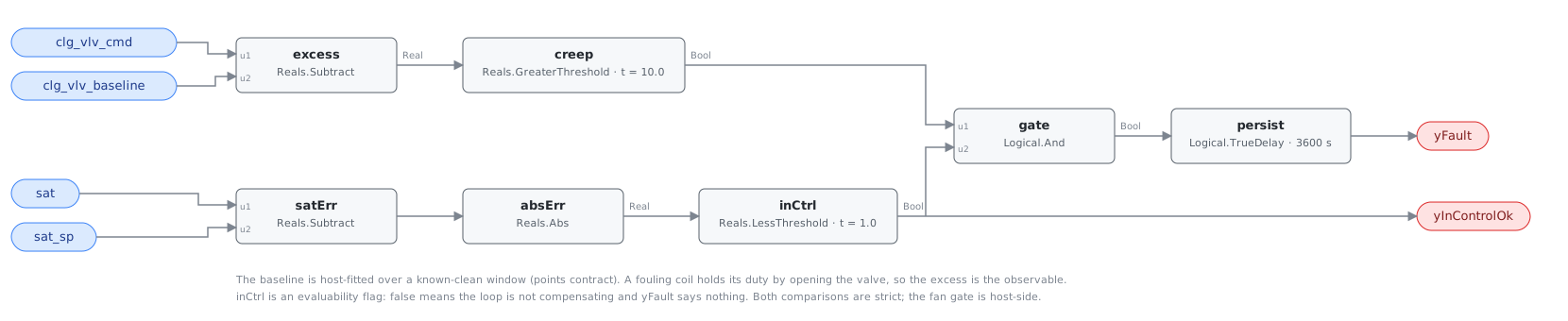
The gate is the rule’s argument, not a detail. Valve position is evidence about
a coil only while the loop is closing on setpoint; once it saturates, position
is pinned at 100% and the excess arithmetic is meaningless, so yInControlOk
goes false and the host reads NO_EVAL rather than a clean coil. That is why it
is an evaluability flag and not a sub-condition flag. The magnitude is taken
before the comparison, so an overcooling loop is out of the band the same as an
undercooling one; without it, a coil running 1.5 K cold with its valve wide open
would read as in control and be alarmed as fouled.
Both comparisons are strict: a valve sitting exactly on the creep line, and a
loop sitting exactly on the band edge, both read healthy. persist requires the
full hour continuously and delayOnInit = true holds that window across a
controller restart. Any interruption of either conjunct restarts it, so the
alarm follows the last excursion rather than the fault’s onset.
Possible Diagnoses
The rule detects hydraulic excess. It cannot name the cause, and four causes share the signature — the playbook discriminates:
- Coil fouling — the finding this card is named for. Air-side (fin blockage, a filter bank someone stopped changing) or water-side (scale, biofilm, corrosion product). Both reduce transfer and both are answered by more flow.
- Valve authority degradation — an oversized, worn, or failing valve and actuator delivering less flow per point of command than it used to. The command creeps for a reason that has nothing to do with the coil.
- Air-bound coil — air trapped at a high point reduces the wetted surface and the flow through it. The cheapest fix on this list: bleed it.
- Low chilled-water differential pressure at the coil — a plant-side shortfall, a throttled branch, or a DP reset tuned past what the far coils need. Every coil on the affected branch creeps together, which is the tell.
- A baseline that no longer describes the operating condition — a changed supply-air setpoint strategy, a new load, or a fit that has simply aged out. The fix is a refit, not a work order.
Energy Impact
EFFICIENCY_LOSS, MEDIUM confidence, QUALITATIVE_ONLY. The AHU’s own thermal energy does not move — that is the mechanism, not a caveat — so there is nothing to book on the air side. The cost is on the water side: the same duty carried by more flow returns colder water, which is the low delta-T arithmetic CHW-0004 prices in pump energy and chiller staging, one coil’s contribution at a time. Confidence is MEDIUM because the mechanism is well published while the shipped thresholds are placeholders and the baseline is a host obligation the graph cannot audit. Cooling-dominant.
Emissions Impact
Scope 2, QUALITATIVE_EMISSIONS, MEDIUM confidence. All of it is purchased electricity — pumping and the chiller hours the depressed delta-T buys — so the avoided-emissions basis is the marginal operating emissions rate (MOER), and the timing is unhelpful: coils creep hardest on the hottest afternoons, when the marginal generator is dirtiest.
Deviations
- The observable is hydraulic, and that is the whole design. Patil et al. (2022) show that under temperature control a fouling exchanger holds its heat rate while the loop compensates, so thermal tests cannot see it. AHU-0033, AHU-0032 and the SAT-to-MAT family all stay quiet through this fault by construction; only the valve moves.
clg_vlv_baselineis consumed as an ordinary Real, with the fit host-side. Same contract and same precedent as RTU-0007’scond_split_baseline: the regression lives in the host, the comparison in the graph. The known-clean fit window is the price, it is unverifiable from inside the rule, andbaseline_fitted_on_a_fouled_coil_stays_silentpins the failure so nobody discovers it in the field.creep_threshold10.0% andin_control_band1.0 °C ship as commissioning placeholders, not literature values. No source publishes a portable valve-creep band — the right number depends on the fit’s residual scatter and the loop’s hunting amplitude, which are properties of the installation. HP-0001 ships its baseline coefficients the same way and for the same reason.- The in-control band is tighter than AHU-0033’s 1.7 K alarm line on purpose. The two rules then partition the tracking error: inside 1.0 K this card evaluates, beyond 1.7 K AHU-0033 alarms, and the strip between is deliberately NO_EVAL here — a loop that is neither clearly compensating nor clearly failing supports neither finding.
- The fan gate is host-side, against AHU-0036’s in-graph choice. AHU-0036
wired fan status into its graph because dampers park open and the signature is
present all night, so the timer would charge through it. Here the valve is
driven shut when the fan stops: the excess goes negative and the fault term is
false on arithmetic alone (
fan_off_signature_is_absent). A host-side gate suppresses output for a condition the graph already reads healthy, which is the library’s default and costs a block. yInControlOkis an evaluability flag, not a sub-condition flag. False means the comparison is meaningless, so the host must read it beforeyFault— the CHW-0004 / HP-0001 / RTU-0007 shape. It is a comparison against a parameter rather than an echo of an input, which is what SCHEMA.md asks of a boundary output.- Valve position stands in for flow, and the rule cannot separate the causes. A fouled coil, a valve losing authority, an air-bound coil and a starved branch all move the command up at constant duty; distinguishing them needs a wrench, a flow meter, or the neighbours’ behaviour. Naming the fault after the most common cause and listing the other three in Possible Diagnoses is the honest form — the same trade CHW-0004 makes at plant scale.
playbooks: [low-delta-t]is the least-bad fit, and the library has a gap. That playbook’s Step 2.4 (CHW DP reset), Step 3.1 (coil fouling), Step 3.2 (valve sizing) and Step 3.3 (air in the piping) are exactly the four causes above, in order — but its Step 1 verifies plant delta-T and its Step 4 confirms at the plant, where this finding is one coil. A coil-maintenance playbook that starts at the AHU is a queued gap for the orchestrator; until it exists, this binding gets the discrimination steps right and the framing wrong.clusters: []. CLU-06 is chilled-water plant inefficiency triggered by CHW-0001, and fixing plant efficiency does not clear a fouled AHU coil — the causality runs the other way, coil by coil. This card is a contributor to that syndrome, not a member of it, andrelated: [CHW-0004]carries the link.alarm_delay3600 s and the restart semantics. Fouling is a season-long process, so detection latency is free and false positives are not. The cost of an hour is that both conjuncts must hold continuously through it: a loop that steps out of band every twenty minutes never accumulates the window (loop_excursion_restarts_persistence), which is the correct behaviour for a rule whose premise is a settled loop.method: statisticaldescribes the baseline’s provenance, not the runtime. The graph performs two subtractions, an absolute value, two comparisons, an AND and a delay. The fit behindclg_vlv_baselineis the statistical part; RTU-0007 and HP-0001 carry the same note.- Severity 3,
category: EFFICIENCY_LOSS,estimation_method: QUALITATIVE_ONLYand the name are library-authored, mirrored from RTU-0007 — the nearest shipped relative, a fouling rule against a host-fitted baseline.g36: null: G36 has no coil-degradation check. persist.delayOnInit = true(CDL defaultfalse), the library’s standing choice: a coil already creeping at controller start waits out the full hour rather than alarming on the first tick.- Every scenario in
vectors.jsonis library-authored — there is no reference card to transcribe. Both threshold edges, both band edges, both gates on and off, the persistence edge and the two restart paths are pinned against the engine rev inverified.
Notes
Read yInControlOk before yFault. A coil that has lost control and a coil
that is fine both hold yFault low, and only the flag separates them; the first
case belongs to AHU-0033 and is the more urgent of the two.
Run this beside CHW-0004. The plant rule sees the sum of every creeping coil in the building and cannot say which; this rule names them one at a time. A building where CHW-0004 alarms and no AHU-0038 instance does is telling you the coils are fine and the bypass, the staging or the plant sensors are not.
Test Vectors
13 scenarios, clock step 60 s over 7200 s.
| Scenario | Description |
|---|---|
clean_coil_holding_setpoint | NO_FAULT: the loop sits at 45% against a fitted 42% and holds supply air 0.2 K off a 13.0 °C setpoint. Three points of hydraulic excess is fit residual, not fouling, and yInControlOk is true the whole run so the silence means healthy rather than unevaluated. |
fouled_coil_alarms_at_the_persistence_edge | FAULT, and the whole point of the card: supply air is still 0.2 K off setpoint — thermally the unit looks perfect — while the valve holds 65% where the fit expects 42%. The alarm lands at exactly 3600 s, which also pins delayOnInit: the condition is present from the first tick and still serves the full hour. |
excess_exactly_at_the_threshold | Boundary, bit-exact: 52.0 − 42.0 is exactly 10.0 and the parameter is exactly 10.0, so the verdict is decided by the strictness of Reals.GreaterThreshold and not by rounding. A valve sitting exactly on the creep line reads healthy. |
excess_just_above_the_threshold | Boundary from above: one hundredth of a percent more valve opening puts the excess at 10.01 points and the rule alarms on the normal schedule. |
in_control_band_exactly_at_the_edge_is_no_eval | NO_EVAL boundary: 14.0 − 13.0 is exactly 1.0 and Reals.LessThreshold is strict, so a loop sitting exactly on the band edge is NOT in control. The hydraulic excess is 23 points and the rule still says nothing — yInControlOk false is the only thing that distinguishes this from a clean coil. |
in_control_band_just_inside_alarms | The other side of the same boundary: 13.99 against 13.0 is 0.99 K of tracking error, inside the band, and the same 23 points of excess now count. Together with the previous scenario this pins both sides of the evaluability gate. |
loop_lost_control_is_no_eval | NO_EVAL: the valve is pinned at 100% and supply air runs 4 K warm. This is a coil that has stopped meeting its setpoint, which is AHU-0033’s finding and a louder one; the excess-over-baseline arithmetic means nothing once the loop is saturated, so this card stands down. |
overcooling_side_of_the_band_is_no_eval | NO_EVAL on the cold side, and the vector that pins the Abs: sat − sat_sp is −1.5 K, which is less than the 1.0 K band as a signed number and outside it as a magnitude. Without absErr the rule would read an overcooling loop as in control and count its open valve as fouling. |
fan_off_signature_is_absent | Why the fan gate is a host precondition rather than a conjunct in the graph: with the fan stopped the cooling valve is driven shut, so the excess is −45 points and the fault term is false on arithmetic alone. Nothing charges the persistence timer overnight, which is the failure mode that put the fan status inside AHU-0036’s graph. |
loop_excursion_restarts_persistence | A single tick outside the control band at 1800 s — a load step the loop has to chase — drops the evaluability gate and restarts the hour. The alarm moves from 3600 s to 5460 s, one delay after the loop settles back inside the band. |
excess_dip_restarts_persistence | The same restart driven from the other conjunct: the valve backs off to 50% for one tick, putting the excess at 8 points, then returns to 65%. The creep gate cycles off and on and the alarm lands at 5460 s. |
coil_cleaned_mid_run_clears_the_alarm | Recovery: the alarm asserts at 3600 s, then the coil is washed at 4800 s and the same duty is met at 44% — two points of excess. TrueDelay drops on the falling edge with no release delay, so the fault clears on the tick the valve backs off. |
baseline_fitted_on_a_fouled_coil_stays_silent | The point dictionary’s known-clean caveat made executable. The valve is at 65% and the coil is fouled, but the host fitted the baseline from that same period and publishes 64%, so the excess is one point and the rule is quiet forever. Nothing in the graph can see this; the fit window is a commissioning obligation. |
vectors.json
{
  "schema": "cxf-library/vectors/v1",
  "clock": {
    "step_s": 60,
    "horizon_s": 7200
  },
  "scenarios": [
    {
      "name": "clean_coil_holding_setpoint",
      "description": "NO_FAULT: the loop sits at 45% against a fitted 42% and holds supply air 0.2 K off a 13.0 \u00b0C setpoint. Three points of hydraulic excess is fit residual, not fouling, and yInControlOk is true the whole run so the silence means healthy rather than unevaluated.",
      "inputs": {
        "clg_vlv_cmd": 45.0,
        "clg_vlv_baseline": 42.0,
        "sat": 13.2,
        "sat_sp": 13.0
      },
      "expect": [
        {
          "output": "yFault",
          "from_s": 0,
          "to_s": 7200,
          "equals": false
        },
        {
          "output": "yInControlOk",
          "from_s": 0,
          "to_s": 7200,
          "equals": true
        }
      ]
    },
    {
      "name": "fouled_coil_alarms_at_the_persistence_edge",
      "description": "FAULT, and the whole point of the card: supply air is still 0.2 K off setpoint \u2014 thermally the unit looks perfect \u2014 while the valve holds 65% where the fit expects 42%. The alarm lands at exactly 3600 s, which also pins delayOnInit: the condition is present from the first tick and still serves the full hour.",
      "inputs": {
        "clg_vlv_cmd": 65.0,
        "clg_vlv_baseline": 42.0,
        "sat": 13.2,
        "sat_sp": 13.0
      },
      "expect": [
        {
          "output": "yFault",
          "from_s": 0,
          "to_s": 3540,
          "equals": false
        },
        {
          "output": "yFault",
          "from_s": 3600,
          "to_s": 7200,
          "equals": true
        },
        {
          "output": "yInControlOk",
          "from_s": 0,
          "to_s": 7200,
          "equals": true
        }
      ]
    },
    {
      "name": "excess_exactly_at_the_threshold",
      "description": "Boundary, bit-exact: 52.0 \u2212 42.0 is exactly 10.0 and the parameter is exactly 10.0, so the verdict is decided by the strictness of Reals.GreaterThreshold and not by rounding. A valve sitting exactly on the creep line reads healthy.",
      "inputs": {
        "clg_vlv_cmd": 52.0,
        "clg_vlv_baseline": 42.0,
        "sat": 13.2,
        "sat_sp": 13.0
      },
      "expect": [
        {
          "output": "yFault",
          "from_s": 0,
          "to_s": 7200,
          "equals": false
        },
        {
          "output": "yInControlOk",
          "from_s": 0,
          "to_s": 7200,
          "equals": true
        }
      ]
    },
    {
      "name": "excess_just_above_the_threshold",
      "description": "Boundary from above: one hundredth of a percent more valve opening puts the excess at 10.01 points and the rule alarms on the normal schedule.",
      "inputs": {
        "clg_vlv_cmd": 52.01,
        "clg_vlv_baseline": 42.0,
        "sat": 13.2,
        "sat_sp": 13.0
      },
      "expect": [
        {
          "output": "yFault",
          "from_s": 0,
          "to_s": 3540,
          "equals": false
        },
        {
          "output": "yFault",
          "from_s": 3600,
          "to_s": 7200,
          "equals": true
        },
        {
          "output": "yInControlOk",
          "from_s": 0,
          "to_s": 7200,
          "equals": true
        }
      ]
    },
    {
      "name": "in_control_band_exactly_at_the_edge_is_no_eval",
      "description": "NO_EVAL boundary: 14.0 \u2212 13.0 is exactly 1.0 and Reals.LessThreshold is strict, so a loop sitting exactly on the band edge is NOT in control. The hydraulic excess is 23 points and the rule still says nothing \u2014 yInControlOk false is the only thing that distinguishes this from a clean coil.",
      "inputs": {
        "clg_vlv_cmd": 65.0,
        "clg_vlv_baseline": 42.0,
        "sat": 14.0,
        "sat_sp": 13.0
      },
      "expect": [
        {
          "output": "yFault",
          "from_s": 0,
          "to_s": 7200,
          "equals": false
        },
        {
          "output": "yInControlOk",
          "from_s": 0,
          "to_s": 7200,
          "equals": false
        }
      ]
    },
    {
      "name": "in_control_band_just_inside_alarms",
      "description": "The other side of the same boundary: 13.99 against 13.0 is 0.99 K of tracking error, inside the band, and the same 23 points of excess now count. Together with the previous scenario this pins both sides of the evaluability gate.",
      "inputs": {
        "clg_vlv_cmd": 65.0,
        "clg_vlv_baseline": 42.0,
        "sat": 13.99,
        "sat_sp": 13.0
      },
      "expect": [
        {
          "output": "yFault",
          "from_s": 0,
          "to_s": 3540,
          "equals": false
        },
        {
          "output": "yFault",
          "from_s": 3600,
          "to_s": 7200,
          "equals": true
        },
        {
          "output": "yInControlOk",
          "from_s": 0,
          "to_s": 7200,
          "equals": true
        }
      ]
    },
    {
      "name": "loop_lost_control_is_no_eval",
      "description": "NO_EVAL: the valve is pinned at 100% and supply air runs 4 K warm. This is a coil that has stopped meeting its setpoint, which is AHU-0033's finding and a louder one; the excess-over-baseline arithmetic means nothing once the loop is saturated, so this card stands down.",
      "inputs": {
        "clg_vlv_cmd": 100.0,
        "clg_vlv_baseline": 42.0,
        "sat": 17.0,
        "sat_sp": 13.0
      },
      "expect": [
        {
          "output": "yFault",
          "from_s": 0,
          "to_s": 7200,
          "equals": false
        },
        {
          "output": "yInControlOk",
          "from_s": 0,
          "to_s": 7200,
          "equals": false
        }
      ]
    },
    {
      "name": "overcooling_side_of_the_band_is_no_eval",
      "description": "NO_EVAL on the cold side, and the vector that pins the Abs: sat \u2212 sat_sp is \u22121.5 K, which is less than the 1.0 K band as a signed number and outside it as a magnitude. Without absErr the rule would read an overcooling loop as in control and count its open valve as fouling.",
      "inputs": {
        "clg_vlv_cmd": 65.0,
        "clg_vlv_baseline": 42.0,
        "sat": 11.5,
        "sat_sp": 13.0
      },
      "expect": [
        {
          "output": "yFault",
          "from_s": 0,
          "to_s": 7200,
          "equals": false
        },
        {
          "output": "yInControlOk",
          "from_s": 0,
          "to_s": 7200,
          "equals": false
        }
      ]
    },
    {
      "name": "fan_off_signature_is_absent",
      "description": "Why the fan gate is a host precondition rather than a conjunct in the graph: with the fan stopped the cooling valve is driven shut, so the excess is \u221245 points and the fault term is false on arithmetic alone. Nothing charges the persistence timer overnight, which is the failure mode that put the fan status inside AHU-0036's graph.",
      "inputs": {
        "clg_vlv_cmd": 0.0,
        "clg_vlv_baseline": 45.0,
        "sat": 24.0,
        "sat_sp": 13.0
      },
      "expect": [
        {
          "output": "yFault",
          "from_s": 0,
          "to_s": 7200,
          "equals": false
        },
        {
          "output": "yInControlOk",
          "from_s": 0,
          "to_s": 7200,
          "equals": false
        }
      ]
    },
    {
      "name": "loop_excursion_restarts_persistence",
      "description": "A single tick outside the control band at 1800 s \u2014 a load step the loop has to chase \u2014 drops the evaluability gate and restarts the hour. The alarm moves from 3600 s to 5460 s, one delay after the loop settles back inside the band.",
      "inputs": {
        "clg_vlv_cmd": 65.0,
        "clg_vlv_baseline": 42.0,
        "sat": [
          {
            "t": 0,
            "value": 13.2
          },
          {
            "t": 1800,
            "value": 15.0
          },
          {
            "t": 1860,
            "value": 13.2
          }
        ],
        "sat_sp": 13.0
      },
      "expect": [
        {
          "output": "yInControlOk",
          "from_s": 0,
          "to_s": 1740,
          "equals": true
        },
        {
          "output": "yInControlOk",
          "from_s": 1800,
          "to_s": 1800,
          "equals": false
        },
        {
          "output": "yInControlOk",
          "from_s": 1860,
          "to_s": 7200,
          "equals": true
        },
        {
          "output": "yFault",
          "from_s": 0,
          "to_s": 5400,
          "equals": false
        },
        {
          "output": "yFault",
          "from_s": 5460,
          "to_s": 7200,
          "equals": true
        }
      ]
    },
    {
      "name": "excess_dip_restarts_persistence",
      "description": "The same restart driven from the other conjunct: the valve backs off to 50% for one tick, putting the excess at 8 points, then returns to 65%. The creep gate cycles off and on and the alarm lands at 5460 s.",
      "inputs": {
        "clg_vlv_cmd": [
          {
            "t": 0,
            "value": 65.0
          },
          {
            "t": 1800,
            "value": 50.0
          },
          {
            "t": 1860,
            "value": 65.0
          }
        ],
        "clg_vlv_baseline": 42.0,
        "sat": 13.2,
        "sat_sp": 13.0
      },
      "expect": [
        {
          "output": "yFault",
          "from_s": 0,
          "to_s": 5400,
          "equals": false
        },
        {
          "output": "yFault",
          "from_s": 5460,
          "to_s": 7200,
          "equals": true
        },
        {
          "output": "yInControlOk",
          "from_s": 0,
          "to_s": 7200,
          "equals": true
        }
      ]
    },
    {
      "name": "coil_cleaned_mid_run_clears_the_alarm",
      "description": "Recovery: the alarm asserts at 3600 s, then the coil is washed at 4800 s and the same duty is met at 44% \u2014 two points of excess. TrueDelay drops on the falling edge with no release delay, so the fault clears on the tick the valve backs off.",
      "inputs": {
        "clg_vlv_cmd": [
          {
            "t": 0,
            "value": 65.0
          },
          {
            "t": 4800,
            "value": 44.0
          }
        ],
        "clg_vlv_baseline": 42.0,
        "sat": 13.2,
        "sat_sp": 13.0
      },
      "expect": [
        {
          "output": "yFault",
          "from_s": 0,
          "to_s": 3540,
          "equals": false
        },
        {
          "output": "yFault",
          "from_s": 3600,
          "to_s": 4740,
          "equals": true
        },
        {
          "output": "yFault",
          "from_s": 4800,
          "to_s": 7200,
          "equals": false
        }
      ]
    },
    {
      "name": "baseline_fitted_on_a_fouled_coil_stays_silent",
      "description": "The point dictionary's known-clean caveat made executable. The valve is at 65% and the coil is fouled, but the host fitted the baseline from that same period and publishes 64%, so the excess is one point and the rule is quiet forever. Nothing in the graph can see this; the fit window is a commissioning obligation.",
      "inputs": {
        "clg_vlv_cmd": 65.0,
        "clg_vlv_baseline": 64.0,
        "sat": 13.2,
        "sat_sp": 13.0
      },
      "expect": [
        {
          "output": "yFault",
          "from_s": 0,
          "to_s": 7200,
          "equals": false
        },
        {
          "output": "yInControlOk",
          "from_s": 0,
          "to_s": 7200,
          "equals": true
        }
      ]
    }
  ]
}