SYS-0009 — Sensor flatline while equipment active
| Status | verified — engine e2ff2f8, cxf:fnv1a128:e9b6eca9434e06c98d3fbdf289ffa6c6, 2026-08-17 |
| Severity | 3 |
| Method | rule |
| Phase | 3 |
| Category | PROTECTIVE |
| Confidence | LOW |
| Estimation | QUALITATIVE_ONLY |
| G36 | — |
| Clusters | CLU-09 |
| Suppresses | — |
| Suppressed by | — |
| Related | SYS-0005, SYS-0010, AHU-0028, RTU-0003 |
| Playbooks | sensor-drift |
| Source | Accepted design: internal sensor-health design note (local-only, not distributed) — §1 (the flatline shape and its activity gate), §2 (why a physical-plausibility rule does not break the fault-given-valid-data stance), §2.3 (the adjudicates contract), §4.3 (Discrete.Sampler mechanics and the MovingAverage rejection), §4.4 (the flatline vector strategy this card’s scenarios follow); Yang, H., Cho, S., Tae, C.-S., Zaheeruddin, M. (2008). Sequential rule based algorithms for temperature sensor fault detection in air handling units. Energy Conversion and Management 49(8), 2291-2306. doi:10.1016/j.enconman.2008.01.029 — rule-based temperature-sensor FDD validated on real AHUs; the source of the isolation argument this card’s adjudicates verdict rests on; Liao, H., Cai, W., Cheng, F., Dubey, S., Rajesh, P. B. (2021). An Online Data-Driven Fault Diagnosis Method for Air Handling Units by Rule and Convolutional Neural Networks. Sensors 21(13), 4358. doi:10.3390/s21134358 — published evidence that a cheap deterministic sensor layer under a heavier diagnostic layer works in the field; Dey, D., Dong, B. (2016). A probabilistic approach to diagnose faults of air handling units in buildings. Energy and Buildings 130, 177-187. doi:10.1016/j.enbuild.2016.08.017 — the motivation stated negatively: a satisfied equipment rule cannot separate a real fault from a sensor fault after the fact; Library-authored: the HVAC FDD Reference v1.0 specifies no flatline rule in any chapter. Name, severity 3 and method: rule are faults/sys/README.md’s; everything else is argued on this card; Sibling precedent: AHU-0023 (the Discrete.Sampler baseline plus flatness dwell this graph reuses), AHU-0028 and RTU-0003 (physical-plausibility rules the library already ships), VAV-0001 (the per-binding placeholder parameter convention) |
| Operating states | all — the rule evaluates only while equip_active is true, and its own yWindowOk reports whether a complete window of running time has accumulated |
Preconditions (host-enforced): Host delivery quality must be resolved before this rule runs, and this is the load-bearing precondition rather than boilerplate: a value the host is re-serving from cache because the subscription died presents to the graph as a perfectly frozen sensor, and the rule will report flatline and be right about the number it was given and wrong about the transmitter. Freshness, PointStatus and gap handling stay where the reference’s ch.4 puts them — host-side, ahead of this rule (design doc §2.2). sensor_value must be bound to a live measurement: a setpoint, a configured constant, a schedule output or a host-derived aggregate that only refreshes hourly will all read as flatline and none of them is a sensor. equip_active must be bound to the run status of the equipment whose process actually drives the bound sensor — sf_status for an AHU supply-air temperature, comp_status for a suction line, pump_status for a loop reading. A VAV box has no run status of its own; bind the parent AHU’s fan status or zone_airflow > 0 and record which. Both flatline_band and flatline_window are per-binding site configuration in the bound point’s units and MUST be set for this instance before the rule is trusted; the shipped defaults are a worked example for a supply-air temperature, not a site value. Where yWindowOk is false the verdict is NO_EVAL, not a healthy sensor.
Points: sensor_value, equip_active
Outputs:
yFault— True while the bound sensor has stayed within flatline_band of its window baseline continuously for flatline_window of running time, and has then held that condition for a further alarm_delay. While true, the host treats sensor_value as invalid for every rule bound to this equipment instance that consumes it (see adjudicates)yWindowOk— Evaluability signal — true once equip_active has been continuously true for a full flatline_window, which is the shortest run the rule can form any verdict from. False means NO_EVAL, never a healthy sensor
Parameters:
| Name | Default | Unit | CXF path | Description |
|---|---|---|---|---|
flatline_band | 0.25 | varies (the bound point’s units) | stillBand.t | How far the reading may travel from its window baseline and still count as not moving. PER-BINDING SITE CONFIGURATION, in the units of whatever real point sensor_value is bound to — the VAV-0001 ventilation_requirement convention. The shipped 0.25 is the worked example for sensor_value := sat on an AHU (0.25 °C: above the 0.1 °C quantum most BAS report a duct temperature at, well below the 1-3 °C a controlled supply-air temperature travels in two hours). It is meaningless on any other quantity — see Deviations for the duct-static counter-example and for which direction each mis-tuning fails in. |
flatline_window | 7200.0 | s | sensRef.samplePeriod, stillHeld.delayTime, windowOk.delayTime | How long the reading must stay inside the band, measured in running time, before the rule believes the sensor rather than the process. ADOPTED at 2 h and argued in Deviations; tune within roughly 1-4 h per binding. One card parameter binds three block parameters — the sampler that produces the baseline and both dwell timers — and hosts must set all three together. |
alarm_delay | 900.0 | s | persist.delayTime | Further continuous persistence after the window completes, before the alarm asserts (15 min). The retuning knob for alarm hygiene, kept separate from flatline_window because that parameter also sets the baseline’s re-arm period and cannot be moved for reporting reasons alone. |
Description
A transmitter that has stopped reporting change is the quietest failure in a building. Nothing alarms, no zone complains, the trend line is beautifully smooth, and every rule downstream keeps producing verdicts from a number that stopped being a measurement weeks ago. A frozen sensing element, a controller holding last-known-good, a point re-served from cache after a dead subscription — all three present identically: zero variance under a load that should be producing some. The reason to write the rule is Dey & Dong (2016): a Bayesian layer sits over APAR precisely because a satisfied equipment rule cannot separate coil fouling from a temperature-sensor bias after the fact, and the cheaper answer is to detect the sensor case directly and drop it from the candidate set first. It is library-authored — the HVAC FDD Reference specifies no flatline rule in any chapter — and it binds role points, whose real identities live in the host’s instance configuration.
The adjudicates contract. While yFault is active, sensor_value is
invalid: the host must return NO_EVAL for every rule on this equipment instance
that consumes it, deriving that set by intersecting each card’s points with
adjudicates.points. equip_active is consumed but deliberately not
adjudicated. yWindowOk is a separate gate: while it is false the verdict is
NO_EVAL, never a healthy sensor.
Detection Logic
baseline   = Sampler(sensor_value, flatline_window)   (re-arms once per window)
still      = |sensor_value − baseline| < flatline_band

yWindowOk  = equip_active held continuously for flatline_window
                                            (false ⇒ host reports NO_EVAL)
yFault     = (still AND equip_active) held continuously for flatline_window,
             then sustained a further alarm_delay
Block graph (rule.cxf.jsonld):
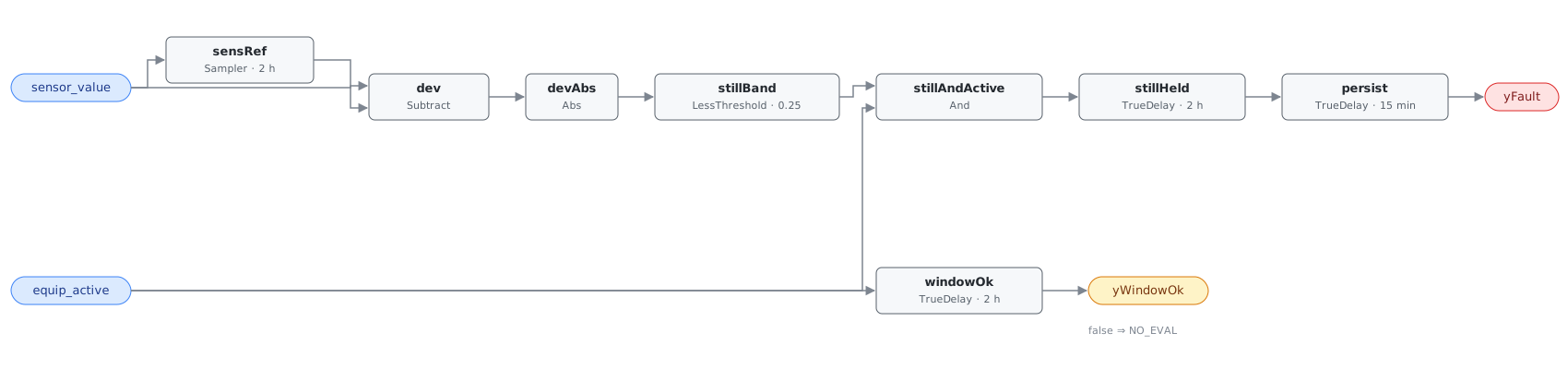
Eight blocks. sensRef is a Discrete.Sampler on the window period, so the
comparison is always against where the reading sat at the start of the current
window; stillBand is strict, so a deviation of exactly flatline_band reads
as moving. The activity gate sits inside the dwell rather than after it —
equip_active is one leg of stillAndActive, so flatline_window is a window
of running time and a plant that stops discards the elapsed time rather than
pausing it. windowOk is not an echo of that input: it asserts only once the
equipment has run continuously for a full window, the shortest run this rule can
form any verdict from, so a true yFault implies a true yWindowOk and not the
reverse.
Both thresholds are per-binding and the shipped pair is a worked example for
sensor_value := sat, equip_active := sf_status: 0.25 °C sits above the 0.1 °C
quantum most BAS report a duct temperature at and well below the one to three
degrees a controlled supply-air temperature travels in two hours, and 7200 s
fits inside a single occupied period. Every other binding needs its own two
numbers — Deviations works the arithmetic on which direction each mis-tuning
fails.
persist (15 min) is the only knob a host should touch for reporting reasons;
flatline_window binds the sampler period and both dwell timers at once,
because they express one quantity. All three TrueDelays assert at exactly
T + delayTime and carry delayOnInit = true (CDL default false).
Possible Diagnoses
Library-authored; no published diagnosis list exists for this shape.
- Failed sensing element — a thermistor or RTD opened or shorted into a fixed reading, a transducer whose diaphragm has seized. The only repair that is a part
- Failed or saturated A/D channel — the element is fine, the input is not; distinguishable on site by moving the sensor to a spare input
- A controller holding last-known-good — many BAS substitute the previous value on a read failure rather than flagging the point
- A point re-served from cache after a lost subscription — the host is supposed to catch this as a delivery fault before the rule sees it
- A manual override or hand mode left on the point — costs nothing to check and is the most common finding on a new deployment
- A sensor installed where nothing happens — a duct probe in a dead leg, a well without paste, a space sensor behind a closed door. The repair is relocation
- Genuinely stable process — the false-positive case: a tight loop on a light
load can sit still for two hours. Raise
flatline_window, neverflatline_band
Energy Impact
PROTECTIVE, LOW confidence, QUALITATIVE_ONLY. There is no waste term — a frozen
transmitter burns nothing — and the cost is the diagnostic coverage of every
rule that reads it, realized as energy only through the faults it hides.
AHU-0028 set the convention this card follows: the value of a sensor gate
belongs to the rules it gates. The fan-out is the number that matters and it is
per-instance, computed by the host from the points lists every card already
carries. Confidence is LOW for two honest reasons: diagnoses 6 and 7 cannot be
separated from a stuck transmitter by this graph, and a deployment that has not
retuned the thresholds is comparing against a supply-air temperature’s numbers.
Emissions Impact
Scope 1 or 2 depending on what the adjudicated point serves,
QUALITATIVE_EMISSIONS, LOW confidence. Same argument as the energy claim: no
direct term, and the avoided emissions belong to whichever rules were restored
to service when the sensor was repaired. AHU-0028’s 1|2 assignment is the
precedent, for the same reason — a bad temperature can be hiding a gas-fired
heating fault or an electric cooling one, and the rule does not know which.
Deviations
- Library-authored, not a transcription. No chapter of the reference
specifies a flatline rule, so there is no algorithm to deviate from. The ID,
name, severity 3 and
method: rulearefaults/sys/README.md’s; everything else is argued here on the accepted design plus Yang et al. (2008) and Liao et al. (2021). - The stance, in brief. Delivery quality — arrival,
PointStatus, gaps — stays host-side and is untouched by this rule; physical plausibility (the sample arrived clean and is wrong) is a property of the signal and a fault of a piece of equipment, because a sensor is equipment. AHU-0028 and RTU-0003 are the precedent. - The rule depends on host delivery quality and cannot substitute for it. This keeps the layering acyclic and is the one way a deployment can make the card lie: fed a value held over from a dead subscription, the rule reports flatline — right about the number it was given, wrong about the transmitter.
adjudicates: {points: [sensor_value], verdict: invalid_while_active}. The verdict names one sensor rather than SYS-0005’s pair.equip_activeis not adjudicated: the rule says nothing about whether the run status is telling the truth. The fan-out is deliberately not enumerated, so it stays complete as rules are added — AHU-0028’s hand-writtensuppresseslist is the counter-example that motivated the field.suppresses: []andsuppressed_by: [], and the second is normative. An equipment fault silencing the sensor rule that invalidates it is a cycle with a wrong answer at both ends. The two fields are not interchangeable:suppressessays the silenced verdict is true but redundant,adjudicatessays the consuming verdicts are meaningless and their rolling state should be reset. Whose job that reset is remains open.- The evaluability output is a dwell rather than an echo. A passthrough of a
boolean boundary input carries no information the host does not have
(HW-0005’s
yMildWeatherdeviation is explicit), soyWindowOkisequip_activeheld for a fullflatline_window. - Both thresholds ship as per-binding placeholders in the bound point’s
units, the VAV-0001 convention. The counter-example that makes it bite:
bound to a duct static pressure, 0.25 Pa is below the noise floor of every
transducer on the market, so
stillis never true and the rule sits silent forever — that binding wants something nearer 5 Pa. The failure directions are not symmetric: a band too small produces silent misses, a band too large turns a slowly moving healthy sensor into a flatline finding, and only the second is visible from the alarm list. flatline_window = 7200 sis ADOPTED, and short by this family’s standards. AHU-0023 uses seven days for the same sampler-and-dwell structure; copying it would be wrong because the window is continuous running time and a scheduled air handler never runs for a week, because every unreported hour blinds everything downstream, and because above roughly four hours the window exceeds the uninterrupted run of ordinary scheduled plant. The floor is diagnosis 7 at about an hour.Discrete.Sampler, notReals.MovingAverage, and notReals.Derivative. Engine-verified at the pin.MovingAverage’s fixed 64-checkpoint ring imposes a minimum tick ofwindow/64(112.5 s here) and degrades silently when a deployment ticks faster; AHU-0023 rejected it for the same reason.Reals.Derivativeis forbidden in this family outright — itskandTare input pins, and its implicit-Euler discretisation biases a ramp by(1 + dt/T), reporting twice the actual slope at a 300 s tick withT = 300 s.Discrete.Sampleremits the live input on its first tick, so there is no startup artifact of the kindDiscrete.UnitDelayproduces withy_start = 0(that is SYS-0010’s problem). This is pinned by an arrival time rather than asserted: the alarm lands atflatline_window + alarm_delayfrom t = 0, which is only reachable if the first baseline was the live reading.- The sampler grid is anchored to absolute model time, not to controller
start: the first sample instant is
floor(t_start/period)·period, so a rule loaded at t = 137 s with a two-hour period takes its first grid instant at t = 0. It does not change the verdict, but a deployment’s tick must divideflatline_window. - The baseline re-arms every window, with two consequences. At each sample
instant the block emits the live input, so the deviation is exactly zero on
that tick however hard the signal is moving — a burst of apparent stillness
that cannot mature, since the dwell needs a full window. And a sensor that
freezes partway through a window is not detected until the next re-arm
re-baselines onto its stuck value, so worst-case time to alarm from the moment
of failure is
2 × flatline_window + alarm_delay. - A slow drift reads as a flatline. Any reading moving slower than
flatline_bandperflatline_windowsatisfies the test. That is a sensor finding either way, but the name is wrong and this rule cannot supply the right one — naming drift is SYS-0005’s job, and a host running both should read a simultaneous SYS-0009 and SYS-0005 as drift, not two faults. - Strict
<on the band. CDLRealshas noLessEqualand the disagreement is measure-zero on a real-valued signal, so the comparison errs toward silence. Edge cases use dyadic values (14.0 against 14.25) so the difference is exactly 0.25 in IEEE-754: 14.2 − 14.0 is not 0.2 in double precision, and a naively written edge test would pin the wrong side of its own threshold. delayOnInit = trueon all threeTrueDelays (CDL defaultfalse), the library’s standing choice: a restart onto an already-frozen sensor waits out the full window, andwindowOkrefuses to claim a window it did not observe. Each asserts at exactlyT + delayTime, so every realized test is “strictly more than” its delay at tick resolution.alarm_delayis a separate parameter fromflatline_windowon purpose. The two answer different questions:flatline_windowis a physical claim about how long the bound process can legitimately sit still and it also sets the baseline’s re-arm period, so it cannot be shortened for alarm hygiene without changing what the rule measures.alarm_delayis the knob that moves freely.clusters: [], flagged not edited. CLU-09 (Sensor Integrity Failure) is where this card belongs, and if the FC-100 family lands its trigger is arguably one of these rules with AHU-0028 demoted to member.clusters/clusters.jsonis a single-writer file, as isplaybooks/sensor-drift.md, whose four steps already apply to this finding.category: PROTECTIVE, departing from the two precedent sensor gates. AHU-0028 and RTU-0003 are bothCOMFORT_ENERGYand consistency is the honest counter-argument; it is declined because the alternative misdescribes the card — there is no comfort effect and no energy term, and what the rule delivers is avoided false findings and preserved diagnostic coverage. Severity stays 3: the fan-out is the host’s consequence of the verdict, not a property of the finding.- Operating states and preconditions are declared in frontmatter for host enforcement rather than encoded in the block graph, per the library’s design stance.
Notes
Read yWindowOk before yFault, and read adjudicates before doing anything
with either. A true yFault is not an instruction to dispatch a technician and
stop — it is an instruction to stop believing every other finding on that
equipment that touches the bound point, and the second half is worth more.
Check the cheap causes first: diagnoses 3, 4 and 5 account for most of what this rule finds on a new deployment, cost nothing to check from a desk, and are configuration rather than hardware. Then look at where the sensor is before assuming it is broken — diagnosis 6 survives recalibration, because a probe in a dead leg reports a real temperature of a place where nothing happens and passes every bench test. The tell is a reading that is plausible and static while its neighbours move.
Tune the window, never the band, when the rule is too talkative. Raising
flatline_band pulls genuinely drifting sensors into the finding, making the
report noisier and less specific at once; raising flatline_window costs only
detection latency, and this family has latency to spare. See the
sensor-drift playbook for the verification
and service workflow.
Test Vectors
14 scenarios, clock step 300 s over 21600 s.
| Scenario | Description |
|---|---|
frozen_sensor_with_equipment_running | The plain fault: the reading never moves while the equipment runs. The alarm lands at 8100 s = flatline_window + alarm_delay measured from t = 0, and that arrival time is itself the pin for Discrete.Sampler emitting the LIVE input on its first tick. A UnitDelay-style y_start = 0 artifact would have made the first baseline 0.0, held stillBand false until the t = 7200 s re-arm, and pushed the alarm out to 15300 s. |
flat_signal_on_idle_equipment_is_not_a_fault | The gate’s whole purpose: an identical frozen reading on stopped equipment is normal, not a sensor fault. yWindowOk never rises, so the host reads NO_EVAL rather than a healthy sensor. |
equipment_stop_restarts_the_window | The gate sits inside the dwell, so the window is a window of RUNNING time: a 600 s stop at 5400 s discards the elapsed 5400 s rather than pausing it. The clock restarts at 6000 s, stillHeld matures at 13200 s and the alarm lands at 14100 s. |
wobble_inside_the_band_still_asserts | The band is not decorative. A reading stepping 0.15 units either side of its baseline - quantisation and transmitter noise, not process movement - still reads as flatline and alarms on the same 8100 s schedule as a bit-frozen signal. The wobble period divides flatline_window, so every re-arm lands on the low value and the baseline is stable across windows. |
band_edge_exactly_on_the_line | stillBand is a strict Reals.LessThreshold: a deviation of exactly flatline_band reads as MOVING, so the rule stays silent. Both values are dyadic, so 14.25 - 14.0 is exactly 0.25 in IEEE-754 and the comparison really does sit on the line rather than near it. |
band_edge_a_hair_under | 0.001 below the line: 14.249 against a 14.0 baseline is inside the band, so the same waveform that stayed silent at exactly 0.25 now alarms at 8100 s. |
band_edge_a_hair_over | 0.001 above the line: 14.251 clears the band, stillBand drops on every high half-cycle and the dwell never completes. |
healthy_sensor_tracking_the_process | The ordinary healthy case - a reading swinging 2.0 units as the process moves under control. Never silent for a full window, never alarms, and yWindowOk is true throughout the run so the silence is a verdict rather than an unasked question. |
signal_moves_on_the_maturity_tick | Delay edge from below: the reading is frozen from t = 0 and jumps 6.0 units at exactly 8100 s, the tick persist matures on. The input is false when the timer comes due, so a full window plus alarm_delay of stillness is never reported. |
signal_moves_one_tick_after_maturity | Delay edge from above: the same freeze held 300 s longer asserts at exactly 8100 s and clears at 8400 s. The pair makes the T + delayTime boundary observable rather than assumed. After the jump the rule is blind until the next re-arm at 14400 s re-baselines onto 20.0, and the fresh dwell cannot mature before the horizon. |
slow_drift_reads_as_flatline | A documented limit, pinned rather than left for a site to find: a reading climbing 0.05 units every 1800 s never travels more than 0.15 from its baseline inside one window, so the rule calls it flatline and alarms at 8100 s. SYS-0009 cannot separate a frozen transmitter from one moving slower than flatline_band per flatline_window; both are sensor findings, and naming which is the redundancy-pair rule’s job. |
rearm_stillness_never_matures | The Sampler re-arm artifact: at every sample instant the block emits the live input, so the deviation is exactly zero and stillBand reads true no matter how hard the signal is moving. Here the reading climbs 6.0 units every 1800 s and still shows a burst of apparent stillness after each re-arm; the burst is bounded by the sample grid, the dwell needs a full window, and yFault never rises. |
equipment_stops_on_the_window_tick | Window delay edge from below, on the evaluability output: the equipment stops at exactly 7200 s, the tick windowOk matures on. The input is false when the timer comes due, so the rule never claims to have had a complete window of running time. |
equipment_stops_one_tick_after_the_window_tick | Window delay edge from above: the same run held 300 s longer sets yWindowOk for exactly one tick at 7200 s. yFault stays false because persist still owed 900 s when the gate dropped, which also pins that a true yFault implies a true yWindowOk and never the reverse. |
vectors.json
{
"schema": "cxf-library/vectors/v1",
"clock": {
"step_s": 300,
"horizon_s": 21600
},
"scenarios": [
{
"name": "frozen_sensor_with_equipment_running",
"description": "The plain fault: the reading never moves while the equipment runs. The alarm lands at 8100 s = flatline_window + alarm_delay measured from t = 0, and that arrival time is itself the pin for Discrete.Sampler emitting the LIVE input on its first tick. A UnitDelay-style y_start = 0 artifact would have made the first baseline 0.0, held stillBand false until the t = 7200 s re-arm, and pushed the alarm out to 15300 s.",
"inputs": {
"sensor_value": 14.0,
"equip_active": true
},
"expect": [
{
"output": "yFault",
"from_s": 0,
"to_s": 7800,
"equals": false
},
{
"output": "yFault",
"from_s": 8400,
"to_s": 21600,
"equals": true
},
{
"output": "yWindowOk",
"from_s": 0,
"to_s": 6900,
"equals": false
},
{
"output": "yWindowOk",
"from_s": 7500,
"to_s": 21600,
"equals": true
}
]
},
{
"name": "flat_signal_on_idle_equipment_is_not_a_fault",
"description": "The gate's whole purpose: an identical frozen reading on stopped equipment is normal, not a sensor fault. yWindowOk never rises, so the host reads NO_EVAL rather than a healthy sensor.",
"inputs": {
"sensor_value": 14.0,
"equip_active": false
},
"expect": [
{
"output": "yFault",
"from_s": 0,
"to_s": 21600,
"equals": false
},
{
"output": "yWindowOk",
"from_s": 0,
"to_s": 21600,
"equals": false
}
]
},
{
"name": "equipment_stop_restarts_the_window",
"description": "The gate sits inside the dwell, so the window is a window of RUNNING time: a 600 s stop at 5400 s discards the elapsed 5400 s rather than pausing it. The clock restarts at 6000 s, stillHeld matures at 13200 s and the alarm lands at 14100 s.",
"inputs": {
"sensor_value": 14.0,
"equip_active": [
{
"t": 0,
"value": true
},
{
"t": 5400,
"value": false
},
{
"t": 6000,
"value": true
}
]
},
"expect": [
{
"output": "yFault",
"from_s": 0,
"to_s": 13800,
"equals": false
},
{
"output": "yFault",
"from_s": 14400,
"to_s": 21600,
"equals": true
},
{
"output": "yWindowOk",
"from_s": 0,
"to_s": 12900,
"equals": false
},
{
"output": "yWindowOk",
"from_s": 13500,
"to_s": 21600,
"equals": true
}
]
},
{
"name": "wobble_inside_the_band_still_asserts",
"description": "The band is not decorative. A reading stepping 0.15 units either side of its baseline - quantisation and transmitter noise, not process movement - still reads as flatline and alarms on the same 8100 s schedule as a bit-frozen signal. The wobble period divides flatline_window, so every re-arm lands on the low value and the baseline is stable across windows.",
"inputs": {
"sensor_value": [
{
"t": 0,
"value": 14.0
},
{
"t": 1800,
"value": 14.15
},
{
"t": 3600,
"value": 14.0
},
{
"t": 5400,
"value": 14.15
},
{
"t": 7200,
"value": 14.0
},
{
"t": 9000,
"value": 14.15
},
{
"t": 10800,
"value": 14.0
},
{
"t": 12600,
"value": 14.15
},
{
"t": 14400,
"value": 14.0
},
{
"t": 16200,
"value": 14.15
},
{
"t": 18000,
"value": 14.0
},
{
"t": 19800,
"value": 14.15
},
{
"t": 21600,
"value": 14.0
}
],
"equip_active": true
},
"expect": [
{
"output": "yFault",
"from_s": 0,
"to_s": 7800,
"equals": false
},
{
"output": "yFault",
"from_s": 8400,
"to_s": 21600,
"equals": true
},
{
"output": "yWindowOk",
"from_s": 0,
"to_s": 6900,
"equals": false
},
{
"output": "yWindowOk",
"from_s": 7500,
"to_s": 21600,
"equals": true
}
]
},
{
"name": "band_edge_exactly_on_the_line",
"description": "stillBand is a strict Reals.LessThreshold: a deviation of exactly flatline_band reads as MOVING, so the rule stays silent. Both values are dyadic, so 14.25 - 14.0 is exactly 0.25 in IEEE-754 and the comparison really does sit on the line rather than near it.",
"inputs": {
"sensor_value": [
{
"t": 0,
"value": 14.0
},
{
"t": 1800,
"value": 14.25
},
{
"t": 3600,
"value": 14.0
},
{
"t": 5400,
"value": 14.25
},
{
"t": 7200,
"value": 14.0
},
{
"t": 9000,
"value": 14.25
},
{
"t": 10800,
"value": 14.0
},
{
"t": 12600,
"value": 14.25
},
{
"t": 14400,
"value": 14.0
},
{
"t": 16200,
"value": 14.25
},
{
"t": 18000,
"value": 14.0
},
{
"t": 19800,
"value": 14.25
},
{
"t": 21600,
"value": 14.0
}
],
"equip_active": true
},
"expect": [
{
"output": "yFault",
"from_s": 0,
"to_s": 21600,
"equals": false
},
{
"output": "yWindowOk",
"from_s": 0,
"to_s": 6900,
"equals": false
},
{
"output": "yWindowOk",
"from_s": 7500,
"to_s": 21600,
"equals": true
}
]
},
{
"name": "band_edge_a_hair_under",
"description": "0.001 below the line: 14.249 against a 14.0 baseline is inside the band, so the same waveform that stayed silent at exactly 0.25 now alarms at 8100 s.",
"inputs": {
"sensor_value": [
{
"t": 0,
"value": 14.0
},
{
"t": 1800,
"value": 14.249
},
{
"t": 3600,
"value": 14.0
},
{
"t": 5400,
"value": 14.249
},
{
"t": 7200,
"value": 14.0
},
{
"t": 9000,
"value": 14.249
},
{
"t": 10800,
"value": 14.0
},
{
"t": 12600,
"value": 14.249
},
{
"t": 14400,
"value": 14.0
},
{
"t": 16200,
"value": 14.249
},
{
"t": 18000,
"value": 14.0
},
{
"t": 19800,
"value": 14.249
},
{
"t": 21600,
"value": 14.0
}
],
"equip_active": true
},
"expect": [
{
"output": "yFault",
"from_s": 0,
"to_s": 7800,
"equals": false
},
{
"output": "yFault",
"from_s": 8400,
"to_s": 21600,
"equals": true
},
{
"output": "yWindowOk",
"from_s": 0,
"to_s": 6900,
"equals": false
},
{
"output": "yWindowOk",
"from_s": 7500,
"to_s": 21600,
"equals": true
}
]
},
{
"name": "band_edge_a_hair_over",
"description": "0.001 above the line: 14.251 clears the band, stillBand drops on every high half-cycle and the dwell never completes.",
"inputs": {
"sensor_value": [
{
"t": 0,
"value": 14.0
},
{
"t": 1800,
"value": 14.251
},
{
"t": 3600,
"value": 14.0
},
{
"t": 5400,
"value": 14.251
},
{
"t": 7200,
"value": 14.0
},
{
"t": 9000,
"value": 14.251
},
{
"t": 10800,
"value": 14.0
},
{
"t": 12600,
"value": 14.251
},
{
"t": 14400,
"value": 14.0
},
{
"t": 16200,
"value": 14.251
},
{
"t": 18000,
"value": 14.0
},
{
"t": 19800,
"value": 14.251
},
{
"t": 21600,
"value": 14.0
}
],
"equip_active": true
},
"expect": [
{
"output": "yFault",
"from_s": 0,
"to_s": 21600,
"equals": false
},
{
"output": "yWindowOk",
"from_s": 0,
"to_s": 6900,
"equals": false
},
{
"output": "yWindowOk",
"from_s": 7500,
"to_s": 21600,
"equals": true
}
]
},
{
"name": "healthy_sensor_tracking_the_process",
"description": "The ordinary healthy case - a reading swinging 2.0 units as the process moves under control. Never silent for a full window, never alarms, and yWindowOk is true throughout the run so the silence is a verdict rather than an unasked question.",
"inputs": {
"sensor_value": [
{
"t": 0,
"value": 14.0
},
{
"t": 1800,
"value": 16.0
},
{
"t": 3600,
"value": 14.0
},
{
"t": 5400,
"value": 16.0
},
{
"t": 7200,
"value": 14.0
},
{
"t": 9000,
"value": 16.0
},
{
"t": 10800,
"value": 14.0
},
{
"t": 12600,
"value": 16.0
},
{
"t": 14400,
"value": 14.0
},
{
"t": 16200,
"value": 16.0
},
{
"t": 18000,
"value": 14.0
},
{
"t": 19800,
"value": 16.0
},
{
"t": 21600,
"value": 14.0
}
],
"equip_active": true
},
"expect": [
{
"output": "yFault",
"from_s": 0,
"to_s": 21600,
"equals": false
},
{
"output": "yWindowOk",
"from_s": 0,
"to_s": 6900,
"equals": false
},
{
"output": "yWindowOk",
"from_s": 7500,
"to_s": 21600,
"equals": true
}
]
},
{
"name": "signal_moves_on_the_maturity_tick",
"description": "Delay edge from below: the reading is frozen from t = 0 and jumps 6.0 units at exactly 8100 s, the tick persist matures on. The input is false when the timer comes due, so a full window plus alarm_delay of stillness is never reported.",
"inputs": {
"sensor_value": [
{
"t": 0,
"value": 14.0
},
{
"t": 8100,
"value": 20.0
}
],
"equip_active": true
},
"expect": [
{
"output": "yFault",
"from_s": 0,
"to_s": 21600,
"equals": false
},
{
"output": "yWindowOk",
"from_s": 0,
"to_s": 6900,
"equals": false
},
{
"output": "yWindowOk",
"from_s": 7500,
"to_s": 21600,
"equals": true
}
]
},
{
"name": "signal_moves_one_tick_after_maturity",
"description": "Delay edge from above: the same freeze held 300 s longer asserts at exactly 8100 s and clears at 8400 s. The pair makes the T + delayTime boundary observable rather than assumed. After the jump the rule is blind until the next re-arm at 14400 s re-baselines onto 20.0, and the fresh dwell cannot mature before the horizon.",
"inputs": {
"sensor_value": [
{
"t": 0,
"value": 14.0
},
{
"t": 8400,
"value": 20.0
}
],
"equip_active": true
},
"expect": [
{
"output": "yFault",
"from_s": 0,
"to_s": 7800,
"equals": false
},
{
"output": "yFault",
"from_s": 8100,
"to_s": 8100,
"equals": true
},
{
"output": "yFault",
"from_s": 8700,
"to_s": 21600,
"equals": false
},
{
"output": "yWindowOk",
"from_s": 0,
"to_s": 6900,
"equals": false
},
{
"output": "yWindowOk",
"from_s": 7500,
"to_s": 21600,
"equals": true
}
]
},
{
"name": "slow_drift_reads_as_flatline",
"description": "A documented limit, pinned rather than left for a site to find: a reading climbing 0.05 units every 1800 s never travels more than 0.15 from its baseline inside one window, so the rule calls it flatline and alarms at 8100 s. SYS-0009 cannot separate a frozen transmitter from one moving slower than flatline_band per flatline_window; both are sensor findings, and naming which is the redundancy-pair rule's job.",
"inputs": {
"sensor_value": [
{
"t": 0,
"value": 14.0
},
{
"t": 1800,
"value": 14.05
},
{
"t": 3600,
"value": 14.1
},
{
"t": 5400,
"value": 14.15
},
{
"t": 7200,
"value": 14.2
},
{
"t": 9000,
"value": 14.25
},
{
"t": 10800,
"value": 14.3
},
{
"t": 12600,
"value": 14.35
},
{
"t": 14400,
"value": 14.4
},
{
"t": 16200,
"value": 14.45
},
{
"t": 18000,
"value": 14.5
},
{
"t": 19800,
"value": 14.55
},
{
"t": 21600,
"value": 14.6
}
],
"equip_active": true
},
"expect": [
{
"output": "yFault",
"from_s": 0,
"to_s": 7800,
"equals": false
},
{
"output": "yFault",
"from_s": 8400,
"to_s": 21600,
"equals": true
},
{
"output": "yWindowOk",
"from_s": 0,
"to_s": 6900,
"equals": false
},
{
"output": "yWindowOk",
"from_s": 7500,
"to_s": 21600,
"equals": true
}
]
},
{
"name": "rearm_stillness_never_matures",
"description": "The Sampler re-arm artifact: at every sample instant the block emits the live input, so the deviation is exactly zero and stillBand reads true no matter how hard the signal is moving. Here the reading climbs 6.0 units every 1800 s and still shows a burst of apparent stillness after each re-arm; the burst is bounded by the sample grid, the dwell needs a full window, and yFault never rises.",
"inputs": {
"sensor_value": [
{
"t": 0,
"value": 14.0
},
{
"t": 1800,
"value": 20.0
},
{
"t": 3600,
"value": 26.0
},
{
"t": 5400,
"value": 32.0
},
{
"t": 7200,
"value": 38.0
},
{
"t": 9000,
"value": 44.0
},
{
"t": 10800,
"value": 50.0
},
{
"t": 12600,
"value": 56.0
},
{
"t": 14400,
"value": 62.0
},
{
"t": 16200,
"value": 68.0
},
{
"t": 18000,
"value": 74.0
},
{
"t": 19800,
"value": 80.0
},
{
"t": 21600,
"value": 86.0
}
],
"equip_active": true
},
"expect": [
{
"output": "yFault",
"from_s": 0,
"to_s": 21600,
"equals": false
},
{
"output": "yWindowOk",
"from_s": 0,
"to_s": 6900,
"equals": false
},
{
"output": "yWindowOk",
"from_s": 7500,
"to_s": 21600,
"equals": true
}
]
},
{
"name": "equipment_stops_on_the_window_tick",
"description": "Window delay edge from below, on the evaluability output: the equipment stops at exactly 7200 s, the tick windowOk matures on. The input is false when the timer comes due, so the rule never claims to have had a complete window of running time.",
"inputs": {
"sensor_value": 14.0,
"equip_active": [
{
"t": 0,
"value": true
},
{
"t": 7200,
"value": false
}
]
},
"expect": [
{
"output": "yFault",
"from_s": 0,
"to_s": 21600,
"equals": false
},
{
"output": "yWindowOk",
"from_s": 0,
"to_s": 21600,
"equals": false
}
]
},
{
"name": "equipment_stops_one_tick_after_the_window_tick",
"description": "Window delay edge from above: the same run held 300 s longer sets yWindowOk for exactly one tick at 7200 s. yFault stays false because persist still owed 900 s when the gate dropped, which also pins that a true yFault implies a true yWindowOk and never the reverse.",
"inputs": {
"sensor_value": 14.0,
"equip_active": [
{
"t": 0,
"value": true
},
{
"t": 7500,
"value": false
}
]
},
"expect": [
{
"output": "yFault",
"from_s": 0,
"to_s": 21600,
"equals": false
},
{
"output": "yWindowOk",
"from_s": 0,
"to_s": 6900,
"equals": false
},
{
"output": "yWindowOk",
"from_s": 7200,
"to_s": 7200,
"equals": true
},
{
"output": "yWindowOk",
"from_s": 7800,
"to_s": 21600,
"equals": false
}
]
}
]
}