PMP-0001 — Pump commanded on, no flow detected
| Status | verified — engine e2ff2f8, cxf:fnv1a128:3fa07dea0d2d769e0de5ca7bed13e0c1, 2026-08-17 |
| Severity | 2 |
| Method | rule |
| Phase | 2 |
| Category | PROTECTIVE |
| Confidence | MEDIUM |
| Estimation | DIRECT_MEASUREMENT |
| G36 | — |
| Clusters | — |
| Suppresses | — |
| Suppressed by | PMP-0002 |
| Related | PMP-0002, PMP-0005, PMP-0006, VFD-0001, HX-0002 |
| Playbooks | vfd-pump-faults |
| Source | HVAC FDD Reference v1.0 §15 (ch. ‘Pumps’, pdf pp. 133-134), PMP-0001; G36 alarm patterns (the reference’s citation; no clause identified — see Deviations); Engineering best practice |
| Operating states | pump commanded on and proven running, past the start transient — the rule’s own yRunOk is that state |
Preconditions (host-enforced): pump_cmd, pump_status, and pump_flow must belong to the same pump. On a headered set that is the precondition most likely to be violated: sites commonly trend one loop flow meter and bind it to every pump on the header, and a lag pump that is running and delivering nothing then reads the lead pump’s flow and is never detected. Bind the pump’s own flow element, or accept that the rule only sees a whole-header failure. pump_flow must be in L/s (the rule converts nothing) and no_flow_threshold must have been set from this loop’s design flow — the shipped 1.0 L/s is a placeholder, not a site value (see Deviations). The flow measurement itself is uncorroborated: nothing in this rule cross-checks the meter, and the reference’s own diagnosis 5 is that the meter is what failed. Run status should be proof of rotation (a current switch or the drive’s own run feedback), not a repeat of the command from a relay; a status point wired back from the start contactor makes the two conjuncts one conjunct. Evaluability is signalled in-rule by yRunOk: when it is false the verdict is NO_EVAL, not healthy, and that covers an idle pump, either kind of command/status mismatch, and the first flow_check_delay seconds of every start.
Points: pump_cmd, pump_status, pump_flow
Outputs:
yFault— True while the pump has been commanded on and proven running for at least flow_check_delay with its flow below no_flow_threshold, continuously for a further alarm_delayyRunOk— Evaluability signal — true when pump_cmd and pump_status have both been true for flow_check_delay, which is when the flow reading means something. False means NO_EVAL and the host must ignore yFault
Parameters:
| Name | Default | Unit | CXF path | Description |
|---|---|---|---|---|
no_flow_threshold | 1.0 | L/s | noFlow.t | Flow below which the pump is delivering nothing. PER-LOOP SITE CONFIGURATION — the reference states this as 5% of design flow and the rule carries absolute units, so the shipped 1.0 L/s is 5% of a 20 L/s design flow and means nothing on any other loop (see Deviations) |
flow_check_delay | 60.0 | s | settled.delayTime | How long the pump must be proven running before its flow reading is believed (1 min). The reference’s own description is ‘wait after pump start’, so it is applied to the run condition rather than to the fault condition — see Deviations |
alarm_delay | 300.0 | s | persist.delayTime | Continuous no-flow required, after the run condition has settled, before the alarm asserts (5 min). The reference’s AlarmDelay, renamed to the library’s convention |
Description
A pump that is running and moving no water is the cheapest fault in the building to describe and one of the more expensive to leave alone. Every kilowatt going into the motor goes into churning water and spinning bearings; none of it reaches a coil. The building notices eventually — a chilled water loop that will not hold temperature, a heating branch that never warms — but by then the finding is a comfort complaint being chased at the air handler, a subsystem away from the pump that caused it. The rule is the direct test: the pump says it is on, the starter says it is running, the flow meter says nothing is moving. Its value is coverage — impeller damage, a closed isolation valve, an air lock, a sheared coupling and a failed flow meter all fire it, which is also why the confidence rating is MEDIUM rather than HIGH.
Detection Logic
yRunOk = (pump_cmd AND pump_status) sustained for flow_check_delay
                                        (false ⇒ host reports NO_EVAL)

yFault = (pump_flow < no_flow_threshold AND yRunOk)
         sustained continuously for alarm_delay
Block graph (rule.cxf.jsonld):
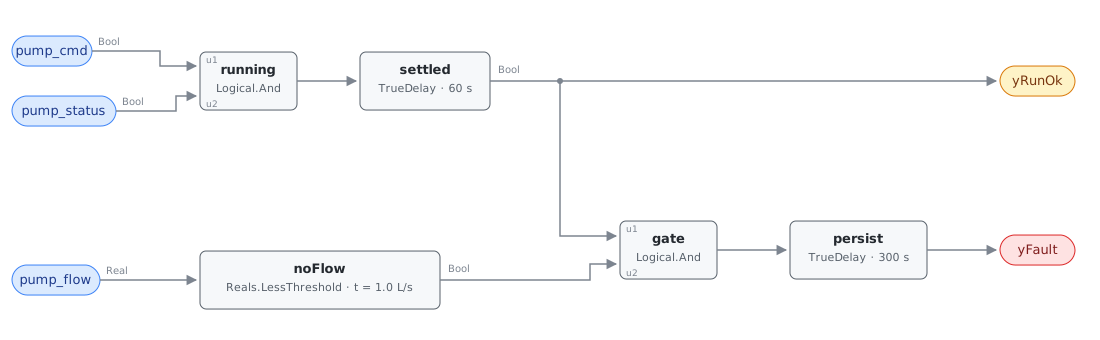
running forms the reference’s first two conjuncts and settled holds them for
flow_check_delay before the rest of the rule believes anything. That placement
is the one structural decision in this card: a start is exactly when a healthy
pump reads zero flow — the check valve has not lifted, the volute is still
filling — so delaying the run condition rather than the fault condition means
the rule has no verdict at all for the first minute of every run, and yRunOk
tells the host so.
The consequence is that the two delays are not interchangeable with one longer
delay, which is where this card differs from VFD-0001’s superficially similar
chain. A pump that starts dry alarms at 360 s, the two delays adding; a pump
that has been running for hours and loses its flow alarms at 300 s, because the
run condition settled long ago and only persist is left to run.
yRunOk is also the rule’s whole answer to the reference’s NO_EVAL row. Four
states hold it down and none of them is a healthy pump: the pump is off, it is
commanded on and not running, it is running while commanded off, or it started
less than a minute ago. noFlow is a strict Reals.LessThreshold, so flow
sitting exactly on the threshold is not no-flow.
Possible Diagnoses
Transcribed from the reference’s PMP-0001 card:
- Pump impeller failure — eroded, corroded, or spun loose on the shaft; the pump turns, the head collapses, and the loop gets nothing
- Isolation valve closed — the cheapest cause and the most common one, and what the playbook’s first on-site step (2.3) goes looking for
- Air lock in the pump — a bubble the pump cannot push through, often self-clearing and then recurring
- Broken coupling between motor and pump — near no-load motor current with a stationary pump shaft, free to confirm with a clamp meter
- Flow meter failure — the pump is fine and the measurement is wrong; this rule cannot tell that from any of the four above, and it is the first to rule out because it is the only one that costs nothing to check
The discriminator for 1 against 2 and 4 is the pump differential pressure, which this rule does not read and PMP-0002 does: high DP with no flow is a deadhead, low DP with no flow is a pump that has stopped making head.
Energy Impact
PROTECTIVE, MEDIUM confidence, DIRECT_MEASUREMENT. The savings line is the whole
pump — 100% of its energy while the condition lasts, because none of it is doing
work — and climate sensitivity is neutral. DIRECT_MEASUREMENT is the reference’s
rating, defensible with one caveat: the measurement it refers to is the pump’s
own power, which this rule does not read, so waste_kw = pump_rated_kw × (pump_speed/100)³ is only as good as the nameplate and speed feedback behind
it. The larger cost is usually not energy at all — a pump running dry runs its
mechanical seal without the water that lubricates and cools it, and that damage
is measured in thousands rather than kilowatt-hours.
Emissions Impact
Scope 2, DIRECT_EMISSIONS, MEDIUM confidence; the reference’s typical range is 100–500 kg CO₂e/yr for pump energy doing no useful work, on a marginal operating emissions rate (MOER) basis. Pumps are electric everywhere, so the scope assignment is not site-dependent the way a heating fault’s is. The avoided motor and seal damage is real and deliberately not in the range — the reference counts it as protective value rather than as CO₂e, and so does this card.
Deviations
no_flow_thresholdships an absolute placeholder, not the reference’s percentage. The reference gives 5% of design flow; the rule carries L/s because CDL parameters carry units and this library does no unit conversion in v1. The shipped 1.0 L/s is 5% of a 20 L/s design flow and is arbitrary on any other loop — 25% of design on a 4 L/s zone pump (alarms at normal part load), 1% on a 100 L/s primary (detects almost nothing). Hosts MUST set it per loop, aspump_flow’s dictionary notes require. Precedent: VAV-0001’sventilation_requirement.- A variable-speed pump at genuine low load can sit under 5% of design flow with nothing broken, because the threshold is a fraction of design flow, not of current demand. The reference’s stance — a pump making no useful work is a finding regardless of why — is right for a protective rule, but the action differs: that case is a missing minimum-flow bypass or a deadhead, PMP-0002’s territory. Sites seeing this rule fire at low load should read PMP-0002 first.
flow_check_delaygates the run condition, not the fault condition, which is what the reference’s own description (“wait after pump start”) asks for. Applying it to the conjunction instead — VFD-0001’s and AHU-0027’s shape — would give the same 360 s alarm on a dry start and a 60 s slower alarm on every mid-run flow loss, for no stated reason. This chain is therefore not a repackaged single delay, and collapsing the two tunables would change behaviour.- The command/status mismatch is NO_EVAL here and is nobody’s fault rule
today. A pump commanded on that never proves running, and a pump running
against a command of off, are both real and both silent in this library:
yRunOkgoes false and this rule stands down. The check that would cover them is a status-versus-command comparison the library has for fans only in the after-hours sense (AHU-0018, RTU-0006). The reference’s vector table has the same hole — it publishes OFF/OFF as NO_EVAL and states no verdict for the mismatch rows — so this decision is the card’s, not a transcription. - The flow meter is uncorroborated and the rule reports its failure as a pump
fault. Diagnosis 5 is in the reference’s list and nothing in three points
separates it from the other four. The nearest cross-check is
pump_dp, which this rule does not bind: a failed meter leaves DP at its normal operating point, an impeller failure collapses it, a deadhead raises it. That is a host-side read of a dictionary point, and the reason to run PMP-0002 on the same pump. yRunOkis the library’s, not the reference’s. The reference writes the command and status tests as conjuncts of the fault condition and the graph computes exactly that; exposing the settled conjunction adds no logic and changes no verdict. It is a computed signal — the AND of two booleans held for a delay — which is what SCHEMA.md asks an evaluability output to be.- Strict
<at the flow threshold. The reference writes<too, and CDLRealshas noLessEqualin any case, so flow of exactly 1.0 L/s reads as flow. The disagreement is measure-zero and errs toward silence; all three sides are pinned. A site whose BAS quantizes flow coarsely, or clamps small readings to zero as many meters do, should retune rather than rely on the signal landing off the boundary. suppressed_by: [PMP-0002]is an authored relationship, not the reference’s — neither card declares suppression. Both rules fire on one physical event (every valve on the loop closed against a running pump), and PMP-0002 is the specific diagnosis where this is the general condition. Worse than redundant, this card’s diagnosis list is actively misleading on a deadhead: impeller failure, air lock and a broken coupling all produce low pump DP. Precedent for authoring the edge: the VFD-0001/VFD-0002 pair.- The two rules do not alarm at the same moment. On a mid-run valve closure
both land 300 s after the event; on a pump started into a closed system this
rule waits out
flow_check_delayand lands at 360 s while PMP-0002 lands at 300 s. A host implementing the suppression as “drop PMP-0001 if PMP-0002 is active” is right in both cases; “drop it only if PMP-0002 alarmed first” is right in one. - The energy formula’s inputs are not this rule’s inputs.
waste_kw = pump_rated_kw × (pump_speed/100)³needs nameplate power and drive speed, and the pump dictionary carries neither. The host supplies them — speed is the VFD family’svfd_speedwhere a drive exists, and the term is 1 where one does not. Transcribed unchanged otherwise. - Persistence stands in for averaging. The rule consumes instantaneous
points; the reference specifies no averaging and G36’s AHU set would have used
a 5-minute rolling mean. The two are not equivalent — flow alternating between
zero and normal every four minutes never accumulates
alarm_delay, though a pump catching and losing its prime all day is a genuine finding. A steady failure reads the same either way. AlarmDelayis renamedalarm_delay. The reference’s tunables table spells this one parameter in G36’s PascalCase while spelling its two neighbours in snake_case. The value is unchanged at 5 min and the CXF path (persist.delayTime) is the one every other card exposes for the quantity.- The chapter number is uncertain. The reference’s page headers label Energy
Recovery, Pumps and Variable Frequency Drives all as “Ch. 15”, which cannot be
right for all three.
sourcefollows the VFD cards’ §15 and names the chapter title and page range so the citation resolves regardless. g36is null although the reference cites G36. Its source line reads “G36 alarm patterns; engineering best practice” — a family of patterns, not a clause — so there is nothing to put in the field and the claim is carried insourceas prose. Contrast FCU-0005, where the reference names §5.22.6.settled.delayOnInitandpersist.delayOnInitare bothtrue(CDL default isfalse), the library’s standing choice: a pump already running dry at controller restart waits out the full 360 s, and its flow reading is treated as untrustworthy for the first minute exactly as after a real start.- Three of the reference’s test vectors are published and reproduced under their
own names — normal operation, no flow while running, and pump off; the
remaining eleven scenarios in
vectors.jsonare library-authored. clustersis empty:clusters/clusters.jsondefines no cluster containing a pump rule, and this card does not edit the cluster set.
Notes
Read yRunOk before reading yFault. On a lead/lag pair the standby pump’s
yRunOk is false for weeks at a time, and every yFault = false under it means
“not evaluated”, not “no problem”. The
vfd-pump-faults playbook owns the
service procedure — its step 2 takes this fault and PMP-0002 together in the
order that costs least: DP setpoint and reset sequence remotely, then closed
isolation valves and a blocked strainer on site, then the impeller. Step 2.6 is
worth reading before deploying on a variable-primary chilled water plant, where
a missing minimum-flow bypass deadheads the lead pump whenever the last AHU
valve closes and presents as a fleet of these alarms. That playbook’s header and
the chapter README both still list the pump family as future work; both belong
to other owners to correct.
Test Vectors
14 scenarios, clock step 60 s over 1800 s.
| Scenario | Description |
|---|---|
normal_operation | The reference’s published vector 1: pump commanded on, proven running, 3.2 L/s of flow. Well above the 1.0 L/s no-flow line, so the rule is live and silent. yRunOk is false only on the init tick, while the 60 s flow_check_delay rides out the start transient. |
no_flow_pump_running | The reference’s published vector 2: commanded on, proven running, zero flow. The run condition settles at exactly 60 s and the alarm lands at exactly 360 s — flow_check_delay plus alarm_delay, the two delays adding exactly. |
pump_off | The reference’s published vector 3: pump off, no flow, expected NO_EVAL. yRunOk is false for the whole run, which is how the host distinguishes this from a healthy pump — an idle pump makes no flow and that means nothing. |
flow_exactly_at_threshold | Boundary: flow sits exactly on no_flow_threshold (1.0 L/s). CDL Reals has no LessEqual, so the comparison is strict and exactly 1.0 is not ‘no flow’. |
flow_just_below_threshold | Boundary from below: 0.9 L/s clears the strict comparison and alarms on the same 360 s schedule as zero flow. |
flow_just_above_threshold | Boundary from above: 1.1 L/s is flow, however little, and never alarms. |
commanded_on_but_not_running | Commanded on with status false and zero flow. This is a real failure — a pump that will not start — and it is not this one: yRunOk is false, so the verdict is NO_EVAL rather than ‘no flow detected’. No library rule covers it today (see Deviations). |
running_while_commanded_off | The other mismatch: status true against a command of off, zero flow. A welded contactor or a hand-off-auto switch left in hand. Also NO_EVAL here — the reference’s equation requires both conjuncts and this rule reports on neither mismatch. |
flow_in_the_deadhead_band | 1.5 L/s: above this rule’s 5%-of-design no-flow line and below PMP-0002’s 10%-of-design deadhead line. Silent here by design; PMP-0002 is the rule that reports this band when the pump DP is also high. |
flow_lost_mid_run | A pump running normally loses its flow at t=600 s. The run condition settled long ago, so only alarm_delay is left to run and the alarm lands at exactly 900 s. This is the vector that pins the structure: with flow_check_delay applied to the whole conjunction instead of to the run condition, the alarm would come at 960 s and this window would fail. |
intermittent_flow_never_alarms | Flow alternating between zero and 3.2 L/s every 240 s — an air-locked pump that keeps catching prime, or a flow meter dropping out. No single no-flow episode reaches alarm_delay, so nothing ever fires. Persistence is not averaging: a pump delivering flow half the time is a real finding this rule cannot make. |
flow_returns_after_alarm | Recovery: the alarm asserts at 360 s and the pump picks up flow at t=900 s. TrueDelay passes the falling edge with no delay, so yFault drops on that tick and the accumulated time is discarded. |
status_drops_after_alarm | The evaluability release: an alarming pump loses its run status at t=900 s. yFault and yRunOk go false on the same tick and only the pair tells the host that the pump stopped rather than started delivering — the analogue of VFD-0001’s command_drops_below_floor_after_alarm. |
pump_starts_dry_mid_run | The pump starts at t=600 s into a system that never produces flow. yRunOk asserts at exactly 660 s (60 s after the rising edge) and yFault at exactly 960 s — mid-run edges carry the same exact arithmetic as the init case. |
vectors.json
{
  "schema": "cxf-library/vectors/v1",
  "clock": {
    "step_s": 60,
    "horizon_s": 1800
  },
  "scenarios": [
    {
      "name": "normal_operation",
      "description": "The reference's published vector 1: pump commanded on, proven running, 3.2 L/s of flow. Well above the 1.0 L/s no-flow line, so the rule is live and silent. yRunOk is false only on the init tick, while the 60 s flow_check_delay rides out the start transient.",
      "inputs": {
        "pump_cmd": true,
        "pump_status": true,
        "pump_flow": 3.2
      },
      "expect": [
        {
          "output": "yFault",
          "from_s": 0,
          "to_s": 1800,
          "equals": false
        },
        {
          "output": "yRunOk",
          "from_s": 0,
          "to_s": 0,
          "equals": false
        },
        {
          "output": "yRunOk",
          "from_s": 60,
          "to_s": 1800,
          "equals": true
        }
      ]
    },
    {
      "name": "no_flow_pump_running",
      "description": "The reference's published vector 2: commanded on, proven running, zero flow. The run condition settles at exactly 60 s and the alarm lands at exactly 360 s \u2014 flow_check_delay plus alarm_delay, the two delays adding exactly.",
      "inputs": {
        "pump_cmd": true,
        "pump_status": true,
        "pump_flow": 0.0
      },
      "expect": [
        {
          "output": "yFault",
          "from_s": 0,
          "to_s": 300,
          "equals": false
        },
        {
          "output": "yFault",
          "from_s": 360,
          "to_s": 1800,
          "equals": true
        },
        {
          "output": "yRunOk",
          "from_s": 0,
          "to_s": 0,
          "equals": false
        },
        {
          "output": "yRunOk",
          "from_s": 60,
          "to_s": 1800,
          "equals": true
        }
      ]
    },
    {
      "name": "pump_off",
      "description": "The reference's published vector 3: pump off, no flow, expected NO_EVAL. yRunOk is false for the whole run, which is how the host distinguishes this from a healthy pump \u2014 an idle pump makes no flow and that means nothing.",
      "inputs": {
        "pump_cmd": false,
        "pump_status": false,
        "pump_flow": 0.0
      },
      "expect": [
        {
          "output": "yFault",
          "from_s": 0,
          "to_s": 1800,
          "equals": false
        },
        {
          "output": "yRunOk",
          "from_s": 0,
          "to_s": 1800,
          "equals": false
        }
      ]
    },
    {
      "name": "flow_exactly_at_threshold",
      "description": "Boundary: flow sits exactly on no_flow_threshold (1.0 L/s). CDL Reals has no LessEqual, so the comparison is strict and exactly 1.0 is not 'no flow'.",
      "inputs": {
        "pump_cmd": true,
        "pump_status": true,
        "pump_flow": 1.0
      },
      "expect": [
        {
          "output": "yFault",
          "from_s": 0,
          "to_s": 1800,
          "equals": false
        },
        {
          "output": "yRunOk",
          "from_s": 60,
          "to_s": 1800,
          "equals": true
        }
      ]
    },
    {
      "name": "flow_just_below_threshold",
      "description": "Boundary from below: 0.9 L/s clears the strict comparison and alarms on the same 360 s schedule as zero flow.",
      "inputs": {
        "pump_cmd": true,
        "pump_status": true,
        "pump_flow": 0.9
      },
      "expect": [
        {
          "output": "yFault",
          "from_s": 0,
          "to_s": 300,
          "equals": false
        },
        {
          "output": "yFault",
          "from_s": 360,
          "to_s": 1800,
          "equals": true
        },
        {
          "output": "yRunOk",
          "from_s": 60,
          "to_s": 1800,
          "equals": true
        }
      ]
    },
    {
      "name": "flow_just_above_threshold",
      "description": "Boundary from above: 1.1 L/s is flow, however little, and never alarms.",
      "inputs": {
        "pump_cmd": true,
        "pump_status": true,
        "pump_flow": 1.1
      },
      "expect": [
        {
          "output": "yFault",
          "from_s": 0,
          "to_s": 1800,
          "equals": false
        },
        {
          "output": "yRunOk",
          "from_s": 60,
          "to_s": 1800,
          "equals": true
        }
      ]
    },
    {
      "name": "commanded_on_but_not_running",
      "description": "Commanded on with status false and zero flow. This is a real failure \u2014 a pump that will not start \u2014 and it is not this one: yRunOk is false, so the verdict is NO_EVAL rather than 'no flow detected'. No library rule covers it today (see Deviations).",
      "inputs": {
        "pump_cmd": true,
        "pump_status": false,
        "pump_flow": 0.0
      },
      "expect": [
        {
          "output": "yFault",
          "from_s": 0,
          "to_s": 1800,
          "equals": false
        },
        {
          "output": "yRunOk",
          "from_s": 0,
          "to_s": 1800,
          "equals": false
        }
      ]
    },
    {
      "name": "running_while_commanded_off",
      "description": "The other mismatch: status true against a command of off, zero flow. A welded contactor or a hand-off-auto switch left in hand. Also NO_EVAL here \u2014 the reference's equation requires both conjuncts and this rule reports on neither mismatch.",
      "inputs": {
        "pump_cmd": false,
        "pump_status": true,
        "pump_flow": 0.0
      },
      "expect": [
        {
          "output": "yFault",
          "from_s": 0,
          "to_s": 1800,
          "equals": false
        },
        {
          "output": "yRunOk",
          "from_s": 0,
          "to_s": 1800,
          "equals": false
        }
      ]
    },
    {
      "name": "flow_in_the_deadhead_band",
      "description": "1.5 L/s: above this rule's 5%-of-design no-flow line and below PMP-0002's 10%-of-design deadhead line. Silent here by design; PMP-0002 is the rule that reports this band when the pump DP is also high.",
      "inputs": {
        "pump_cmd": true,
        "pump_status": true,
        "pump_flow": 1.5
      },
      "expect": [
        {
          "output": "yFault",
          "from_s": 0,
          "to_s": 1800,
          "equals": false
        },
        {
          "output": "yRunOk",
          "from_s": 60,
          "to_s": 1800,
          "equals": true
        }
      ]
    },
    {
      "name": "flow_lost_mid_run",
      "description": "A pump running normally loses its flow at t=600 s. The run condition settled long ago, so only alarm_delay is left to run and the alarm lands at exactly 900 s. This is the vector that pins the structure: with flow_check_delay applied to the whole conjunction instead of to the run condition, the alarm would come at 960 s and this window would fail.",
      "inputs": {
        "pump_cmd": true,
        "pump_status": true,
        "pump_flow": [
          {
            "t": 0,
            "value": 3.2
          },
          {
            "t": 600,
            "value": 0.0
          }
        ]
      },
      "expect": [
        {
          "output": "yFault",
          "from_s": 0,
          "to_s": 840,
          "equals": false
        },
        {
          "output": "yFault",
          "from_s": 900,
          "to_s": 1800,
          "equals": true
        },
        {
          "output": "yRunOk",
          "from_s": 60,
          "to_s": 1800,
          "equals": true
        }
      ]
    },
    {
      "name": "intermittent_flow_never_alarms",
      "description": "Flow alternating between zero and 3.2 L/s every 240 s \u2014 an air-locked pump that keeps catching prime, or a flow meter dropping out. No single no-flow episode reaches alarm_delay, so nothing ever fires. Persistence is not averaging: a pump delivering flow half the time is a real finding this rule cannot make.",
      "inputs": {
        "pump_cmd": true,
        "pump_status": true,
        "pump_flow": [
          {
            "t": 0,
            "value": 0.0
          },
          {
            "t": 240,
            "value": 3.2
          },
          {
            "t": 480,
            "value": 0.0
          },
          {
            "t": 720,
            "value": 3.2
          },
          {
            "t": 960,
            "value": 0.0
          },
          {
            "t": 1200,
            "value": 3.2
          },
          {
            "t": 1440,
            "value": 0.0
          },
          {
            "t": 1680,
            "value": 3.2
          }
        ]
      },
      "expect": [
        {
          "output": "yFault",
          "from_s": 0,
          "to_s": 1800,
          "equals": false
        },
        {
          "output": "yRunOk",
          "from_s": 60,
          "to_s": 1800,
          "equals": true
        }
      ]
    },
    {
      "name": "flow_returns_after_alarm",
      "description": "Recovery: the alarm asserts at 360 s and the pump picks up flow at t=900 s. TrueDelay passes the falling edge with no delay, so yFault drops on that tick and the accumulated time is discarded.",
      "inputs": {
        "pump_cmd": true,
        "pump_status": true,
        "pump_flow": [
          {
            "t": 0,
            "value": 0.0
          },
          {
            "t": 900,
            "value": 3.2
          }
        ]
      },
      "expect": [
        {
          "output": "yFault",
          "from_s": 0,
          "to_s": 300,
          "equals": false
        },
        {
          "output": "yFault",
          "from_s": 360,
          "to_s": 840,
          "equals": true
        },
        {
          "output": "yFault",
          "from_s": 900,
          "to_s": 1800,
          "equals": false
        },
        {
          "output": "yRunOk",
          "from_s": 60,
          "to_s": 1800,
          "equals": true
        }
      ]
    },
    {
      "name": "status_drops_after_alarm",
      "description": "The evaluability release: an alarming pump loses its run status at t=900 s. yFault and yRunOk go false on the same tick and only the pair tells the host that the pump stopped rather than started delivering \u2014 the analogue of VFD-0001's command_drops_below_floor_after_alarm.",
      "inputs": {
        "pump_cmd": true,
        "pump_status": [
          {
            "t": 0,
            "value": true
          },
          {
            "t": 900,
            "value": false
          }
        ],
        "pump_flow": 0.0
      },
      "expect": [
        {
          "output": "yFault",
          "from_s": 0,
          "to_s": 300,
          "equals": false
        },
        {
          "output": "yFault",
          "from_s": 360,
          "to_s": 840,
          "equals": true
        },
        {
          "output": "yFault",
          "from_s": 900,
          "to_s": 1800,
          "equals": false
        },
        {
          "output": "yRunOk",
          "from_s": 60,
          "to_s": 840,
          "equals": true
        },
        {
          "output": "yRunOk",
          "from_s": 900,
          "to_s": 1800,
          "equals": false
        }
      ]
    },
    {
      "name": "pump_starts_dry_mid_run",
      "description": "The pump starts at t=600 s into a system that never produces flow. yRunOk asserts at exactly 660 s (60 s after the rising edge) and yFault at exactly 960 s \u2014 mid-run edges carry the same exact arithmetic as the init case.",
      "inputs": {
        "pump_cmd": [
          {
            "t": 0,
            "value": false
          },
          {
            "t": 600,
            "value": true
          }
        ],
        "pump_status": [
          {
            "t": 0,
            "value": false
          },
          {
            "t": 600,
            "value": true
          }
        ],
        "pump_flow": 0.0
      },
      "expect": [
        {
          "output": "yFault",
          "from_s": 0,
          "to_s": 900,
          "equals": false
        },
        {
          "output": "yFault",
          "from_s": 960,
          "to_s": 1800,
          "equals": true
        },
        {
          "output": "yRunOk",
          "from_s": 0,
          "to_s": 600,
          "equals": false
        },
        {
          "output": "yRunOk",
          "from_s": 660,
          "to_s": 1800,
          "equals": true
        }
      ]
    }
  ]
}