ERV-0001 — Sensible effectiveness degradation
| Status | verified — engine e2ff2f8, cxf:fnv1a128:968e1ca7cc234dd1107a381f01adb7b2, 2026-08-17 |
| Severity | 3 |
| Method | statistical |
| Phase | 2 |
| Category | EFFICIENCY_LOSS |
| Confidence | MEDIUM |
| Estimation | BASELINE_COMPARISON |
| G36 | — |
| Clusters | — |
| Suppresses | — |
| Suppressed by | — |
| Related | ERV-0002 |
| Playbooks | erv-effectiveness |
| Source | HVAC FDD Reference v1.0 §15, ERV-0001; Nehasil et al. 2021; Mattera et al. 2020; PNNL EEM-37 (optimized heat recovery wheel) |
| Operating states | ERV enabled with both supply and exhaust fans running |
Preconditions (host-enforced): Both fans must be running. The graph consumes erv_enabled and holds the alarm down while it is false, but an enable command is not proof that air is moving: a unit enabled with a failed exhaust fan reads as low effectiveness, correctly in arithmetic and wrongly in diagnosis, and the ERV dictionary carries no fan-status point to separate the two. The host must also not evaluate during frost protection — a unit in preheat, wheel-speed reduction, or bypass is recovering less on purpose, and erv_frost_prot (ERV-0002’s point) is the flag to gate on. All three temperature sensors must be trustworthy and correctly positioned: entering upstream of the recovery device, leaving downstream of it and upstream of any coil, exhaust on the building side. A leaving-air sensor mounted after the preheat coil measures the coil, not the wheel. Temperature-difference evaluability is signalled in-rule by yTempDeltaOk; when it is false the verdict is NO_EVAL, not healthy.
Points: erv_oa_entering_temp, erv_oa_leaving_temp, erv_exhaust_temp, erv_enabled
Outputs:
yFault— True while the measured sensible effectiveness has stayed more than effectiveness_threshold below baseline_effectiveness for at least alarm_delay, with the ERV enabled and the temperature difference large enough to evaluateyTempDeltaOk— Evaluability signal — true when |erv_exhaust_temp − erv_oa_entering_temp| exceeds min_delta_for_eval; false means NO_EVAL and the host must ignore yFault
Parameters:
| Name | Default | Unit | CXF path | Description |
|---|---|---|---|---|
baseline_effectiveness | 0.75 | 1 | base.k | Design sensible effectiveness of the recovery device (0–1). Per-unit configuration — the shipped 0.75 is the reference’s population default, not this unit’s rating (see Deviations) |
effectiveness_threshold | 0.15 | 1 | shortHigh.t | Shortfall below baseline that counts as degradation (0.15 = 15 effectiveness points) |
min_delta_for_eval | 5.0 | °C | deltaOk.t | Minimum |
alarm_delay | 1800.0 | s | persist.delayTime | Continuous degradation required before the alarm asserts (30 min) |
Description
An energy recovery device is a heat exchanger between two air streams, and its whole value is the fraction of the available temperature difference it manages to move. That fraction is measurable from three temperatures: how far the incoming outdoor air was dragged toward the exhaust temperature, over how far it could have been dragged. A wheel that has stopped turning, a plate core packed with dust, a bypass damper stuck open, a run-around loop that lost its pump — all read the same way, and none of them shows anywhere else. Ventilation is still delivered and the extra load lands on the downstream coils looking like ordinary weather. Nehasil et al. (2021) report a 90% detection rate for this diagnostic; the reference cites Mattera et al. (2020) alongside it.
Detection Logic
effectiveness = (erv_oa_leaving_temp − erv_oa_entering_temp)
                / (erv_exhaust_temp − erv_oa_entering_temp)
shortfall     = baseline_effectiveness − effectiveness

yTempDeltaOk  = |erv_exhaust_temp − erv_oa_entering_temp| > min_delta_for_eval
                                                    (false ⇒ host reports NO_EVAL)
yFault        = shortfall > effectiveness_threshold AND yTempDeltaOk AND erv_enabled,
                sustained for alarm_delay
Block graph (rule.cxf.jsonld):
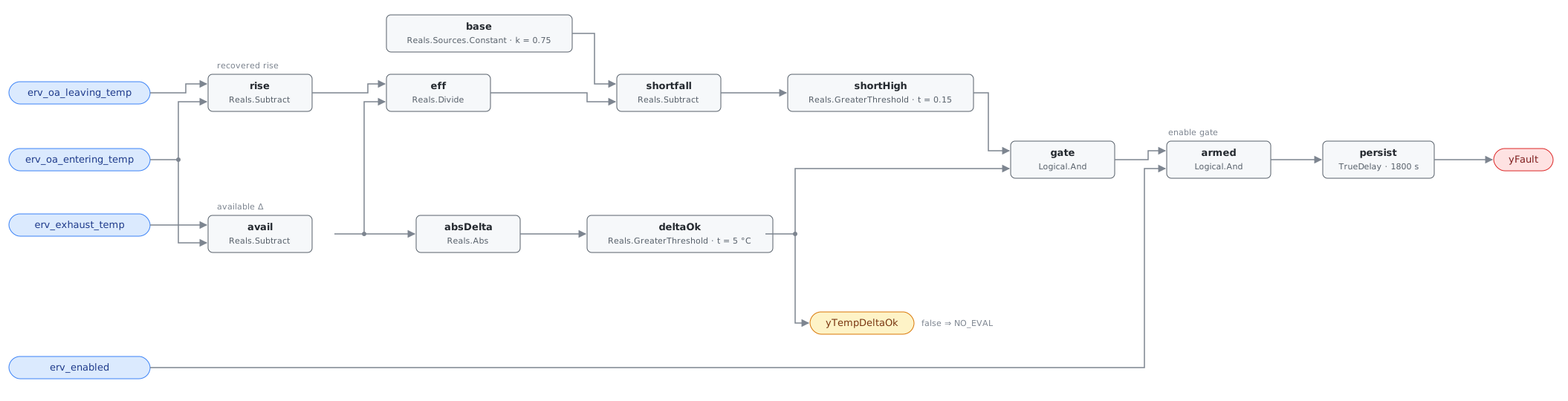
rise is the temperature the device actually delivered, avail the temperature
it had to work with, and eff divides them. base carries the design
effectiveness as a constant so shortfall can subtract the measured value from
it and shortHigh can test the remainder against one positive threshold — the
AHU-0021 arrangement. The ratio needs no seasonal branch: in summer both
numerator and denominator go negative and the quotient reads as it does in
winter.
avail fans out into absDelta and deltaOk, which does two jobs — the
reference’s min_delta_for_eval precondition, exposed as the boundary output
yTempDeltaOk because it is computable from this rule’s own inputs, and the
guard on the division. CDL Divide follows IEEE-754, so an exhaust temperature
equal to the entering temperature yields ±∞ or NaN rather than an error, and a
near-zero denominator turns a tenth of a degree of sensor noise into an
effectiveness of any magnitude. Because deltaOk also drives gate, arithmetic
garbage can make this rule unevaluable; it cannot make it fire.
armed adds the enable state, so a unit that is switched off is not accused of
recovering nothing. Both comparisons are strict — the temperature-difference
boundary is exact, the effectiveness boundary is not representable at all (see
Deviations) — and persist requires 30 continuous minutes, long enough to ride
out a brief frost-control excursion.
Possible Diagnoses
- Energy recovery wheel fouled or contaminated — dust bridging the media, the most common cause and the cheapest to correct ($200–$1,000 for cleaning)
- Energy recovery wheel motor stopped — a failed drive motor or broken belt leaves the wheel stationary and produces the most extreme readings this rule sees
- Bypass damper stuck open, routing air around the core entirely
- Plate heat exchanger fouled — same failure, no moving parts to check
- Run-around coil pump failure or glycol degradation, on the loop-type installations where the two air streams never meet
Energy Impact
EFFICIENCY_LOSS, MEDIUM confidence, BASELINE_COMPARISON. The reference gives
10–30% of recovery energy lost and the estimator lost_kw = (baseline_eff − actual_eff) × airflow × cp × |exhaust − entering|, whose first factor is the
shortfall this rule already computes; airflow and cp are not rule inputs, so
the conversion to kilowatts is the host’s. PNNL EEM-37 (optimized heat recovery
wheel) is the related measure. A wheel at half its rated effectiveness is not
saving half as much energy — it is handing the coils half of the ventilation
load it was bought to eliminate. Both climates, and worth most where the
outdoor-to-exhaust difference is largest, which is when the rule is most
evaluable.
Emissions Impact
Scope 1 + 2, PROXY_EMISSIONS, MEDIUM confidence; typically 400–3,000 kg CO₂e/yr for lost recovery. The split follows the season and the plant: the unrecovered winter load usually burns scope 1 fuel at a heating coil, the summer load draws scope 2 electricity at a chiller, and an all-electric building puts both in scope 2. Avoided-emissions basis: marginal operating emissions rate (MOER).
Deviations
min_delta_for_evalis 5.0 °C, and the reference disagrees with itself about that number. The chapter’s tunables table gives 5 °C; theerv-effectivenessplaybook gives the same gate as |OAT − RAT| > 10 °F (5.56 °C), a Fahrenheit rule of thumb the reference never reconciles with its metric restatement. This card adopts the tunables value, the library’s standing precedent when a chapter card and its playbook disagree numerically (RTU-0002 does the same). The cost is a narrow 5.0–5.56 °C band where this rule evaluates and the playbook would not; hosts preferring the playbook setdeltaOk.t = 5.56. The playbook’s |OAT − RAT| is this rule’s |exhaust − entering| — exhaust air entering the ERV is return air measured at the device.- The evaluability gate is also the divide guard, deliberately. SCHEMA.md
requires exposing an in-rule evaluability test as a boolean output, which is
yTempDeltaOk; wiring the same signal intogateis the second, independent reason it exists. NaN compares false everywhere and can never raise the alarm, but +∞ can and does, so a host that readyTempDeltaOkas advisory and ignored the gate would be relying on arithmetic with no defined answer. - The effectiveness boundary is not representable, and the nominal case lands
on the fault side. With the shipped 0.75 and 0.15 as IEEE-754 doubles, no
measured effectiveness makes the shortfall exactly equal the threshold: near
0.6 the subtraction
0.75 − effis exact (Sterbenz), so equality would require0.75 − 0.15to be a double, and it is not. An effectiveness of exactly 60.0% computes 0.15000000000000002, one ulp above the threshold, so the strict>fires where paper arithmetic says it should not. Both sides of the machine crossing are pinned. Invisible in practice — sensors resolve 0.1 °C at best — but “exactly 15 points below baseline is safe” is wrong by one ulp, toward alarming. erv_enabledis in the block graph, not only the frontmatter. Operating states are normally host-side here, but the enable half is a dictionary point ERV-0002 already consumes and the failure mode is nightly: a disabled unit recovers nothing by construction, so an ungated rule alarms every unoccupied period on every healthy ERV. Precedent: RTU-0006 consumessf_statusandocc_schedule. The fans-running half stays a host precondition — the dictionary has no ERV fan-status point.baseline_effectivenessships the reference’s default, which is a population value. 75% is reasonable for a well-specified wheel and it is what the reference publishes, so it carries more authority than a placeholder — but it is not this unit’s rating. Devices in service run 50–80%, and the interaction with the threshold is unforgiving at the low end: a unit rated 60% operating exactly at its rating alarms. Setbase.kto the certified sensible effectiveness at design airflow, or to the commissioning measurement.- The comparison is written
baseline − measured > threshold, notmeasured < (baseline − threshold). Algebraically identical to the reference’s form; implemented this way so both tunables stay independent single-value parameters and the threshold stays positive, clear of the library’s prohibition on negative parameters. method: statisticaldescribes where the baseline comes from, not what the graph does. Two subtractions, a division, a comparison — nothing statistical happens on a tick. The classification is the reference’s and it is fair: the baseline is a design or commissioning figure, and the detection literature behind the card (Nehasil et al. 2021, Mattera et al. 2020) is statistical. Same stance as RTU-0002.- Latent recovery is out of scope. The reference specifies sensible effectiveness and this rule computes only that, so an enthalpy wheel whose desiccant coating has failed while sensible transfer is intact passes. Humidity points are not in the ERV dictionary; the gap is recorded, not papered over.
- Frost protection is not excluded in-graph. A unit in its frost sequence is
recovering less on purpose. The 30-minute
alarm_delayrides out short excursions, but a long cold snap with frost control active for hours will alarm; hosts with sustained frost operation should gate onerv_frost_prot, which exists in the dictionary for ERV-0002. Not added as a fourth input because the reference does not list it for this fault. - Strict
>on both comparisons, as CDL requires — there is noGreaterEqualin Reals. The temperature-difference boundary is exactly representable and pinned from both sides: 5.0 °C is not evaluable, 5.1 °C is. persist.delayOnInit = true(CDL default isfalse), the library’s standing choice: a wheel already degraded when the controller starts waits out the full 30 minutes rather than alarming on the first tick.- All three of the reference’s published test vectors are reproduced and their
computed effectiveness matches its stated values to the digit — the cheapest
available confirmation that the ratio is wired the right way up. The remaining
scenarios in
vectors.jsonare authored.
Notes
The erv-effectiveness playbook starts with operating/frost state, proves any active recovery device, and compares the two air streams before recalculating effectiveness or cleaning the core. That order avoids condemning heat-transfer media for a stopped wheel, intentional frost sequence, bypass condition, or airflow problem. Its resolution target is effectiveness back within 15 percentage points of the commissioned value, the same absolute 0.15 shortfall this rule alarms at. A device restored just inside the alarm point has therefore met the target by exactly the margin that clears the alarm and is worth re-measuring next season.
Test Vectors
15 scenarios, clock step 60 s over 3600 s.
| Scenario | Description |
|---|---|
reference_good_effectiveness | Reference vector: entering −5 °C, leaving 15 °C, exhaust 22 °C — 74.1% sensible effectiveness against a 75% baseline. The shortfall is under one point, nowhere near the 15-point threshold. |
reference_degraded_effectiveness | Reference vector: the same air with the leaving temperature at 0 °C — 18.5% effectiveness, a 56-point shortfall. The wheel is barely recovering anything and the alarm lands one alarm_delay in. |
reference_insufficient_delta | Reference vector (NO_EVAL): entering 20 °C, leaving 21 °C, exhaust 22 °C. Only 2 °C is available to recover, so the ratio reads 50% off a denominator dominated by sensor error. yTempDeltaOk is false and the host must report NO_EVAL rather than reading yFault as healthy. |
delta_exactly_at_eval_threshold | Boundary: exhaust − entering is exactly min_delta_for_eval (25.0 − 20.0 = 5.0 °C) with a 35-point shortfall behind it. The comparison is strict, so the rule reports itself unevaluable rather than alarming. |
delta_just_above_eval_threshold | Boundary from the other side: exhaust 25.1 °C makes the available difference 5.1 °C, the rule becomes evaluable, and the same 36-point shortfall now alarms. |
shortfall_just_under_threshold | Threshold boundary, readable side: entering 0 °C, leaving 12.1 °C, exhaust 20 °C — 60.5% effectiveness, a 14.5-point shortfall, below the 15-point threshold. |
shortfall_just_over_threshold | The other readable side: leaving 11.9 °C gives 59.5% effectiveness, a 15.5-point shortfall, and the alarm lands after alarm_delay. |
shortfall_at_nominal_boundary_alarms | The nominal boundary: leaving 12.0 °C gives effectiveness 0.6 exactly, so in decimal arithmetic the shortfall is exactly 0.15 and the strict > would read healthy. In IEEE-754 doubles 0.75 − 0.6 evaluates to 0.15000000000000002, one ulp above the threshold, so the rule alarms. See Deviations — the exact boundary is unrepresentable and this is which side the machine lands on. |
shortfall_one_ulp_under_threshold | The machine boundary from the other side: leaving 12.000000000000002 °C is one ulp above 12, effectiveness comes out 0.6000000000000001, and the shortfall is 0.1499999999999999 — just under the threshold, so the rule is silent. This scenario and the one above are the two adjacent doubles that straddle the comparison. |
zero_delta_divide_guard | Divide guard: exhaust equals entering (both 20 °C) so the denominator is exactly zero, and with leaving below entering the quotient is −∞ and the shortfall +∞ — an ungated rule would alarm on garbage arithmetic. yTempDeltaOk is false and holds yFault down. |
summer_reverse_delta_degraded | Sign case: in summer the exhaust is the cold stream (entering 32 °C, exhaust 24 °C, leaving 30 °C). Both differences flip sign and the quotient still reads an effectiveness — 25%, a 50-point shortfall — so the rule alarms without a seasonal branch. |
erv_disabled_is_silent | The recovery device is off with the reference degraded temperatures on its sensors. A stationary wheel recovers nothing by design, so the shortfall means nothing and erv_enabled holds the alarm down. yTempDeltaOk stays true throughout — it reports the temperature difference only, never the enable state. |
enable_starts_the_persistence_clock | The unit is enabled at t=600 s with the degraded temperatures already present. The persistence timer starts at the enable, not at t=0, so the alarm lands one alarm_delay after the enable rather than at 1800 s. |
transient_degradation_clears_before_delay | Transient: the leaving temperature collapses from 15 °C to 0 °C at t=600 s and recovers at t=1800 s — 1200 s of degradation, short of the 1800 s alarm_delay. A wheel briefly slowed by a frost-control cycle looks exactly like this, and it raises nothing. |
alarm_clears_after_cleaning | Recovery: the degraded alarm asserts, the core is cleaned at t=2400 s and effectiveness returns to 74.1%. TrueDelay passes falling edges immediately, so yFault clears on that tick. |
vectors.json
{
  "schema": "cxf-library/vectors/v1",
  "clock": {
    "step_s": 60,
    "horizon_s": 3600
  },
  "scenarios": [
    {
      "name": "reference_good_effectiveness",
      "description": "Reference vector: entering \u22125 \u00b0C, leaving 15 \u00b0C, exhaust 22 \u00b0C \u2014 74.1% sensible effectiveness against a 75% baseline. The shortfall is under one point, nowhere near the 15-point threshold.",
      "inputs": {
        "erv_oa_entering_temp": -5.0,
        "erv_oa_leaving_temp": 15.0,
        "erv_exhaust_temp": 22.0,
        "erv_enabled": true
      },
      "expect": [
        {
          "output": "yTempDeltaOk",
          "from_s": 0,
          "to_s": 3600,
          "equals": true
        },
        {
          "output": "yFault",
          "from_s": 0,
          "to_s": 3600,
          "equals": false
        }
      ]
    },
    {
      "name": "reference_degraded_effectiveness",
      "description": "Reference vector: the same air with the leaving temperature at 0 \u00b0C \u2014 18.5% effectiveness, a 56-point shortfall. The wheel is barely recovering anything and the alarm lands one alarm_delay in.",
      "inputs": {
        "erv_oa_entering_temp": -5.0,
        "erv_oa_leaving_temp": 0.0,
        "erv_exhaust_temp": 22.0,
        "erv_enabled": true
      },
      "expect": [
        {
          "output": "yTempDeltaOk",
          "from_s": 0,
          "to_s": 3600,
          "equals": true
        },
        {
          "output": "yFault",
          "from_s": 0,
          "to_s": 1740,
          "equals": false
        },
        {
          "output": "yFault",
          "from_s": 1860,
          "to_s": 3600,
          "equals": true
        }
      ]
    },
    {
      "name": "reference_insufficient_delta",
      "description": "Reference vector (NO_EVAL): entering 20 \u00b0C, leaving 21 \u00b0C, exhaust 22 \u00b0C. Only 2 \u00b0C is available to recover, so the ratio reads 50% off a denominator dominated by sensor error. yTempDeltaOk is false and the host must report NO_EVAL rather than reading yFault as healthy.",
      "inputs": {
        "erv_oa_entering_temp": 20.0,
        "erv_oa_leaving_temp": 21.0,
        "erv_exhaust_temp": 22.0,
        "erv_enabled": true
      },
      "expect": [
        {
          "output": "yTempDeltaOk",
          "from_s": 0,
          "to_s": 3600,
          "equals": false
        },
        {
          "output": "yFault",
          "from_s": 0,
          "to_s": 3600,
          "equals": false
        }
      ]
    },
    {
      "name": "delta_exactly_at_eval_threshold",
      "description": "Boundary: exhaust \u2212 entering is exactly min_delta_for_eval (25.0 \u2212 20.0 = 5.0 \u00b0C) with a 35-point shortfall behind it. The comparison is strict, so the rule reports itself unevaluable rather than alarming.",
      "inputs": {
        "erv_oa_entering_temp": 20.0,
        "erv_oa_leaving_temp": 22.0,
        "erv_exhaust_temp": 25.0,
        "erv_enabled": true
      },
      "expect": [
        {
          "output": "yTempDeltaOk",
          "from_s": 0,
          "to_s": 3600,
          "equals": false
        },
        {
          "output": "yFault",
          "from_s": 0,
          "to_s": 3600,
          "equals": false
        }
      ]
    },
    {
      "name": "delta_just_above_eval_threshold",
      "description": "Boundary from the other side: exhaust 25.1 \u00b0C makes the available difference 5.1 \u00b0C, the rule becomes evaluable, and the same 36-point shortfall now alarms.",
      "inputs": {
        "erv_oa_entering_temp": 20.0,
        "erv_oa_leaving_temp": 22.0,
        "erv_exhaust_temp": 25.1,
        "erv_enabled": true
      },
      "expect": [
        {
          "output": "yTempDeltaOk",
          "from_s": 0,
          "to_s": 3600,
          "equals": true
        },
        {
          "output": "yFault",
          "from_s": 0,
          "to_s": 1740,
          "equals": false
        },
        {
          "output": "yFault",
          "from_s": 1860,
          "to_s": 3600,
          "equals": true
        }
      ]
    },
    {
      "name": "shortfall_just_under_threshold",
      "description": "Threshold boundary, readable side: entering 0 \u00b0C, leaving 12.1 \u00b0C, exhaust 20 \u00b0C \u2014 60.5% effectiveness, a 14.5-point shortfall, below the 15-point threshold.",
      "inputs": {
        "erv_oa_entering_temp": 0.0,
        "erv_oa_leaving_temp": 12.1,
        "erv_exhaust_temp": 20.0,
        "erv_enabled": true
      },
      "expect": [
        {
          "output": "yTempDeltaOk",
          "from_s": 0,
          "to_s": 3600,
          "equals": true
        },
        {
          "output": "yFault",
          "from_s": 0,
          "to_s": 3600,
          "equals": false
        }
      ]
    },
    {
      "name": "shortfall_just_over_threshold",
      "description": "The other readable side: leaving 11.9 \u00b0C gives 59.5% effectiveness, a 15.5-point shortfall, and the alarm lands after alarm_delay.",
      "inputs": {
        "erv_oa_entering_temp": 0.0,
        "erv_oa_leaving_temp": 11.9,
        "erv_exhaust_temp": 20.0,
        "erv_enabled": true
      },
      "expect": [
        {
          "output": "yTempDeltaOk",
          "from_s": 0,
          "to_s": 3600,
          "equals": true
        },
        {
          "output": "yFault",
          "from_s": 0,
          "to_s": 1740,
          "equals": false
        },
        {
          "output": "yFault",
          "from_s": 1860,
          "to_s": 3600,
          "equals": true
        }
      ]
    },
    {
      "name": "shortfall_at_nominal_boundary_alarms",
      "description": "The nominal boundary: leaving 12.0 \u00b0C gives effectiveness 0.6 exactly, so in decimal arithmetic the shortfall is exactly 0.15 and the strict `>` would read healthy. In IEEE-754 doubles 0.75 \u2212 0.6 evaluates to 0.15000000000000002, one ulp above the threshold, so the rule alarms. See Deviations \u2014 the exact boundary is unrepresentable and this is which side the machine lands on.",
      "inputs": {
        "erv_oa_entering_temp": 0.0,
        "erv_oa_leaving_temp": 12.0,
        "erv_exhaust_temp": 20.0,
        "erv_enabled": true
      },
      "expect": [
        {
          "output": "yFault",
          "from_s": 0,
          "to_s": 1740,
          "equals": false
        },
        {
          "output": "yFault",
          "from_s": 1860,
          "to_s": 3600,
          "equals": true
        }
      ]
    },
    {
      "name": "shortfall_one_ulp_under_threshold",
      "description": "The machine boundary from the other side: leaving 12.000000000000002 \u00b0C is one ulp above 12, effectiveness comes out 0.6000000000000001, and the shortfall is 0.1499999999999999 \u2014 just under the threshold, so the rule is silent. This scenario and the one above are the two adjacent doubles that straddle the comparison.",
      "inputs": {
        "erv_oa_entering_temp": 0.0,
        "erv_oa_leaving_temp": 12.000000000000002,
        "erv_exhaust_temp": 20.0,
        "erv_enabled": true
      },
      "expect": [
        {
          "output": "yFault",
          "from_s": 0,
          "to_s": 3600,
          "equals": false
        }
      ]
    },
    {
      "name": "zero_delta_divide_guard",
      "description": "Divide guard: exhaust equals entering (both 20 \u00b0C) so the denominator is exactly zero, and with leaving below entering the quotient is \u2212\u221e and the shortfall +\u221e \u2014 an ungated rule would alarm on garbage arithmetic. yTempDeltaOk is false and holds yFault down.",
      "inputs": {
        "erv_oa_entering_temp": 20.0,
        "erv_oa_leaving_temp": 19.0,
        "erv_exhaust_temp": 20.0,
        "erv_enabled": true
      },
      "expect": [
        {
          "output": "yTempDeltaOk",
          "from_s": 0,
          "to_s": 3600,
          "equals": false
        },
        {
          "output": "yFault",
          "from_s": 0,
          "to_s": 3600,
          "equals": false
        }
      ]
    },
    {
      "name": "summer_reverse_delta_degraded",
      "description": "Sign case: in summer the exhaust is the cold stream (entering 32 \u00b0C, exhaust 24 \u00b0C, leaving 30 \u00b0C). Both differences flip sign and the quotient still reads an effectiveness \u2014 25%, a 50-point shortfall \u2014 so the rule alarms without a seasonal branch.",
      "inputs": {
        "erv_oa_entering_temp": 32.0,
        "erv_oa_leaving_temp": 30.0,
        "erv_exhaust_temp": 24.0,
        "erv_enabled": true
      },
      "expect": [
        {
          "output": "yTempDeltaOk",
          "from_s": 0,
          "to_s": 3600,
          "equals": true
        },
        {
          "output": "yFault",
          "from_s": 0,
          "to_s": 1740,
          "equals": false
        },
        {
          "output": "yFault",
          "from_s": 1860,
          "to_s": 3600,
          "equals": true
        }
      ]
    },
    {
      "name": "erv_disabled_is_silent",
      "description": "The recovery device is off with the reference degraded temperatures on its sensors. A stationary wheel recovers nothing by design, so the shortfall means nothing and erv_enabled holds the alarm down. yTempDeltaOk stays true throughout \u2014 it reports the temperature difference only, never the enable state.",
      "inputs": {
        "erv_oa_entering_temp": -5.0,
        "erv_oa_leaving_temp": 0.0,
        "erv_exhaust_temp": 22.0,
        "erv_enabled": false
      },
      "expect": [
        {
          "output": "yTempDeltaOk",
          "from_s": 0,
          "to_s": 3600,
          "equals": true
        },
        {
          "output": "yFault",
          "from_s": 0,
          "to_s": 3600,
          "equals": false
        }
      ]
    },
    {
      "name": "enable_starts_the_persistence_clock",
      "description": "The unit is enabled at t=600 s with the degraded temperatures already present. The persistence timer starts at the enable, not at t=0, so the alarm lands one alarm_delay after the enable rather than at 1800 s.",
      "inputs": {
        "erv_oa_entering_temp": -5.0,
        "erv_oa_leaving_temp": 0.0,
        "erv_exhaust_temp": 22.0,
        "erv_enabled": [
          {
            "t": 0,
            "value": false
          },
          {
            "t": 600,
            "value": true
          }
        ]
      },
      "expect": [
        {
          "output": "yFault",
          "from_s": 0,
          "to_s": 2340,
          "equals": false
        },
        {
          "output": "yFault",
          "from_s": 2460,
          "to_s": 3600,
          "equals": true
        }
      ]
    },
    {
      "name": "transient_degradation_clears_before_delay",
      "description": "Transient: the leaving temperature collapses from 15 \u00b0C to 0 \u00b0C at t=600 s and recovers at t=1800 s \u2014 1200 s of degradation, short of the 1800 s alarm_delay. A wheel briefly slowed by a frost-control cycle looks exactly like this, and it raises nothing.",
      "inputs": {
        "erv_oa_entering_temp": -5.0,
        "erv_oa_leaving_temp": [
          {
            "t": 0,
            "value": 15.0
          },
          {
            "t": 600,
            "value": 0.0
          },
          {
            "t": 1800,
            "value": 15.0
          }
        ],
        "erv_exhaust_temp": 22.0,
        "erv_enabled": true
      },
      "expect": [
        {
          "output": "yFault",
          "from_s": 0,
          "to_s": 3600,
          "equals": false
        }
      ]
    },
    {
      "name": "alarm_clears_after_cleaning",
      "description": "Recovery: the degraded alarm asserts, the core is cleaned at t=2400 s and effectiveness returns to 74.1%. TrueDelay passes falling edges immediately, so yFault clears on that tick.",
      "inputs": {
        "erv_oa_entering_temp": -5.0,
        "erv_oa_leaving_temp": [
          {
            "t": 0,
            "value": 0.0
          },
          {
            "t": 2400,
            "value": 15.0
          }
        ],
        "erv_exhaust_temp": 22.0,
        "erv_enabled": true
      },
      "expect": [
        {
          "output": "yFault",
          "from_s": 0,
          "to_s": 1740,
          "equals": false
        },
        {
          "output": "yFault",
          "from_s": 1860,
          "to_s": 2340,
          "equals": true
        },
        {
          "output": "yFault",
          "from_s": 2460,
          "to_s": 3600,
          "equals": false
        }
      ]
    }
  ]
}