RTU-0009 — Refrigerant overcharge — high liquid subcooling
| Status | verified — engine e2ff2f8, cxf:fnv1a128:6ae419eb306de9d41cfb42dd50a196d8, 2026-08-18 |
| Severity | 3 |
| Method | rule |
| Phase | 2 |
| Category | EFFICIENCY_LOSS |
| Confidence | MEDIUM |
| Estimation | PROXY_ESTIMATION |
| G36 | — |
| Clusters | — |
| Suppresses | — |
| Suppressed by | — |
| Related | HP-0005, RTU-0008, RTU-0007, RTU-0010, RTU-0011 |
| Playbooks | rtu-compressor-refrigerant |
| Source | NIST SP 1087, Kim, Yoon, Payne & Domanski, Cooling Mode Fault Detection and Diagnosis Method for a Residential Heat Pump (October 2008), Table 5.2 — for refrigerant overcharge on a TXV-equipped unit, subcooling, condensing temperature and discharge temperature all rise together while superheat does not move; NIST SP 1087 §5.4.2 — the 0.5 °C upstream-subcooling test that selects which fault chart applies; Figs. 5.16-5.17 and Table 5.17 — overcharge is the least EER-sensitive fault tested, and was diagnosed correctly at fault levels its own EER-degradation detector never flagged; Li, H. & Braun, J.E. (2009), Decoupling features and virtual sensors for diagnosis of faults in vapor compression air conditioners, HVAC&R Research 15(1) — the virtual-refrigerant-charge sensor built from surface-mounted temperatures and validated across unitary systems; the lineage for reading charge off the temperatures this card reads, cited for the measurement rather than for a threshold; Kim, W. & Braun, J.E. (2020), Energy and Buildings 225 — integrated virtual sensors demonstrated on rooftop units, the packaged-equipment continuation of that work; Hu, Y. et al. (2021), Energy and Buildings 248 — single-feature charge inference degrades when other faults are present; the simultaneous-fault caveat, which on a rooftop is the normal case; HVAC FDD Reference v1.0 §11 specifies no refrigerant-charge rule for this family; name, severity 3 and method: rule are argued on this card. Its Remediation Playbooks (pp. 168-169), carried in playbooks/rtu-compressor-refrigerant.md, touch charge once — Step 2.1.2, ‘check subcooling and superheat against manufacturer specs’, filed under short-cycling; points/rtu.points.json cond_sat_temp and liquid_temp — the host-derived P-T contract and the RTU-0008/RTU-0009 charge pair the dictionary notes name; Sibling precedent: HP-0005 (the heat-pump instance of this rule, whose graph this mirrors), RTU-0007 (condenser-side degradation, in-graph runtime gate), RTU-0002 (a fixed baseline shipped as a named simplification of a fitted model) |
| Operating states | mechanical cooling, compressor running and settled — the packaged-unit analogue of the source’s tested mode. One instance per refrigerant circuit; a two-circuit rooftop needs two, each with its own probes and its own band. |
Preconditions (host-enforced): The host gates this rule end to end and there is no in-rule evaluability output: silence outside the gates is NO_EVAL by frontmatter, not a healthy charge. comp_status must have been true continuously for at least 10 min — subcooling on the source’s rig took roughly 5-8 min to settle after a start — and the host must hold evaluation off across a compressor STAGE change, which comp_status does not report: unloading leaves the condenser holding more liquid than the running stage needs. Evaluation must also be suspended while low-ambient head-pressure control is active — cycled or slowed condenser fans, or a flooded-condenser valve, hold liquid in the coil on purpose and produce this rule’s exact signature on a correctly charged unit. No point in this dictionary reports that state, so the gate can only be host-side. cond_sat_temp is host-derived through a refrigerant P-T lookup and the lookup must match the refrigerant actually in the machine; on rooftops replaced since the A2L transition that is often no longer the R-410A a site template assumes, and the wrong table offsets every subcooling reading by a near-constant the rule cannot distinguish from charge. liquid_temp must be sensed between the condenser outlet and the metering device, insulated from the condenser discharge airstream it sits in. subcooling_high_band must be commissioned against this unit’s own known-good subcooling before any verdict means anything (see Deviations).
Points: cond_sat_temp, liquid_temp
Outputs:
yFault— True while liquid subcooling (cond_sat_temp − liquid_temp) has stayed above subcooling_high_band continuously for at least alarm_delay
Parameters:
| Name | Default | Unit | CXF path | Description |
|---|---|---|---|---|
subcooling_high_band | 12.0 | °C | scHigh.t | Liquid subcooling above which the circuit is holding more refrigerant than it should. PER-UNIT COMMISSIONING VALUE — the shipped 12.0 is roughly double a typical commissioned packaged-unit target of 5-8 °C and catches gross overcharge only. Set it to this unit’s own known-good subcooling plus about 3 °C; on a fixed-orifice unit there is no published subcooling target to read it off (see Deviations) |
alarm_delay | 900.0 | s | persist.delayTime | Continuous excess subcooling required before the alarm asserts (15 min). Half HP-0005’s window because a rooftop compressor cycles: the alarm has to fit inside a run cycle or it never matures. Long enough to ride out a stage change or a load step, and overcharge itself does not come and go |
Description
Overcharge is refrigerant the circuit has no room for. The surplus backs up into the outlet end of the condenser, turning surface that should be condensing into extra subcooling area, and the liquid line leaves colder relative to its own condensing saturation temperature — subcooling rises, which is what this rule reads. NIST SP 1087 imposed 10%, 20% and 30% overcharge on a TXV-equipped machine in cooling and measured subcooling, condensing temperature and discharge temperature all rising together while superheat did not move at all. On a packaged rooftop unit the fault is service-induced almost by definition: the machine leaves the factory charged, carries no field line set to justify an adder, and so any surplus arrived on a service visit. It is cheap in energy — 1.1-3.4% of EER at 20% overcharge — and expensive in compressor life.
Detection Logic
liquid_subcooling = cond_sat_temp − liquid_temp

yFault = liquid_subcooling > subcooling_high_band,
         sustained continuously for alarm_delay
Block graph (rule.cxf.jsonld):
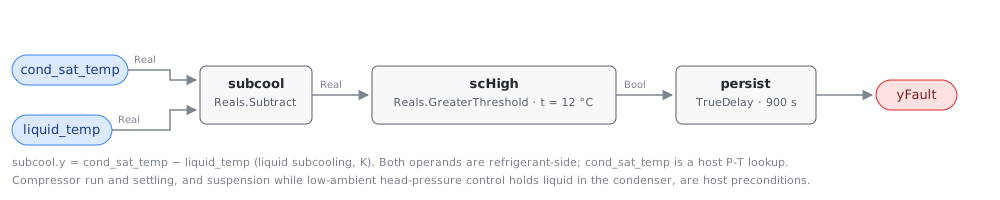
One subtraction, one comparison, one timer — HP-0005’s graph on packaged-unit
points and a shorter window. liquid_subcooling is computed in-graph rather
than bound as a point: the dictionary defines subcooling as exactly this
difference and both operands are already boundary inputs.
There is deliberately no superheat term and no evaluability output. Compressor state, stage changes and head-pressure control are host preconditions, and the last of those is the one that bites on a rooftop: a low-ambient control holding liquid in the condenser reproduces this signature on a correctly charged unit.
The comparison is strict, so a unit exactly on the band reads healthy. persist
requires 15 continuous minutes and delayOnInit = true holds that window across
a controller restart. Everything here is a difference, so head pressure alone
never fires it: high lift with normal subcooling is RTU-0007’s finding.
Possible Diagnoses
- Charge added on a no-cooling call whose real fault was air-side. The rooftop failure path: a loaded filter or a fouled condenser presents as a pressure complaint, gauges go on, gas goes in, and the original fault is still there underneath the overcharge. Read RTU-0002 and RTU-0007 over the same period before touching the charge
- Charged by pressure rather than by weight, or topped up for several summers with no leak ever found. A factory-charged packaged unit’s target is the nameplate weight, and with no field line set there is no length adder to justify a deviation from it — the split-system excuse does not exist here
- Liquid-line restriction: a plugged filter-drier, a kinked line, or a clogged metering-device screen backs refrigerant up ahead of the restriction and raises subcooling identically. The source separates the two by condensing temperature falling and superheat rising, neither of which this rule reads
- Non-condensable gas from a short or skipped evacuation — raises head pressure and subcooling together; confirm off-cycle against standstill pressure and ambient saturation, which is why the source excluded it from its online method
- Not a charge fault at all: a P-T lookup running the wrong refrigerant, an uninsulated liquid-line probe sitting in the condenser airstream, or low-ambient head-pressure control doing its job. Rule these out first — they cost nothing and one of them alarms every cool morning
Energy Impact
EFFICIENCY_LOSS, MEDIUM confidence, PROXY_ESTIMATION. Overcharge was the fault
EER tolerated best of the six the source imposed: 20% too much refrigerant cost
1.1-3.4% of EER across four operating conditions, and a 5% hit took 32-42%
overcharge. waste_kw ≈ eer_penalty × compressor_kw, with compressor_kw
supplied by the host as RTU-0002 does for rtu_kw. PROXY and MEDIUM because the
rule measures a temperature difference and borrows the penalty from lab results
on a residential machine. The case for fixing it is only partly the meter:
excess charge raises head pressure and discharge temperature and pushes liquid
toward the compressor, a reliability cost this rule cannot size.
Emissions Impact
Scope 2, PROXY_EMISSIONS, MEDIUM confidence; on the order of 50-400 kg CO₂e/yr for a commercial packaged unit, scaling with tonnage and cooling hours — HP-0005’s basis, and an order below RTU-0002’s 300-2,000 kg because this fault’s efficiency penalty is small. The waste is compressor electricity, so the avoided-emissions basis is the marginal operating emissions rate (MOER). The larger climate term is off that meter: the surplus must be recovered rather than vented, and R-410A, still the bulk of the installed rooftop fleet, has a GWP above 2,000 against roughly 470-675 for the R-454B and R-32 machines replacing it.
Deviations
- A fixed nominal band replaces the source’s regressed reference model — the central simplification, carried from HP-0005. The source predicts each feature from a third-order polynomial in outdoor drybulb, indoor drybulb and indoor dew point and tests the residual against a measured noise band. No CDL block expresses that regression, so this card tests an absolute subcooling the way charging practice states one. RTU-0002 names the same substitution.
subcooling_high_bandis a commissioning placeholder, and on a packaged unit there may be no chart to read it off. Fixed-orifice and piston metering are still common on small rooftops, and their manufacturer charging procedure targets superheat, not subcooling — so the commissioner takes the band from this unit’s own known-good operation rather than from a published target. It fails silently in both directions: set low, every hot afternoon alarms; set high, nothing ever does.- No superheat conjunct, for a different reason than HP-0005’s. On a TXV the valve holds superheat against the fault and the source records it unchanged at every level tested. On a fixed-orifice unit overcharge does move superheat down — but metering type is not a point in this dictionary, so a superheat conjunct would make the rule fire on part of the fleet only. Subcooling rises under both, and RTU-0008 is where superheat carries the discriminating information.
alarm_delayis 900 s, half the 1800 s HP-0005 and RTU-0008 both use. The window has to fit inside a run cycle, and with the 10-minute settling gate ahead of it 15 minutes already demands 25 minutes of continuous compressor operation — on a cycling rooftop unit this is a loaded-afternoon detector. The measurand affords the shorter window where RTU-0008’s does not: subcooling responds to inventory and settles in minutes, while the superheat half of the undercharge pattern hunts with the metering device, which is what that card’s 30 minutes is spent outlasting. A host wanting coverage on shorter cycles lowers it further and buys transient exposure with the difference.- The compressor gate stays a host precondition, unlike RTU-0007’s in-graph
yRuntimeOk, and the reason is the failure direction. Ungated readings on this measurement point away from the alarm: off-cycle the high side equalises and subcooling collapses toward zero, and just after a shutdown the falling saturation temperature under a still-hot liquid line drives it negative (ungated_off_cycle_stays_silent). A missed gate here costs coverage. On RTU-0007 it points the other way — a compressor still building head pressure reads as a restricted condenser — which is why that card had to hold its gate in the graph. - The gate that actually matters on a rooftop cannot be expressed at all.
Low-ambient head-pressure control holds liquid in the condenser deliberately
and sustains 15 K of subcooling on a correct charge; no point in this
dictionary reports condenser fan state or head-pressure control mode, so the
precondition is prose and the vectors pin the consequence
(
low_ambient_head_pressure_control_alarms_as_designed) rather than hide it. - No evaluability output. The source’s 0.5 °C two-phase test is satisfied by
construction by any subcooling large enough to trip this rule, so the flag
would be true whenever
yFaultis and false only where “not overcharged” is a sound verdict rather than NO_EVAL. Publishing it would invite hosts to discard a correct answer. - RTU-0007 is
related, notsuppressed_by, in either direction. A condenser restriction raises condensing pressure and can widen subcooling with it, so the two cards can fire together — but they are referenced differently: RTU-0007 measures an air-side split against that unit’s own per-stage, per-OAT fit, while this card reads an absolute refrigerant-side inventory. Neither may silence the other, for two reasons: RTU-0007 is retrofit-gated on a condenser leaving-air sensor most rooftops lack, so a suppression edge would break silently wherever it is unbound; and overcharge on a fouled condenser is a real and common combination, exactly the case Hu et al. (2021) warn single-fault-fitted diagnosis misreads. The pair is the diagnosis (see Notes). - Strict
>at the band. CDLRealshas noGreaterEqual, so a unit exactly on the band reads healthy where a technician would call it high — measure-zero on a real-valued signal, and both sides are pinned, one of them bit-exact. persist.delayOnInit = trueagainst the CDL defaultfalse, the library’s standing choice: a unit already overcharged at controller start waits out the full 15 minutes rather than alarming on the first tick.- Single-fault provenance. The source’s chart is fit from singly imposed faults, and the virtual-charge lineage this card borrows its measurement from (Li & Braun 2009; Kim & Braun 2020) is calibrated the same way. One boolean on one feature inherits no ranking error, but read the diagnosis list as a family whenever a second fault is plausible.
- The playbook carries no charge step for this fault yet. Its nearest content is Step 2.1.2 — check subcooling and superheat against manufacturer specs — filed under short-cycling, and its Applies-To row does not list this rule. Both edits belong to the playbook’s owner, not to this card; the Notes below state the field procedure in the meantime.
- Severity 3,
category: EFFICIENCY_LOSSandclusters: []are authored — the reference chapter has no card for this fault.method: ruledescribes this graph, not the source, whose own diagnosis is a probabilistic classifier over regressed residuals. No published test vectors exist; every scenario invectors.jsonis authored from the equation and replayed against the pinned engine rev.
Notes
Take the service history before the gauges: the surplus came from a visit, and the visit usually had another reason. Read RTU-0007 and RTU-0002 over the same window — if the condenser split is also wide, the coil is the trigger and the charge is what a previous tech did about it, so clean and re-measure before recovering anything. RTU-0007 silent with this card firing puts the surplus in the inventory: charge, a restriction, or non-condensables. RTU-0008 alongside is a contradiction rather than a machine both over- and undercharged — suspect the P-T lookup. Resolve to the nameplate weight with the recovered refrigerant weighed, and rule out the liquid-line restriction first: pulling charge out of a unit with a plugged drier makes it worse.
Test Vectors
11 scenarios, clock step 60 s over 7200 s.
| Scenario | Description |
|---|---|
nominal_subcooling_healthy | A correctly charged rooftop unit on a warm afternoon: 45 °C condensing saturation against a 37 °C liquid line is 8 K of subcooling, a normal packaged-unit reading and two thirds of the shipped band. |
design_day_lift_same_subcooling_healthy | Both temperatures 13 K higher — a 40 °C roof, or a condenser the RTU-0007 test would already be reporting — and the same 8 K of subcooling. This rule reads the difference, not the level, so high head pressure on its own is not a charge verdict. Pairs with overcharged_liquid_backs_up: swap the operands and both flip. |
overcharged_liquid_backs_up | FAULT: excess refrigerant floods the lower condenser circuits and the liquid line leaves at 34 °C against a 50 °C condensing saturation — 16 K of subcooling. Both operands hold from t = 0, so delayOnInit puts the alarm exactly one alarm_delay in. |
subcooling_exactly_at_the_band | Threshold edge: 47.0 − 35.0 is exactly subcooling_high_band (12.0 K) and both operands are binary-exact, so this is a true boundary pin rather than a rounding one. The comparison is strict, so a unit sitting precisely on the band reads healthy. |
subcooling_just_above_the_band | Threshold edge from the other side: 47.2 − 35.0 is 12.2 K, two tenths past the band, and the alarm matures on the normal schedule. |
two_phase_liquid_line_reads_healthy | 0.2 K of subcooling — a liquid line with no measurable liquid seal, which is where the charge question belongs to RTU-0008 rather than to this card. No evaluability flag is published for it because the verdict is sound: whatever this unit is, it is not overcharged. |
ungated_off_cycle_stays_silent | The host’s compressor gate is the one precondition this rule can survive losing. Minutes after a stage drops out, the high side has equalised down to a 30 °C saturation while the liquid line is still holding 45 °C of stored heat: subcooling reads −15 K and the rule is silent. Off-cycle error on this measurement points away from the alarm, which is why the gate stays host-side (see Deviations). |
stage_down_transient_never_alarms | A two-stage unit unloads to stage 1 at t = 600 s and the condenser is briefly holding more liquid than one compressor needs: 16 K of subcooling for 600 s, back to 8 K at t = 1200 s, 300 s short of alarm_delay. The timer resets on recovery and nothing is reported. |
delay_runs_from_the_crossing_not_from_load | The unit starts at 8 K and crosses the band at t = 1200 s, holding 14 K thereafter. The alarm lands at 1200 + alarm_delay, not at alarm_delay — the persistence window is measured from the crossing. |
alarm_clears_after_charge_recovered_to_nameplate | Recovery: 16 K of subcooling alarms at 900 s, the technician recovers the excess to the nameplate weight at t = 3600 s, and the liquid line returns to 8 K. yFault drops on that tick — TrueDelay only delays the rising edge. |
low_ambient_head_pressure_control_alarms_as_designed | The known false positive, pinned rather than hidden: on a 5 °C morning the head-pressure control has cycled the condenser fans off and is deliberately holding liquid in the coil — 32 °C condensing saturation against a 17 °C liquid line, 15 K of subcooling, and the rule alarms on a correctly charged unit. The host precondition that suspends evaluation while that control is active is what prevents this, and there is no in-graph term that could. |
vectors.json
{
  "schema": "cxf-library/vectors/v1",
  "clock": {
    "step_s": 60,
    "horizon_s": 7200
  },
  "scenarios": [
    {
      "name": "nominal_subcooling_healthy",
      "description": "A correctly charged rooftop unit on a warm afternoon: 45 \u00b0C condensing saturation against a 37 \u00b0C liquid line is 8 K of subcooling, a normal packaged-unit reading and two thirds of the shipped band.",
      "inputs": {
        "cond_sat_temp": 45.0,
        "liquid_temp": 37.0
      },
      "expect": [
        {
          "output": "yFault",
          "from_s": 0,
          "to_s": 7200,
          "equals": false
        }
      ]
    },
    {
      "name": "design_day_lift_same_subcooling_healthy",
      "description": "Both temperatures 13 K higher \u2014 a 40 \u00b0C roof, or a condenser the RTU-0007 test would already be reporting \u2014 and the same 8 K of subcooling. This rule reads the difference, not the level, so high head pressure on its own is not a charge verdict. Pairs with overcharged_liquid_backs_up: swap the operands and both flip.",
      "inputs": {
        "cond_sat_temp": 58.0,
        "liquid_temp": 50.0
      },
      "expect": [
        {
          "output": "yFault",
          "from_s": 0,
          "to_s": 7200,
          "equals": false
        }
      ]
    },
    {
      "name": "overcharged_liquid_backs_up",
      "description": "FAULT: excess refrigerant floods the lower condenser circuits and the liquid line leaves at 34 \u00b0C against a 50 \u00b0C condensing saturation \u2014 16 K of subcooling. Both operands hold from t = 0, so delayOnInit puts the alarm exactly one alarm_delay in.",
      "inputs": {
        "cond_sat_temp": 50.0,
        "liquid_temp": 34.0
      },
      "expect": [
        {
          "output": "yFault",
          "from_s": 0,
          "to_s": 840,
          "equals": false
        },
        {
          "output": "yFault",
          "from_s": 900,
          "to_s": 7200,
          "equals": true
        }
      ]
    },
    {
      "name": "subcooling_exactly_at_the_band",
      "description": "Threshold edge: 47.0 \u2212 35.0 is exactly subcooling_high_band (12.0 K) and both operands are binary-exact, so this is a true boundary pin rather than a rounding one. The comparison is strict, so a unit sitting precisely on the band reads healthy.",
      "inputs": {
        "cond_sat_temp": 47.0,
        "liquid_temp": 35.0
      },
      "expect": [
        {
          "output": "yFault",
          "from_s": 0,
          "to_s": 7200,
          "equals": false
        }
      ]
    },
    {
      "name": "subcooling_just_above_the_band",
      "description": "Threshold edge from the other side: 47.2 \u2212 35.0 is 12.2 K, two tenths past the band, and the alarm matures on the normal schedule.",
      "inputs": {
        "cond_sat_temp": 47.2,
        "liquid_temp": 35.0
      },
      "expect": [
        {
          "output": "yFault",
          "from_s": 0,
          "to_s": 840,
          "equals": false
        },
        {
          "output": "yFault",
          "from_s": 900,
          "to_s": 7200,
          "equals": true
        }
      ]
    },
    {
      "name": "two_phase_liquid_line_reads_healthy",
      "description": "0.2 K of subcooling \u2014 a liquid line with no measurable liquid seal, which is where the charge question belongs to RTU-0008 rather than to this card. No evaluability flag is published for it because the verdict is sound: whatever this unit is, it is not overcharged.",
      "inputs": {
        "cond_sat_temp": 45.0,
        "liquid_temp": 44.8
      },
      "expect": [
        {
          "output": "yFault",
          "from_s": 0,
          "to_s": 7200,
          "equals": false
        }
      ]
    },
    {
      "name": "ungated_off_cycle_stays_silent",
      "description": "The host's compressor gate is the one precondition this rule can survive losing. Minutes after a stage drops out, the high side has equalised down to a 30 \u00b0C saturation while the liquid line is still holding 45 \u00b0C of stored heat: subcooling reads \u221215 K and the rule is silent. Off-cycle error on this measurement points away from the alarm, which is why the gate stays host-side (see Deviations).",
      "inputs": {
        "cond_sat_temp": 30.0,
        "liquid_temp": 45.0
      },
      "expect": [
        {
          "output": "yFault",
          "from_s": 0,
          "to_s": 7200,
          "equals": false
        }
      ]
    },
    {
      "name": "stage_down_transient_never_alarms",
      "description": "A two-stage unit unloads to stage 1 at t = 600 s and the condenser is briefly holding more liquid than one compressor needs: 16 K of subcooling for 600 s, back to 8 K at t = 1200 s, 300 s short of alarm_delay. The timer resets on recovery and nothing is reported.",
      "inputs": {
        "cond_sat_temp": 45.0,
        "liquid_temp": [
          {
            "t": 0,
            "value": 37.0
          },
          {
            "t": 600,
            "value": 29.0
          },
          {
            "t": 1200,
            "value": 37.0
          }
        ]
      },
      "expect": [
        {
          "output": "yFault",
          "from_s": 0,
          "to_s": 7200,
          "equals": false
        }
      ]
    },
    {
      "name": "delay_runs_from_the_crossing_not_from_load",
      "description": "The unit starts at 8 K and crosses the band at t = 1200 s, holding 14 K thereafter. The alarm lands at 1200 + alarm_delay, not at alarm_delay \u2014 the persistence window is measured from the crossing.",
      "inputs": {
        "cond_sat_temp": 45.0,
        "liquid_temp": [
          {
            "t": 0,
            "value": 37.0
          },
          {
            "t": 1200,
            "value": 31.0
          }
        ]
      },
      "expect": [
        {
          "output": "yFault",
          "from_s": 0,
          "to_s": 2040,
          "equals": false
        },
        {
          "output": "yFault",
          "from_s": 2100,
          "to_s": 7200,
          "equals": true
        }
      ]
    },
    {
      "name": "alarm_clears_after_charge_recovered_to_nameplate",
      "description": "Recovery: 16 K of subcooling alarms at 900 s, the technician recovers the excess to the nameplate weight at t = 3600 s, and the liquid line returns to 8 K. yFault drops on that tick \u2014 TrueDelay only delays the rising edge.",
      "inputs": {
        "cond_sat_temp": 50.0,
        "liquid_temp": [
          {
            "t": 0,
            "value": 34.0
          },
          {
            "t": 3600,
            "value": 42.0
          }
        ]
      },
      "expect": [
        {
          "output": "yFault",
          "from_s": 0,
          "to_s": 840,
          "equals": false
        },
        {
          "output": "yFault",
          "from_s": 900,
          "to_s": 3540,
          "equals": true
        },
        {
          "output": "yFault",
          "from_s": 3660,
          "to_s": 7200,
          "equals": false
        }
      ]
    },
    {
      "name": "low_ambient_head_pressure_control_alarms_as_designed",
      "description": "The known false positive, pinned rather than hidden: on a 5 \u00b0C morning the head-pressure control has cycled the condenser fans off and is deliberately holding liquid in the coil \u2014 32 \u00b0C condensing saturation against a 17 \u00b0C liquid line, 15 K of subcooling, and the rule alarms on a correctly charged unit. The host precondition that suspends evaluation while that control is active is what prevents this, and there is no in-graph term that could.",
      "inputs": {
        "cond_sat_temp": 32.0,
        "liquid_temp": 17.0
      },
      "expect": [
        {
          "output": "yFault",
          "from_s": 0,
          "to_s": 840,
          "equals": false
        },
        {
          "output": "yFault",
          "from_s": 900,
          "to_s": 7200,
          "equals": true
        }
      ]
    }
  ]
}