RTU-0007 — Condenser airflow restriction (fouling)
| Status | verified — engine e2ff2f8, cxf:fnv1a128:736a68798b5fe88d033216cdb84a4959, 2026-08-18 |
| Severity | 3 |
| Method | statistical |
| Phase | 2 |
| Category | EFFICIENCY_LOSS |
| Confidence | MEDIUM |
| Estimation | BASELINE_COMPARISON |
| G36 | — |
| Clusters | — |
| Suppresses | — |
| Suppressed by | — |
| Related | RTU-0002, HP-0004, RTU-0011 |
| Playbooks | rtu-compressor-refrigerant |
| Source | HVAC FDD Reference v1.0 §11 — this chapter’s condenser card (listed pre-renumbering as RTU-FC-100): the condenser-split equation, the 30% relative-excess threshold, the 15-minute compressor-runtime gate, the four diagnoses, and the 5-15% compressor-energy band; HVAC FDD Reference v1.0, Remediation Playbooks (pp. 168-169), carried in playbooks/rtu-compressor-refrigerant.md: Step 1.3 (measure leaving-condenser-air minus OAT against the baseline for the current stage and OAT; a 30% or greater increase indicates fouling), Step 2.3 (coil, fan motor, blade, adjacent-unit recirculation, in that order) and Step 3.3 (confirm the split back within 20% of baseline); PNNL-23790 — the RTU AFDD algorithm report the rest of this chapter binds (AFDD0 in RTU-0003, AFDD1/AFDD3 in RTU-0004, AFDD4/AFDD5 in RTU-0005, AFDD6 in RTU-0006), cited here for its refrigerant-side fault studies; this condenser test is not one of its numbered algorithms; Catrini & Piacentino (2023) — the packaged-unit fouling measurements RTU-0002 is built on (13.3% capacity reduction, up to 47% additional fan power); the same study family is the evidence that a coil-side airflow restriction shows up as a temperature split before it shows up as a complaint; PNNL EEM-23 (RTU advanced controls, 3-11% electricity) — the retrofit package this finding maps to, as in RTU-0004 and RTU-0005; BEE/Devki Energy Consultancy, Best Practice Manual: HVAC Chillers (2006) §2.5.2 — the 2-4% of compressor power per °C of lift thumb-rule used in runtime_estimation (a chiller source applied to a DX machine; see Deviations); points/rtu.points.json cond_split_baseline — the host-fitted baseline contract (per-stage curve against OAT, published strictly positive) that this rule divides by, and cond_leaving_temp, whose absence on most packaged units was the second half of the original deferral; Sibling precedent: RTU-0002 (relative-degradation ratio against a stage baseline, statistical method label, evaluability output), CHW-0005 (host-derived point the graph cannot see behind), HP-0004 (compressor settling as a runtime gate) |
| Operating states | mechanical cooling, compressor running and settled — one instance per unit, each carrying that unit’s own fit. The rule’s yRuntimeOk covers the settling half of that state in-graph. |
Preconditions (host-enforced): cond_leaving_temp must read the air LEAVING the condenser coil, not the air entering it: entering-air is outdoor air, so a probe on the wrong side of the coil reduces the split to sensor error and the rule goes permanently silent. Most packaged units carry no such sensor at all — a strap-on or discharge-plenum probe is the usual retrofit, and its radiation shielding matters, because an unshaded probe in the condenser discharge reads the sun as fouling. cond_split_baseline must be this unit’s own fit against its own stage and OAT, refreshed after any coil cleaning or fan replacement, and the host must publish it strictly positive: the graph divides by it with no guard (see Deviations). oat sits on both sides of the test — it makes the split and it selects the baseline — so a biased outdoor-air sensor moves both and the graph cannot see it; shield and calibrate it before trusting a marginal finding. The host must additionally hold evaluation off across a compressor STAGE change: comp_status does not move when a unit stages 1 to 2, so yRuntimeOk stays armed while the published baseline switches instantly and the physical split takes minutes to follow. Condenser fan speed must be at its normal control point for the conditions — a head-pressure control that is deliberately slowing the fan on a cool day widens the split by design, and that is not this fault. Evaluability is signalled in-rule by yRuntimeOk; when it is false the verdict is NO_EVAL, not a clean coil.
Points: cond_leaving_temp, oat, cond_split_baseline, comp_status
Outputs:
yFault— True while the condenser split has exceeded the host’s published baseline by more than fouling_threshold, on a compressor that has been running continuously for at least min_compressor_runtimeyRuntimeOk— Evaluability signal — true when comp_status has been continuously true for min_compressor_runtime, the settling time below which the split says nothing about the coil. False means NO_EVAL and the host must ignore yFault
Parameters:
| Name | Default | Unit | CXF path | Description |
|---|---|---|---|---|
fouling_threshold | 0.3 | 1 | excessHigh.t | Fractional excess of the measured condenser split over the host’s baseline that counts as a restriction (0.30 = 30% wider than expected). The reference’s own number, and the one its playbook Step 1.3 states for the field measurement. Carried as a fraction, not a percentage, because the graph compares it against a dimensionless quotient — a host that sets 30 here disables the rule. |
min_compressor_runtime | 900.0 | s | runtimeOk.delayTime | Continuous compressor runtime before the split is read (15 min). Head pressure and condenser discharge climb for minutes after a start, so a unit that just came on looks restricted; this is a settling gate, not an alarm debounce, and it drives yRuntimeOk. Same 15 minutes RTU-0002 and HP-0004 require after a start or a capacity step, and the reference’s own figure. |
Description
An air-cooled condenser rejects heat by warming the air it pulls through the coil, so the split between leaving air and outdoor air is a signature of how much air moves across how much clean fin area. Restrict either and the same heat leaves in less air: cottonwood seed matted into the fins, a fan motor losing speed, a bent blade, a discharge hood aimed so the neighbouring unit’s hot air is drawn back in. The split widens, head pressure climbs with it, and the compressor pays for the extra lift every hour the unit cools — without missing a setpoint, which is why nobody on the ground notices. Two temperatures and a baseline is the whole measurement, and the baseline has to come from the host: the split a healthy unit makes depends on both compressor stage and outdoor air.
Detection Logic
condenser_split = cond_leaving_temp − oat
relative_excess = (condenser_split − cond_split_baseline) / cond_split_baseline

yRuntimeOk = comp_status held continuously true for min_compressor_runtime
             (false ⇒ host reports NO_EVAL)
yFault     = relative_excess > fouling_threshold AND yRuntimeOk
Block graph (rule.cxf.jsonld):
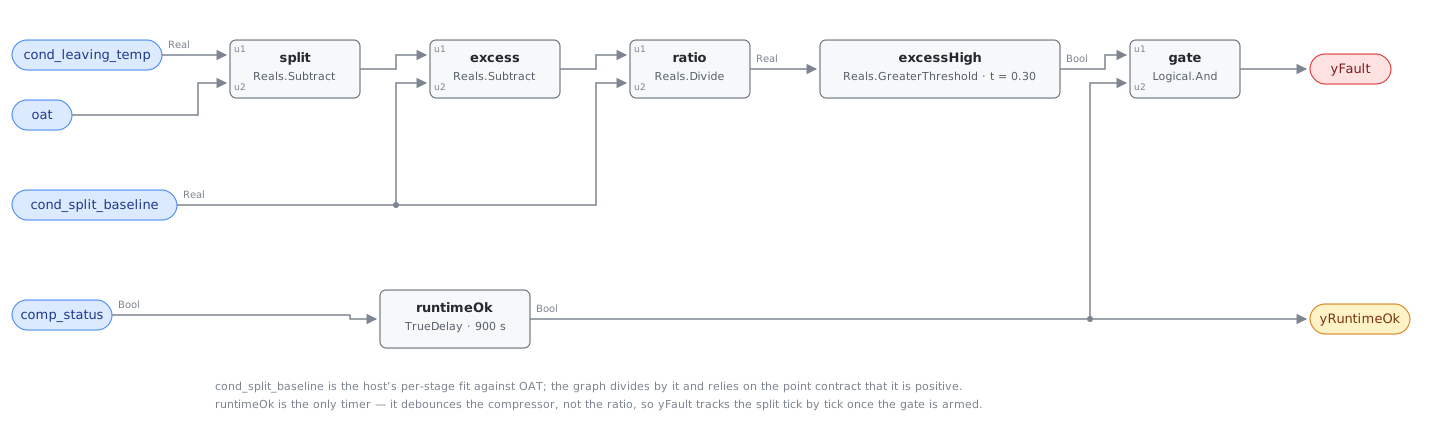
runtimeOk is the only timer, and it debounces the compressor rather than the
ratio: it asserts exactly 900 s after comp_status rises, any stop restarts it,
and once armed yFault follows the split tick by tick with no persistence of
its own (excess_flickering_across_the_threshold_chatters pins that). The
delayOnInit = true house choice makes a compressor already running at engine
start wait out the full window, which is the right reading here — the rule
cannot know how long that machine has been on.
cond_split_baseline reaches the graph twice, once as the subtrahend and once
as the divisor, and nothing guards the division: the point contract carries that
obligation (see Deviations). The threshold comparison is strict, so a split
exactly 30% wide reads healthy; the boundary is bit-exact for a baseline of 10.0
and a split of 13.0, and both sides are pinned.
Possible Diagnoses
- Fouled condenser coil — cottonwood seed, leaves, grass clippings, or roof grit matted into the fins. The most common cause, the cheapest to confirm (look at the coil from outside the unit) and the cheapest to fix
- Condenser fan motor degradation — a failing motor or slipping mount turning the same blade slower, which moves less air across a coil that is clean
- Blade damage or obstruction — a bent or cracked blade, or something set down on the condenser guard; the split widens the same way as a fouled coil
- Hot-air recirculation from an adjacent rooftop unit discharging into this unit’s condenser intake. The coil is clean, the fan is fine, and the fix is sheet metal rather than service — indistinguishable from causes 1-3 on this signal, and the one to suspect when a cleaned coil does not clear the alarm
- Neither: an unshaded leaving-air probe, a biased outdoor-air sensor, or a baseline fitted while the coil was already dirty. Rule these out first — they cost nothing and the third one silences the rule permanently
Energy Impact
EFFICIENCY_LOSS, MEDIUM confidence, BASELINE_COMPARISON. The excess split the
graph already computes is the estimator:
waste_kw ≈ compressor_kw × 0.025 /K × relative_excess × cond_split_baseline —
the share of compressor power spent lifting across resistance that should not be
there. A unit 43% over a 14 K baseline carries 6 K of excess split, which the
estimator reads as 6 K of extra lift and about 15% of compressor power — the top
of the reference’s 5-15% band. MEDIUM because both steps are approximations: the
sensitivity ratio is a thumb-rule borrowed from the chiller side, and air-side
split stands in for refrigerant-side lift. Cooling-dominant, and worst on design
days when the condenser is already working hardest.
Emissions Impact
Scope 2, PROXY_EMISSIONS, MEDIUM confidence; the same order as RTU-0002’s 300-2,000 kg CO₂e/yr, scaling with tonnage and cooling hours. Marginal operating emissions rate (MOER) is the avoided-emissions basis, and the timing works against the building twice over: a restricted condenser costs most on the hot afternoons when the grid dispatches its dirtiest generation and the unit runs longest.
Deviations
- The deferral was resolved by the point dictionary, not by new blocks.
faults/rtu/README.mdcarried this rule as deferred because its baseline is a function of two variables (stage and OAT) and the block set expresses no baseline curve. Publishing the fit as the host-derived pointcond_split_baselinemoves that curve out of the graph entirely, as CHW-0005 and HP-0004 do with derived saturation temperatures. - The stage dependence lives in the host fit, so
comp_stageis not a point of this rule. The baseline the host publishes already answers “which stage”, and re-deriving the stage in-graph would add a binding and a block for information the rule cannot act on. The cost is real and declared inpreconditions: a 1-to-2 stage-up switches the baseline instantly while the physical split takes minutes to follow, and nothing in-graph holds evaluation off across it. comp_statusis the runtime gate, notcomp_stage > 0. The gate asks one question — is a compressor running — whichcomp_statusanswers directly. This rule may use an explicitly documented any-running aggregate while the integer route needs anIntegers.GreaterThresholdto reach the same boolean. The dictionary’s OR-undercount warning is about counting starts (RTU-0001), not about whether anything is running, so it does not bite here.- The TrueDelay sits on the compressor condition, not on the fault
condition. Settling is a property of the machine, not of the finding: a
timer fed the AND would restart its clock every time the split dipped under
the line, so a marginal unit could run all afternoon and never complete a
window it had physically earned in the first 15 minutes. The consequence is
that
yFaulthas no debounce of its own. - No
alarm_delaywas invented to supply that debounce. The reference names two parameters and this card ships two. The arithmetic supports the choice: ±0.5 K of sensor error on a 14 K baseline is ~3.5% of the ratio against a 30% line, so the decision is not normally made on noise. A unit that genuinely oscillates across the line will chatter, which the vectors pin rather than hide, and the host’s alarm layer is where that hold-off belongs. - The division relies on the point contract instead of an in-graph guard.
points/rtu.points.jsonrequires the host to publishcond_split_baselinestrictly positive, which it is by construction — an expected temperature rise across a working condenser. A host that publishes 0 anyway drives the quotient non-finite and the rule alarms permanently rather than going quiet, whichzero_baseline_violates_the_point_contract_and_alarmspins: the survivable direction for a misconfiguration, but still a contract violation. - Strict
>where the reference’s playbook is inclusive (“a 30% or greater increase indicates fouling”). CDLRealshas noGreaterEqual, so a split exactly 30% over baseline reads healthy. The disagreement is measure-zero on a real-valued signal and both sides are pinned, one of them bit-exact. method: statisticaldescribes where the baseline comes from, not what the graph does — RTU-0002’s stance, and more literally true here: the fit is regressed from this unit’s own clean-operation history rather than adopted from a population, which is also whyestimation_methodisBASELINE_COMPARISONrather than RTU-0002’s shipped constants.- The sensor half of the original deferral is not resolved, only declared.
Most packaged units carry no condenser leaving-air sensor, so this rule is
retrofit-gated in a way none of its RTU siblings are; the point dictionary
says so and
preconditionsrepeats it. A library that shipped this rule as broadly deployable would be overstating what a typical RTU can bind. - The energy estimator borrows a chiller thumb-rule. BEE 2006 §2.5.2’s 2-4%
of compressor power per °C of lift is stated for water-cooled machines; the
compressor does not care what fluid raised its condensing temperature, so the
crossover is defensible as an approximation and
runtime_estimationwrites it as one. It is also the reason the estimator is only corroborating evidence for the reference’s 5-15% band rather than a second derivation of it. - The playbook’s resolution target is tighter than this rule’s alarm. Step 3.3 confirms the fix at the split returning within 20% of baseline while the rule alarms at 30%, so a coil cleaned back to 25% over clears the alarm without being fixed — the same trap RTU-0002 documents against its own playbook step. The playbook already carries this fault in its Applies-To row and its Steps 1.3, 2.3 and 3.3, so no playbook edit was needed.
clusters: []andsuppressed_by: [], both deliberate. CLU-10 (condenser-side degradation) is the water-side syndrome behind a shared cooling tower; an air-cooled packaged condenser shares no loop with it, so membership would be a false neighbour. And no rule in this family adjudicatesoatorcond_leaving_temp— RTU-0003’s AFDD0 consistency check coverssat/mat— so there is nothing honest to be suppressed by. Both are the index owner’s to revisit.- The CXF namespace is
urn:cxf-library:rtu-0007#. SCHEMA.md’s normative form, matching VAV-0010; the rest of the RTU family still carries pre-renumberingrtu-fc-0NNnamespaces because renaming them would churn every recordedcontent_idfor no gain. runtimeOk.delayOnInit = trueagainst the CDL default offalse, the library’s standing choice, and load-bearing here: a compressor already running at load raises no edge for the timer to key on. Threshold hysteresis stays at the CDL defaulth = 0; a site whose split chatters should add hold-off at the host rather than widen the band.- No published test vectors exist. The reference supplies no cases for this
test, so every scenario in
vectors.jsonis authored from the equation and replayed against the pinned engine rev. Operating states and preconditions are declared in frontmatter for host enforcement rather than encoded in the graph. Severity 3 andmethod: statisticalare the rowfaults/rtu/README.mdhas carried for this rule since the chapter was indexed;confidence: MEDIUMandestimation_method: BASELINE_COMPARISONare this card’s own, and match the chapter’s other baseline-referenced finding, RTU-0002.
Notes
Read yRuntimeOk first: on a short-cycling unit it never turns true, and that
silence is RTU-0001’s finding rather than a clean coil. Then look at the coil,
which is visible from outside the unit and is cause 1 in both the diagnosis list
and the playbook. If washing it does not restore the split, take the fan next
(motor speed, then the blade), and the neighbours last — hot-air recirculation is
common on dense rooftops, invisible from the trend, and fixed with sheet metal
rather than service. Trend the split against outdoor temperature for a week
before scheduling any of it: a gap that grows with OAT points at the coil or the
fan, while one flat and wide across the range points at recirculation or at a
baseline fitted while the unit was already dirty.
Test Vectors
14 scenarios, clock step 60 s over 3600 s.
| Scenario | Description |
|---|---|
clean_condenser_running | NO_FAULT: 50 °C off the coil against 35 °C outdoor air is a 15 K split where the host’s fit expects 14 K — 7% over, a coil worth hosing next spring and nothing this rule should say. yRuntimeOk turns true at exactly 900 s because delayOnInit holds the compressor condition from the first tick. |
fouled_condenser_alarms_at_the_runtime_edge | FAULT: the same unit discharging 55 °C is a 20 K split against the same 14 K fit — 43% excess, well past the 30% line. The alarm lands on the tick the runtime gate arms, which is the whole timing story of this rule: excess is not debounced, arming is. |
compressor_off_is_no_eval | NO_EVAL: the fouled numbers with the compressor off. A condenser rejecting no heat holds whatever split the last cycle left in the sheet metal, so the reading is not evidence either way — yRuntimeOk false is what tells the host that the silence is not a clean coil. |
excess_exactly_at_the_threshold | Boundary, bit-exact: 43.0 − 30.0 is exactly 13.0, minus a 10.0 baseline is exactly 3.0, and 3.0/10.0 is the same double the parameter 0.30 rounds to. Reals.GreaterThreshold is strict, so a unit sitting exactly on the line reads healthy by the strictness rather than by rounding. |
excess_just_above_the_threshold | Boundary from above: 10 mK more off the coil puts the ratio at 0.3010 and the rule alarms on the normal schedule. |
excess_just_below_the_threshold | Boundary from below: 10 mK less puts the ratio at 0.2990 and nothing fires, however long the compressor runs. |
compressor_start_arms_the_rule | The mid-run rising edge: a fouled unit whose compressor starts at t = 600 s. The gate arms at exactly 1500 s and the alarm lands on the same tick — T + delayTime, whether the condition arrives at init or mid-run. |
short_cycling_unit_never_reaches_the_runtime_gate | A fouled unit that also short-cycles: 10 min on, 10 min off, 10 min on. Each stop resets the delay, so the first window that completes 900 s of continuous running starts at 1200 s and arms at 2100 s. Below a 15-minute duty cycle this rule reports nothing at all and RTU-0001 is the finding. |
condenser_cleaned_mid_run | Recovery: the alarm asserts at 900 s and the coil is hosed off at t = 1800 s, dropping the split back to 15 K. yFault falls on that tick while yRuntimeOk stays true — the compressor never stopped, so the gate never re-armed. |
compressor_stops_after_alarm | The evaluability release: an alarming unit stages off at t = 2400 s with the split unchanged. yFault and yRuntimeOk fall on the same tick, and only the pair distinguishes a cleaned coil from a unit that stopped cooling. |
baseline_steps_under_a_running_rule | The derived point moves: the split holds at 20 K while the host republishes the fit from 16 K to 14 K at t = 1800 s — a stage-up, or the OAT bin changing under the curve. The ratio crosses 0.30 on that tick and, with the gate already armed, so does yFault. Nothing in the graph waits for the physical split to catch up with the new baseline. |
excess_flickering_across_the_threshold_chatters | Blind spot, pinned: a unit whose relative excess alternates between 0.35 and 0.25 every 300 s — a condenser fan cycling on head pressure, or a marginal coil in gusty wind. yFault follows every crossing because the rule debounces arming, not excess. A host that alarms on the raw output gets one alarm per crossing. |
outdoor_air_sensor_reading_high_hides_fouling | The other blind spot, pinned: a sun-baked outdoor-air sensor reads 40 °C on a 35 °C day while the coil is genuinely fouled at 55 °C leaving. The measured split shrinks to 15 K and the ratio lands on 0.0714 — the identical number the clean scenario produces. oat is on both sides of this test, the split and the fit that predicts it, and a bias on it is invisible to the graph in the false-negative direction. |
zero_baseline_violates_the_point_contract_and_alarms | Contract violation, pinned so the failure direction is on the record: a host publishes cond_split_baseline = 0 — an unfitted instance, or a default that leaked — against a real 20 K split. The graph has no divide guard, the quotient goes non-finite, and the strict comparison passes, so the rule alarms permanently instead of going quiet. Loud is the survivable direction for a misconfiguration, but the point dictionary requires a strictly positive baseline and this is what happens when that is not honoured. |
vectors.json
{
  "schema": "cxf-library/vectors/v1",
  "clock": {
    "step_s": 60,
    "horizon_s": 3600
  },
  "scenarios": [
    {
      "name": "clean_condenser_running",
      "description": "NO_FAULT: 50 \u00b0C off the coil against 35 \u00b0C outdoor air is a 15 K split where the host's fit expects 14 K \u2014 7% over, a coil worth hosing next spring and nothing this rule should say. yRuntimeOk turns true at exactly 900 s because delayOnInit holds the compressor condition from the first tick.",
      "inputs": {
        "cond_leaving_temp": 50.0,
        "oat": 35.0,
        "cond_split_baseline": 14.0,
        "comp_status": true
      },
      "expect": [
        {
          "output": "yFault",
          "from_s": 0,
          "to_s": 3600,
          "equals": false
        },
        {
          "output": "yRuntimeOk",
          "from_s": 0,
          "to_s": 840,
          "equals": false
        },
        {
          "output": "yRuntimeOk",
          "from_s": 900,
          "to_s": 3600,
          "equals": true
        }
      ]
    },
    {
      "name": "fouled_condenser_alarms_at_the_runtime_edge",
      "description": "FAULT: the same unit discharging 55 \u00b0C is a 20 K split against the same 14 K fit \u2014 43% excess, well past the 30% line. The alarm lands on the tick the runtime gate arms, which is the whole timing story of this rule: excess is not debounced, arming is.",
      "inputs": {
        "cond_leaving_temp": 55.0,
        "oat": 35.0,
        "cond_split_baseline": 14.0,
        "comp_status": true
      },
      "expect": [
        {
          "output": "yFault",
          "from_s": 0,
          "to_s": 840,
          "equals": false
        },
        {
          "output": "yFault",
          "from_s": 900,
          "to_s": 3600,
          "equals": true
        },
        {
          "output": "yRuntimeOk",
          "from_s": 0,
          "to_s": 840,
          "equals": false
        },
        {
          "output": "yRuntimeOk",
          "from_s": 900,
          "to_s": 3600,
          "equals": true
        }
      ]
    },
    {
      "name": "compressor_off_is_no_eval",
      "description": "NO_EVAL: the fouled numbers with the compressor off. A condenser rejecting no heat holds whatever split the last cycle left in the sheet metal, so the reading is not evidence either way \u2014 yRuntimeOk false is what tells the host that the silence is not a clean coil.",
      "inputs": {
        "cond_leaving_temp": 55.0,
        "oat": 35.0,
        "cond_split_baseline": 14.0,
        "comp_status": false
      },
      "expect": [
        {
          "output": "yFault",
          "from_s": 0,
          "to_s": 3600,
          "equals": false
        },
        {
          "output": "yRuntimeOk",
          "from_s": 0,
          "to_s": 3600,
          "equals": false
        }
      ]
    },
    {
      "name": "excess_exactly_at_the_threshold",
      "description": "Boundary, bit-exact: 43.0 \u2212 30.0 is exactly 13.0, minus a 10.0 baseline is exactly 3.0, and 3.0/10.0 is the same double the parameter 0.30 rounds to. Reals.GreaterThreshold is strict, so a unit sitting exactly on the line reads healthy by the strictness rather than by rounding.",
      "inputs": {
        "cond_leaving_temp": 43.0,
        "oat": 30.0,
        "cond_split_baseline": 10.0,
        "comp_status": true
      },
      "expect": [
        {
          "output": "yFault",
          "from_s": 0,
          "to_s": 3600,
          "equals": false
        },
        {
          "output": "yRuntimeOk",
          "from_s": 0,
          "to_s": 840,
          "equals": false
        },
        {
          "output": "yRuntimeOk",
          "from_s": 900,
          "to_s": 3600,
          "equals": true
        }
      ]
    },
    {
      "name": "excess_just_above_the_threshold",
      "description": "Boundary from above: 10 mK more off the coil puts the ratio at 0.3010 and the rule alarms on the normal schedule.",
      "inputs": {
        "cond_leaving_temp": 43.01,
        "oat": 30.0,
        "cond_split_baseline": 10.0,
        "comp_status": true
      },
      "expect": [
        {
          "output": "yFault",
          "from_s": 0,
          "to_s": 840,
          "equals": false
        },
        {
          "output": "yFault",
          "from_s": 900,
          "to_s": 3600,
          "equals": true
        },
        {
          "output": "yRuntimeOk",
          "from_s": 900,
          "to_s": 3600,
          "equals": true
        }
      ]
    },
    {
      "name": "excess_just_below_the_threshold",
      "description": "Boundary from below: 10 mK less puts the ratio at 0.2990 and nothing fires, however long the compressor runs.",
      "inputs": {
        "cond_leaving_temp": 42.99,
        "oat": 30.0,
        "cond_split_baseline": 10.0,
        "comp_status": true
      },
      "expect": [
        {
          "output": "yFault",
          "from_s": 0,
          "to_s": 3600,
          "equals": false
        },
        {
          "output": "yRuntimeOk",
          "from_s": 900,
          "to_s": 3600,
          "equals": true
        }
      ]
    },
    {
      "name": "compressor_start_arms_the_rule",
      "description": "The mid-run rising edge: a fouled unit whose compressor starts at t = 600 s. The gate arms at exactly 1500 s and the alarm lands on the same tick \u2014 T + delayTime, whether the condition arrives at init or mid-run.",
      "inputs": {
        "cond_leaving_temp": 55.0,
        "oat": 35.0,
        "cond_split_baseline": 14.0,
        "comp_status": [
          {
            "t": 0,
            "value": false
          },
          {
            "t": 600,
            "value": true
          }
        ]
      },
      "expect": [
        {
          "output": "yFault",
          "from_s": 0,
          "to_s": 1440,
          "equals": false
        },
        {
          "output": "yFault",
          "from_s": 1500,
          "to_s": 3600,
          "equals": true
        },
        {
          "output": "yRuntimeOk",
          "from_s": 0,
          "to_s": 1440,
          "equals": false
        },
        {
          "output": "yRuntimeOk",
          "from_s": 1500,
          "to_s": 3600,
          "equals": true
        }
      ]
    },
    {
      "name": "short_cycling_unit_never_reaches_the_runtime_gate",
      "description": "A fouled unit that also short-cycles: 10 min on, 10 min off, 10 min on. Each stop resets the delay, so the first window that completes 900 s of continuous running starts at 1200 s and arms at 2100 s. Below a 15-minute duty cycle this rule reports nothing at all and RTU-0001 is the finding.",
      "inputs": {
        "cond_leaving_temp": 55.0,
        "oat": 35.0,
        "cond_split_baseline": 14.0,
        "comp_status": [
          {
            "t": 0,
            "value": true
          },
          {
            "t": 600,
            "value": false
          },
          {
            "t": 1200,
            "value": true
          }
        ]
      },
      "expect": [
        {
          "output": "yFault",
          "from_s": 0,
          "to_s": 2040,
          "equals": false
        },
        {
          "output": "yFault",
          "from_s": 2100,
          "to_s": 3600,
          "equals": true
        },
        {
          "output": "yRuntimeOk",
          "from_s": 0,
          "to_s": 2040,
          "equals": false
        },
        {
          "output": "yRuntimeOk",
          "from_s": 2100,
          "to_s": 3600,
          "equals": true
        }
      ]
    },
    {
      "name": "condenser_cleaned_mid_run",
      "description": "Recovery: the alarm asserts at 900 s and the coil is hosed off at t = 1800 s, dropping the split back to 15 K. yFault falls on that tick while yRuntimeOk stays true \u2014 the compressor never stopped, so the gate never re-armed.",
      "inputs": {
        "cond_leaving_temp": [
          {
            "t": 0,
            "value": 55.0
          },
          {
            "t": 1800,
            "value": 50.0
          }
        ],
        "oat": 35.0,
        "cond_split_baseline": 14.0,
        "comp_status": true
      },
      "expect": [
        {
          "output": "yFault",
          "from_s": 0,
          "to_s": 840,
          "equals": false
        },
        {
          "output": "yFault",
          "from_s": 900,
          "to_s": 1740,
          "equals": true
        },
        {
          "output": "yFault",
          "from_s": 1800,
          "to_s": 3600,
          "equals": false
        },
        {
          "output": "yRuntimeOk",
          "from_s": 900,
          "to_s": 3600,
          "equals": true
        }
      ]
    },
    {
      "name": "compressor_stops_after_alarm",
      "description": "The evaluability release: an alarming unit stages off at t = 2400 s with the split unchanged. yFault and yRuntimeOk fall on the same tick, and only the pair distinguishes a cleaned coil from a unit that stopped cooling.",
      "inputs": {
        "cond_leaving_temp": 55.0,
        "oat": 35.0,
        "cond_split_baseline": 14.0,
        "comp_status": [
          {
            "t": 0,
            "value": true
          },
          {
            "t": 2400,
            "value": false
          }
        ]
      },
      "expect": [
        {
          "output": "yFault",
          "from_s": 0,
          "to_s": 840,
          "equals": false
        },
        {
          "output": "yFault",
          "from_s": 900,
          "to_s": 2340,
          "equals": true
        },
        {
          "output": "yFault",
          "from_s": 2400,
          "to_s": 3600,
          "equals": false
        },
        {
          "output": "yRuntimeOk",
          "from_s": 900,
          "to_s": 2340,
          "equals": true
        },
        {
          "output": "yRuntimeOk",
          "from_s": 2400,
          "to_s": 3600,
          "equals": false
        }
      ]
    },
    {
      "name": "baseline_steps_under_a_running_rule",
      "description": "The derived point moves: the split holds at 20 K while the host republishes the fit from 16 K to 14 K at t = 1800 s \u2014 a stage-up, or the OAT bin changing under the curve. The ratio crosses 0.30 on that tick and, with the gate already armed, so does yFault. Nothing in the graph waits for the physical split to catch up with the new baseline.",
      "inputs": {
        "cond_leaving_temp": 55.0,
        "oat": 35.0,
        "cond_split_baseline": [
          {
            "t": 0,
            "value": 16.0
          },
          {
            "t": 1800,
            "value": 14.0
          }
        ],
        "comp_status": true
      },
      "expect": [
        {
          "output": "yFault",
          "from_s": 0,
          "to_s": 1740,
          "equals": false
        },
        {
          "output": "yFault",
          "from_s": 1800,
          "to_s": 3600,
          "equals": true
        },
        {
          "output": "yRuntimeOk",
          "from_s": 900,
          "to_s": 3600,
          "equals": true
        }
      ]
    },
    {
      "name": "excess_flickering_across_the_threshold_chatters",
      "description": "Blind spot, pinned: a unit whose relative excess alternates between 0.35 and 0.25 every 300 s \u2014 a condenser fan cycling on head pressure, or a marginal coil in gusty wind. yFault follows every crossing because the rule debounces arming, not excess. A host that alarms on the raw output gets one alarm per crossing.",
      "inputs": {
        "cond_leaving_temp": [
          {
            "t": 0,
            "value": 43.5
          },
          {
            "t": 1200,
            "value": 42.5
          },
          {
            "t": 1500,
            "value": 43.5
          },
          {
            "t": 1800,
            "value": 42.5
          },
          {
            "t": 2100,
            "value": 43.5
          }
        ],
        "oat": 30.0,
        "cond_split_baseline": 10.0,
        "comp_status": true
      },
      "expect": [
        {
          "output": "yFault",
          "from_s": 0,
          "to_s": 840,
          "equals": false
        },
        {
          "output": "yFault",
          "from_s": 900,
          "to_s": 1140,
          "equals": true
        },
        {
          "output": "yFault",
          "from_s": 1200,
          "to_s": 1440,
          "equals": false
        },
        {
          "output": "yFault",
          "from_s": 1500,
          "to_s": 1740,
          "equals": true
        },
        {
          "output": "yFault",
          "from_s": 1800,
          "to_s": 2040,
          "equals": false
        },
        {
          "output": "yFault",
          "from_s": 2100,
          "to_s": 3600,
          "equals": true
        },
        {
          "output": "yRuntimeOk",
          "from_s": 900,
          "to_s": 3600,
          "equals": true
        }
      ]
    },
    {
      "name": "outdoor_air_sensor_reading_high_hides_fouling",
      "description": "The other blind spot, pinned: a sun-baked outdoor-air sensor reads 40 \u00b0C on a 35 \u00b0C day while the coil is genuinely fouled at 55 \u00b0C leaving. The measured split shrinks to 15 K and the ratio lands on 0.0714 \u2014 the identical number the clean scenario produces. oat is on both sides of this test, the split and the fit that predicts it, and a bias on it is invisible to the graph in the false-negative direction.",
      "inputs": {
        "cond_leaving_temp": 55.0,
        "oat": 40.0,
        "cond_split_baseline": 14.0,
        "comp_status": true
      },
      "expect": [
        {
          "output": "yFault",
          "from_s": 0,
          "to_s": 3600,
          "equals": false
        },
        {
          "output": "yRuntimeOk",
          "from_s": 900,
          "to_s": 3600,
          "equals": true
        }
      ]
    },
    {
      "name": "zero_baseline_violates_the_point_contract_and_alarms",
      "description": "Contract violation, pinned so the failure direction is on the record: a host publishes cond_split_baseline = 0 \u2014 an unfitted instance, or a default that leaked \u2014 against a real 20 K split. The graph has no divide guard, the quotient goes non-finite, and the strict comparison passes, so the rule alarms permanently instead of going quiet. Loud is the survivable direction for a misconfiguration, but the point dictionary requires a strictly positive baseline and this is what happens when that is not honoured.",
      "inputs": {
        "cond_leaving_temp": 55.0,
        "oat": 35.0,
        "cond_split_baseline": 0.0,
        "comp_status": true
      },
      "expect": [
        {
          "output": "yFault",
          "from_s": 0,
          "to_s": 840,
          "equals": false
        },
        {
          "output": "yFault",
          "from_s": 900,
          "to_s": 3600,
          "equals": true
        },
        {
          "output": "yRuntimeOk",
          "from_s": 900,
          "to_s": 3600,
          "equals": true
        }
      ]
    }
  ]
}