FCU-0003 — SAT too high in full cooling
| Status | verified — engine e2ff2f8, cxf:fnv1a128:f33110926b9fc6d206913b6ce4dea351, 2026-08-17 |
| Severity | 3 |
| Method | rule |
| Phase | 1 |
| Category | EXCESS_CONSUMPTION |
| Confidence | MEDIUM |
| Estimation | PROXY_ESTIMATION |
| G36 | §5.22.6 FC#3 |
| Clusters | — |
| Suppresses | — |
| Suppressed by | — |
| Related | FCU-0002, FCU-0004, FCU-0006 |
| Playbooks | fcu-faults |
| Source | HVAC FDD Reference v1.0 §12, FCU-0003; G36 §5.22.6 FC#3 (cited by the reference; clause text not in hand — see Deviations); G36 Addendum u, Table 5.16.14.5 (εSAT = 1 °C, AlarmDelay = 30 min — the adopted defaults); NISTIR 7365 (the provenance Addendum u gives for those defaults) |
| Operating states | OS#3 (cooling) — host-gated |
Preconditions (host-enforced): The fan must be running and the unit in its cooling operating state. A fan coil with a stopped fan holds stagnant air on the discharge sensor, which reads at room temperature and looks exactly like a coil that has lost capacity. Suspend evaluation for a settling period after any mode change, occupancy transition, or valve-sequence changeover, while the coil has not caught up.
clg_vlv_cmdmust be the command the FCU controller is issuing, not a position feedback: this rule asks whether the loop has run out of capacity to ask for, and a feedback that disagrees with its command is a stuck-actuator finding.sat_spmust be a discharge setpoint the sequence is actually holding — many fan coils control to zone temperature and have no discharge setpoint at all, and a host that synthesizes one from the zone setpoint will manufacture faults every mild afternoon; on such a unit omit the rule rather than bind it. Where the host also runs FCU-0004, treat a concurrent cooling-coil leak as a separate finding rather than an explanation of this one; the leak makes the discharge colder, not warmer. When any gate is unmet the verdict is NO_EVAL, not healthy.
Points: sat, sat_sp, clg_vlv_cmd
Outputs:
yFault— True while sat has stayed more than sat_error_threshold above sat_sp with the cooling valve commanded above cc_full_threshold, for at least alarm_delayyClgFullOk— True while clg_vlv_cmd is above cc_full_threshold — the cooling loop has run out of capacity to ask for, so a setpoint miss is interpretable as a defect. False means the loop still has valve left to give and this rule has no verdict; the host reports NO_EVAL, not healthy
Parameters:
| Name | Default | Unit | CXF path | Description |
|---|---|---|---|---|
sat_error_threshold | 1.0 | °C | spMiss.t | The reference’s ε_sat — the amount by which the discharge may exceed its setpoint before the miss is real rather than sensor error. ADOPTED: this card states no value (see Deviations). 1.0 °C is G36 Addendum u’s εSAT, the supply-air sensor accuracy allowance whose provenance is NISTIR 7365, and is the same value AHU-0013 ships. A site with a calibrated discharge sensor may lower it; raising it to quiet a hunting loop hides a tuning problem instead of fixing it |
cc_full_threshold | 99.0 | % | clgFull.t | Cooling coil command above which the loop is treated as having no capacity left to ask for (the reference’s clg_vlv_cmd ≥ 99%, as a strict > — see Deviations) |
alarm_delay | 1800.0 | s | persist.delayTime | Continuous fault persistence required before the alarm asserts. ADOPTED: this card states no AlarmDelay (see Deviations). 1800 s is the AlarmDelay default in Addendum u’s AHU AFDD tables and the value AHU-0013 ships; the reference’s own FCU-0001 uses 3600 s, which is that rule’s one-hour counting window rather than a chapter-wide default |
Description
The chilled-water valve is wide open and the air leaving the fan coil is still above its setpoint. The loop has already asked for everything it has, so whatever is wrong is not tuning: either the coil cannot deliver, the chilled water behind it cannot, the fan is not moving air across it, or the sensor reporting the miss is wrong. On a fan coil the fault is quiet in a way it never is on an air handler — one unit under-cooling one hotel room produces a guest complaint, not a trend review — and the reference’s chapter introduction is blunt about why: fan coils are distributed by the dozens, rarely instrumented well, and faults on them persist for long periods. Two to five percent of a zone’s cooling energy is small until it is multiplied by three hundred rooms. This is the cooling-side member of the reference’s FCU-0002/FCU-0003 pair, the fan coil analog of AHU-0007/AHU-0013.
Detection Logic
yClgFullOk = clg_vlv_cmd > cc_full_threshold      (false ⇒ host reports NO_EVAL)
sp_gap     = sat − sat_sp

yFault = (sp_gap > sat_error_threshold) AND yClgFullOk,
         sustained continuously for alarm_delay
Block graph (rule.cxf.jsonld):
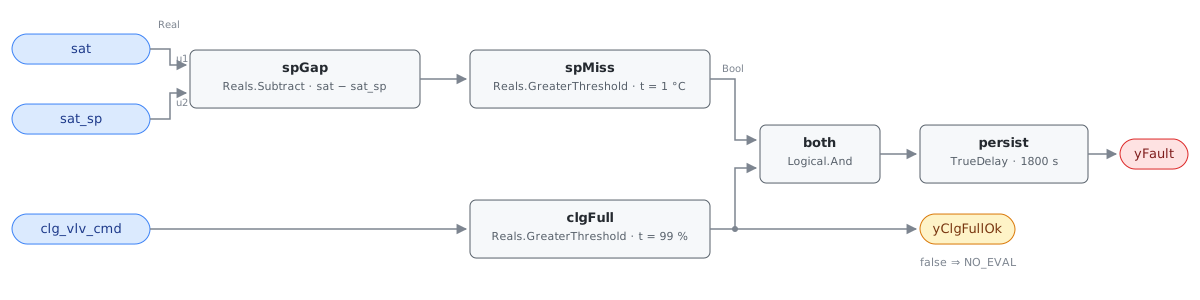
spGap and spMiss are the reference’s sat > (sat_sp + ε_sat) rearranged so
the allowance stays a single positive number at one CXF path. clgFull is the
half that gives the miss its meaning — a discharge above setpoint at a part-open
valve is a control loop doing its job, and only a loop that has run out of coil
is evidence of a defect. It feeds both and also leaves the block as
yClgFullOk, so a host can tell the two silences apart: silence with
yClgFullOk true is a coil keeping up, silence with it false is a loop that
still has valve left to give, about which this rule has nothing to say. Both
comparisons are strict, so a miss sitting exactly on 1.0 °C and a command parked
exactly on 99.0% both read healthy — the second matters on quantized commands
(see Deviations). persist requires 30 continuous minutes, which separates a
failed coil from a morning pulldown or a room coming out of setback;
delayOnInit = true puts the alarm at exactly 1800 s from a miss already
present at load. The graph is FCU-0002’s mirror — same five blocks, same two
outputs, same three parameters, with the subtraction and the valve swapped.
Possible Diagnoses
Transcribed from the reference’s FCU-0003 card:
- Cooling coil fouled
- CHW supply temperature too high
- Cooling valve stuck closed
- Fan speed too low for cooling demand
Two readings that list needs. The reference gives FCU-0002 “SAT sensor out of calibration” and does not repeat it here, but a discharge sensor reading high produces this trace exactly and is the cheapest thing to eliminate; G36’s cooling-side equivalent (§5.16.14 FC#13) leads with SAT sensor error, so check the sensor first. And diagnosis 4 reads backwards at first: lower airflow across a fixed coil makes the discharge colder. The case that presents here is the extreme one — a fan stopped, off its belt, or blocked by a fouled filter leaves near-stagnant air on the discharge sensor, which reads close to room temperature while the valve pins open. That is why fan status is the first precondition.
Energy Impact
EXCESS_CONSUMPTION, MEDIUM confidence, PROXY_ESTIMATION, savings range 2–5% of
zone cooling energy — the reference’s own profile, with no PNNL EEM mapped.
PROXY because the rule reads two temperatures and a command, not airflow,
capacity or power, so both the reference’s
(sat − sat_sp) / sat_sp × fcu_clg_capacity_kw and the scale-free enthalpy form
need a nameplate the rule cannot see. What the range buys depends on the
diagnosis: if a heating valve is leaking on the same unit the shortfall is paid
for twice (FCU-0005 sees that), while a fouled coil or warm chilled water
wastes nothing at the coil and moves the cost to a zone that stays warm and a
plant that runs longer. Cooling-dominant.
Emissions Impact
Scope 2, PROXY_EMISSIONS, MEDIUM confidence; the reference gives 50–400 kg CO₂e/yr per fan coil, MOER basis. Everything this fault spends is purchased electricity at the chiller and pumps. Note the direction of the accounting: emissions can rise when the fault is fixed, because a coil restored to capacity finally delivers the cooling the room was asking for. The honest claim is that this rule buys comfort and diagnosis, and the avoided-emissions half belongs to whatever waste the repair uncovers — most often a leaking heating valve on the same unit.
Deviations
- Both tunables are adopted, not transcribed. The reference’s card states an equation and an operating state and stops. This card adopts 1.0 °C and 1800 s from G36 Addendum u’s AHU AFDD tables (εSAT = 1 °C, AlarmDelay = 30 min, provenance NISTIR 7365), the values AHU-0013 ships. The delay is the more debatable — a fan coil settles far faster than an air handler, so a site can drop it to 900 s — and the chapter’s one published AlarmDelay (FCU-0001’s 60 min) is a counting window, not evidence for this card.
clg_vlv_cmd ≥ 99%becomes a strict> 99.0. CDLRealshas noGreaterEqual, so a command parked at exactly 99.000% reads as not-saturated. Measure-zero on a modulating command and it errs toward silence, but fan coils are the worst offenders for quantization: a host binding integer percent, or a controller that clamps to a rounded 99, should retunecc_full_thresholdto 98.9, and a unit whose “valve” is a two-position solenoid should bind at something like 50% or omit the rule.- The setpoint comparison is rewritten as a gap comparison, the same rearrangement as AHU-0013 and AHU-0001: subtracting first keeps the allowance the positive number the reference names, retunable at one CXF path. The two forms can differ by one ulp on a value straddling the threshold, which is not observable at 1 °C on a sensor rated to ±1 °C.
- The strict comparison at
spMisslikewise makes a miss of exactly 1.0 °C healthy and 1.1 °C a fault — measure zero, same direction of error. - G36 §5.22.6 is cited but was not read. The G36 material available to this library is Addendum u, which carries the AHU AFDD sections but not the fan coil section, so the equation, operating state and diagnosis list are the reference’s transcription of G36 and the adopted defaults come from the AHU tables. This is the card’s largest blind spot: different published defaults would retune without touching the graph, but a specified averaging treatment would be structural — see the next item.
- Instantaneous samples, with no averaging. The reference writes the equation on instantaneous points and this card implements exactly that. Every AHU AFDD section of Addendum u computes 5-minute rolling averages, so §5.22.6 plausibly does too; if it does, this rule differs the way AHU-0013 documents. Averaging tolerates a signal whose mean sits outside the bound while it keeps crossing back, persistence does not, so an oscillating discharge can hide indefinitely. A steady miss against a saturated valve reads the same either way.
- Operating states and the settling window are host-side preconditions. A
verdict outside the cooling state or inside a transition window is NO_EVAL. Fan
status matters more here than on an air handler and leads the list. The
dictionary now defines canonical
fan_status, but this older graph does not consume it; the host must gate evaluation on trusted fan proof. yClgFullOkis the library’s, not the reference’s. Exposing the saturation conjunct as a boundary output adds no logic and changes no verdict; it lets the host distinguish “the coil is keeping up” from “the loop has not saturated, ask me later”, which are the sameyFault = falseand mean different things. Same stance and wiring as FCU-0002’syHtgFullOk.- The chapter’s asymmetries are carried, not smoothed. This card follows the chapter wherever it differs from FCU-0002: Scope 2 against Scope 1, cooling-dominant against heating-dominant, OS#3 against OS#1, and a diagnosis list that trades “SAT sensor out of calibration” for “fan speed too low”. Only the diagnosis swap looks like an authoring slip, and Possible Diagnoses says so in prose instead of editing the list.
- The reference’s runtime formula is transcribed with a caveat rather than
corrected. Dividing a temperature difference by a temperature level makes
the answer depend on whether the setpoint is in °C, K or °F; read literally in
the library’s units it is a fractional-shortfall heuristic.
energy_impact.runtime_estimationkeeps the published form, flags the scale dependence, and adds the scale-free enthalpy-flow expression AHU-0013 uses. - Severity 3, category, confidence and estimation method are the reference’s (3/warning, EXCESS_CONSUMPTION, MEDIUM, PROXY_ESTIMATION), corroborated by the chapter README; the air-handler parent AHU-0013 also sits at 3.
- The reference publishes no vectors for this card, so
vectors.jsonis authored from the equation. persist.delayOnInit = true(Modelica/CDL default isfalse), the library’s standing choice: a violation already present at load waits out the full 30 minutes instead of alarming on the first tick after a restart.- Frontmatter
clusters,suppressesandsuppressed_byare empty. The cluster set defines no FCU cluster and this card does not edit it. The relationships to FCU-0002 (the mirror), FCU-0004 (a cooling leak, which makes the discharge colder and so cannot explain this fault) and FCU-0005 (a heating leak, which can) are carried byrelatedand the shared playbook.
Notes
Read yClgFullOk before reading yFault. On a modulating fan coil it is false
most of the day, and every yFault = false under it means “not evaluated”, not
“the coil is keeping up”.
The setpoint this rule compares against is the one the sequence is actually
holding, which makes it quietly dependent on how the fan coil is controlled. A
unit that controls to zone temperature with no discharge setpoint has nothing to
bind to sat_sp, and a host that fabricates one — from the zone setpoint, or a
design value nobody is holding — will produce a standing alarm every mild
afternoon. Omit the rule on such a unit rather than bind it; that is the common
case on older fan coils.
The fcu-faults playbook orders the service, and its step 1.2 has the right instruction: rule out the plant first, because a CHW riser running warm produces this fault simultaneously on every fan coil it serves, and the fleet-wide pattern is the cheapest discriminator available. A single unit alarming alone points at the coil, the valve, or the fan on that unit; step 3.1 covers the coil work.
Test Vectors
15 scenarios, clock step 60 s over 5400 s.
| Scenario | Description |
|---|---|
cooling_loop_modulating_on_setpoint | Ordinary zone cooling: the discharge sits on its 13 °C setpoint with the chilled-water valve at 55%. The loop has reserve in both directions, which is what a healthy fan coil looks like, and yClgFullOk is false because a loop that has not saturated is one this rule has no verdict about |
valve_wide_open_holding_setpoint | The valve is at 100% and the discharge is 0.5 °C high — a coil sized close to its design point on a design day. Half a degree is inside ε_sat, so this is a unit at capacity rather than a unit that has lost capacity, and here the silence is a health claim: yClgFullOk is true |
sat_error_just_below_threshold | One tenth inside the allowance: sat − sat_sp = 0.9 °C at a saturated valve. Silent, and the closest healthy case to the boundary |
sat_error_exactly_at_threshold | Threshold edge: sat − sat_sp = 1.0 °C exactly, the whole ε_sat allowance, with the valve at 100%. spMiss is a strict >, so an error sitting precisely on the sensor allowance reads healthy |
sat_error_just_over_threshold | Threshold edge, other side: 1.1 °C above setpoint at a 100% valve clears the strict comparison on the first tick, and with delayOnInit the alarm asserts at exactly one alarm_delay (1800 s) |
valve_just_below_full_threshold | Command edge: a 5 °C setpoint miss with the valve at 98.9%. Below cc_full_threshold the loop still has something to ask for, so yClgFullOk is false and this rule has no verdict — the miss is real and belongs to a loop-response rule, not to this one |
valve_exactly_at_full_threshold | Command edge: the same 5 °C miss with the valve parked on exactly 99.0%. clgFull is a strict >, so a command sitting on cc_full_threshold does not count as saturated and the rule stays silent where the reference’s ≥ 99% would report |
valve_just_over_full_threshold | Command edge, third side: the same 5 °C miss at 99.5% clears the strict comparison, yClgFullOk goes true, and the alarm lands after alarm_delay |
coil_saturated_and_missing_setpoint | The motivating case: the valve is wide open and the discharge is stuck 5 °C above setpoint. The loop has asked for everything it has and the air has not moved — chilled water too warm, a fouled coil, a valve that reports open and is not, or a stalled fan leaving stagnant room air on the sensor |
miss_opens_mid_run | A rising edge mid-run rather than at load: the unit holds setpoint at a saturated valve until the chilled-water riser warms at t = 600 s, after which the discharge sits 5 °C high. The alarm lands at exactly 600 + 1800 = 2400 s |
morning_pulldown_clears_before_delay | Transient: the valve pins at 100% and the discharge runs 5 °C high while the coil pulls a hotel room down after an unoccupied night, reaching setpoint at t = 1200 s. A pulldown is shorter than alarm_delay, so nothing alarms |
fault_clears_when_chilled_water_returns | A saturated valve missing setpoint alarms at 1800 s; the riser comes back at t = 3000 s and the discharge reaches setpoint. TrueDelay has no off-delay, so the alarm drops on that tick |
valve_backs_off_before_delay | Recovery through the command term: the discharge stays 5 °C high but the valve modulates back to 80% at t = 1200 s. yClgFullOk goes false, persistence restarts, and no alarm follows — a loop with reserve left is a loop still working, and the saturation half is what makes the setpoint miss evidence of a defect |
setpoint_reset_upward_clears_the_miss | The setpoint moves, not the air: the discharge holds 18 °C at a saturated valve while the sequence resets sat_sp from 13 °C to 17.5 °C at t = 1200 s. The remaining 0.5 °C gap is inside ε_sat, so the rule falls silent — the comparison is against the active setpoint, which is why the preconditions insist on the one the sequence is actually holding |
hunting_loop_never_alarms | A hunting cooling loop swings the discharge between 18 °C and 12.8 °C on a 20-minute period with the valve pinned open. Its mean sits well above setpoint and a 5-minute rolling average would report the fault, but persistence restarts on every compliant tick, so this rule stays silent — the limit of substituting TrueDelay for averaging (see Deviations) |
vectors.json
{
  "schema": "cxf-library/vectors/v1",
  "clock": {
    "step_s": 60,
    "horizon_s": 5400
  },
  "scenarios": [
    {
      "name": "cooling_loop_modulating_on_setpoint",
      "description": "Ordinary zone cooling: the discharge sits on its 13 \u00b0C setpoint with the chilled-water valve at 55%. The loop has reserve in both directions, which is what a healthy fan coil looks like, and yClgFullOk is false because a loop that has not saturated is one this rule has no verdict about",
      "inputs": {
        "sat": 13.0,
        "sat_sp": 13.0,
        "clg_vlv_cmd": 55.0
      },
      "expect": [
        {
          "output": "yFault",
          "from_s": 0,
          "to_s": 5400,
          "equals": false
        },
        {
          "output": "yClgFullOk",
          "from_s": 0,
          "to_s": 5400,
          "equals": false
        }
      ]
    },
    {
      "name": "valve_wide_open_holding_setpoint",
      "description": "The valve is at 100% and the discharge is 0.5 \u00b0C high \u2014 a coil sized close to its design point on a design day. Half a degree is inside \u03b5_sat, so this is a unit at capacity rather than a unit that has lost capacity, and here the silence is a health claim: yClgFullOk is true",
      "inputs": {
        "sat": 13.5,
        "sat_sp": 13.0,
        "clg_vlv_cmd": 100.0
      },
      "expect": [
        {
          "output": "yFault",
          "from_s": 0,
          "to_s": 5400,
          "equals": false
        },
        {
          "output": "yClgFullOk",
          "from_s": 0,
          "to_s": 5400,
          "equals": true
        }
      ]
    },
    {
      "name": "sat_error_just_below_threshold",
      "description": "One tenth inside the allowance: sat \u2212 sat_sp = 0.9 \u00b0C at a saturated valve. Silent, and the closest healthy case to the boundary",
      "inputs": {
        "sat": 13.9,
        "sat_sp": 13.0,
        "clg_vlv_cmd": 100.0
      },
      "expect": [
        {
          "output": "yFault",
          "from_s": 0,
          "to_s": 5400,
          "equals": false
        },
        {
          "output": "yClgFullOk",
          "from_s": 0,
          "to_s": 5400,
          "equals": true
        }
      ]
    },
    {
      "name": "sat_error_exactly_at_threshold",
      "description": "Threshold edge: sat \u2212 sat_sp = 1.0 \u00b0C exactly, the whole \u03b5_sat allowance, with the valve at 100%. `spMiss` is a strict `>`, so an error sitting precisely on the sensor allowance reads healthy",
      "inputs": {
        "sat": 14.0,
        "sat_sp": 13.0,
        "clg_vlv_cmd": 100.0
      },
      "expect": [
        {
          "output": "yFault",
          "from_s": 0,
          "to_s": 5400,
          "equals": false
        },
        {
          "output": "yClgFullOk",
          "from_s": 0,
          "to_s": 5400,
          "equals": true
        }
      ]
    },
    {
      "name": "sat_error_just_over_threshold",
      "description": "Threshold edge, other side: 1.1 \u00b0C above setpoint at a 100% valve clears the strict comparison on the first tick, and with delayOnInit the alarm asserts at exactly one alarm_delay (1800 s)",
      "inputs": {
        "sat": 14.1,
        "sat_sp": 13.0,
        "clg_vlv_cmd": 100.0
      },
      "expect": [
        {
          "output": "yFault",
          "from_s": 0,
          "to_s": 1740,
          "equals": false
        },
        {
          "output": "yFault",
          "from_s": 1800,
          "to_s": 5400,
          "equals": true
        },
        {
          "output": "yClgFullOk",
          "from_s": 0,
          "to_s": 5400,
          "equals": true
        }
      ]
    },
    {
      "name": "valve_just_below_full_threshold",
      "description": "Command edge: a 5 \u00b0C setpoint miss with the valve at 98.9%. Below cc_full_threshold the loop still has something to ask for, so yClgFullOk is false and this rule has no verdict \u2014 the miss is real and belongs to a loop-response rule, not to this one",
      "inputs": {
        "sat": 18.0,
        "sat_sp": 13.0,
        "clg_vlv_cmd": 98.9
      },
      "expect": [
        {
          "output": "yFault",
          "from_s": 0,
          "to_s": 5400,
          "equals": false
        },
        {
          "output": "yClgFullOk",
          "from_s": 0,
          "to_s": 5400,
          "equals": false
        }
      ]
    },
    {
      "name": "valve_exactly_at_full_threshold",
      "description": "Command edge: the same 5 \u00b0C miss with the valve parked on exactly 99.0%. `clgFull` is a strict `>`, so a command sitting on cc_full_threshold does not count as saturated and the rule stays silent where the reference's `\u2265 99%` would report",
      "inputs": {
        "sat": 18.0,
        "sat_sp": 13.0,
        "clg_vlv_cmd": 99.0
      },
      "expect": [
        {
          "output": "yFault",
          "from_s": 0,
          "to_s": 5400,
          "equals": false
        },
        {
          "output": "yClgFullOk",
          "from_s": 0,
          "to_s": 5400,
          "equals": false
        }
      ]
    },
    {
      "name": "valve_just_over_full_threshold",
      "description": "Command edge, third side: the same 5 \u00b0C miss at 99.5% clears the strict comparison, yClgFullOk goes true, and the alarm lands after alarm_delay",
      "inputs": {
        "sat": 18.0,
        "sat_sp": 13.0,
        "clg_vlv_cmd": 99.5
      },
      "expect": [
        {
          "output": "yFault",
          "from_s": 0,
          "to_s": 1740,
          "equals": false
        },
        {
          "output": "yFault",
          "from_s": 1800,
          "to_s": 5400,
          "equals": true
        },
        {
          "output": "yClgFullOk",
          "from_s": 0,
          "to_s": 5400,
          "equals": true
        }
      ]
    },
    {
      "name": "coil_saturated_and_missing_setpoint",
      "description": "The motivating case: the valve is wide open and the discharge is stuck 5 \u00b0C above setpoint. The loop has asked for everything it has and the air has not moved \u2014 chilled water too warm, a fouled coil, a valve that reports open and is not, or a stalled fan leaving stagnant room air on the sensor",
      "inputs": {
        "sat": 18.0,
        "sat_sp": 13.0,
        "clg_vlv_cmd": 100.0
      },
      "expect": [
        {
          "output": "yFault",
          "from_s": 0,
          "to_s": 1740,
          "equals": false
        },
        {
          "output": "yFault",
          "from_s": 1800,
          "to_s": 5400,
          "equals": true
        },
        {
          "output": "yClgFullOk",
          "from_s": 0,
          "to_s": 5400,
          "equals": true
        }
      ]
    },
    {
      "name": "miss_opens_mid_run",
      "description": "A rising edge mid-run rather than at load: the unit holds setpoint at a saturated valve until the chilled-water riser warms at t = 600 s, after which the discharge sits 5 \u00b0C high. The alarm lands at exactly 600 + 1800 = 2400 s",
      "inputs": {
        "sat": [
          {
            "t": 0,
            "value": 13.0
          },
          {
            "t": 600,
            "value": 18.0
          }
        ],
        "sat_sp": 13.0,
        "clg_vlv_cmd": 100.0
      },
      "expect": [
        {
          "output": "yFault",
          "from_s": 0,
          "to_s": 2340,
          "equals": false
        },
        {
          "output": "yFault",
          "from_s": 2400,
          "to_s": 5400,
          "equals": true
        },
        {
          "output": "yClgFullOk",
          "from_s": 0,
          "to_s": 5400,
          "equals": true
        }
      ]
    },
    {
      "name": "morning_pulldown_clears_before_delay",
      "description": "Transient: the valve pins at 100% and the discharge runs 5 \u00b0C high while the coil pulls a hotel room down after an unoccupied night, reaching setpoint at t = 1200 s. A pulldown is shorter than alarm_delay, so nothing alarms",
      "inputs": {
        "sat": [
          {
            "t": 0,
            "value": 18.0
          },
          {
            "t": 1200,
            "value": 13.2
          }
        ],
        "sat_sp": 13.0,
        "clg_vlv_cmd": 100.0
      },
      "expect": [
        {
          "output": "yFault",
          "from_s": 0,
          "to_s": 5400,
          "equals": false
        },
        {
          "output": "yClgFullOk",
          "from_s": 0,
          "to_s": 5400,
          "equals": true
        }
      ]
    },
    {
      "name": "fault_clears_when_chilled_water_returns",
      "description": "A saturated valve missing setpoint alarms at 1800 s; the riser comes back at t = 3000 s and the discharge reaches setpoint. `TrueDelay` has no off-delay, so the alarm drops on that tick",
      "inputs": {
        "sat": [
          {
            "t": 0,
            "value": 18.0
          },
          {
            "t": 3000,
            "value": 13.0
          }
        ],
        "sat_sp": 13.0,
        "clg_vlv_cmd": 100.0
      },
      "expect": [
        {
          "output": "yFault",
          "from_s": 0,
          "to_s": 1740,
          "equals": false
        },
        {
          "output": "yFault",
          "from_s": 1800,
          "to_s": 2940,
          "equals": true
        },
        {
          "output": "yFault",
          "from_s": 3000,
          "to_s": 5400,
          "equals": false
        },
        {
          "output": "yClgFullOk",
          "from_s": 0,
          "to_s": 5400,
          "equals": true
        }
      ]
    },
    {
      "name": "valve_backs_off_before_delay",
      "description": "Recovery through the command term: the discharge stays 5 \u00b0C high but the valve modulates back to 80% at t = 1200 s. yClgFullOk goes false, persistence restarts, and no alarm follows \u2014 a loop with reserve left is a loop still working, and the saturation half is what makes the setpoint miss evidence of a defect",
      "inputs": {
        "sat": 18.0,
        "sat_sp": 13.0,
        "clg_vlv_cmd": [
          {
            "t": 0,
            "value": 100.0
          },
          {
            "t": 1200,
            "value": 80.0
          }
        ]
      },
      "expect": [
        {
          "output": "yFault",
          "from_s": 0,
          "to_s": 5400,
          "equals": false
        },
        {
          "output": "yClgFullOk",
          "from_s": 0,
          "to_s": 1140,
          "equals": true
        },
        {
          "output": "yClgFullOk",
          "from_s": 1200,
          "to_s": 5400,
          "equals": false
        }
      ]
    },
    {
      "name": "setpoint_reset_upward_clears_the_miss",
      "description": "The setpoint moves, not the air: the discharge holds 18 \u00b0C at a saturated valve while the sequence resets sat_sp from 13 \u00b0C to 17.5 \u00b0C at t = 1200 s. The remaining 0.5 \u00b0C gap is inside \u03b5_sat, so the rule falls silent \u2014 the comparison is against the active setpoint, which is why the preconditions insist on the one the sequence is actually holding",
      "inputs": {
        "sat": 18.0,
        "sat_sp": [
          {
            "t": 0,
            "value": 13.0
          },
          {
            "t": 1200,
            "value": 17.5
          }
        ],
        "clg_vlv_cmd": 100.0
      },
      "expect": [
        {
          "output": "yFault",
          "from_s": 0,
          "to_s": 5400,
          "equals": false
        },
        {
          "output": "yClgFullOk",
          "from_s": 0,
          "to_s": 5400,
          "equals": true
        }
      ]
    },
    {
      "name": "hunting_loop_never_alarms",
      "description": "A hunting cooling loop swings the discharge between 18 \u00b0C and 12.8 \u00b0C on a 20-minute period with the valve pinned open. Its mean sits well above setpoint and a 5-minute rolling average would report the fault, but persistence restarts on every compliant tick, so this rule stays silent \u2014 the limit of substituting TrueDelay for averaging (see Deviations)",
      "inputs": {
        "sat": [
          {
            "t": 0,
            "value": 18.0
          },
          {
            "t": 600,
            "value": 12.8
          },
          {
            "t": 1200,
            "value": 18.0
          },
          {
            "t": 1800,
            "value": 12.8
          },
          {
            "t": 2400,
            "value": 18.0
          },
          {
            "t": 3000,
            "value": 12.8
          },
          {
            "t": 3600,
            "value": 18.0
          },
          {
            "t": 4200,
            "value": 12.8
          },
          {
            "t": 4800,
            "value": 18.0
          }
        ],
        "sat_sp": 13.0,
        "clg_vlv_cmd": 100.0
      },
      "expect": [
        {
          "output": "yFault",
          "from_s": 0,
          "to_s": 5400,
          "equals": false
        },
        {
          "output": "yClgFullOk",
          "from_s": 0,
          "to_s": 5400,
          "equals": true
        }
      ]
    }
  ]
}