FCU-0002 — SAT too low in full heating
| Status | verified — engine e2ff2f8, cxf:fnv1a128:59e930986b1feb94a2708f0b1cb1f1e1, 2026-08-17 |
| Severity | 3 |
| Method | rule |
| Phase | 1 |
| Category | EXCESS_CONSUMPTION |
| Confidence | MEDIUM |
| Estimation | PROXY_ESTIMATION |
| G36 | §5.22.6 FC#2 |
| Clusters | — |
| Suppresses | — |
| Suppressed by | — |
| Related | AHU-0007, FCU-0006 |
| Playbooks | fcu-faults |
| Source | HVAC FDD Reference v1.0 §12, FCU-0002; G36 §5.22.6 FC#2; G36 §5.16.14 FC#7 and Table 5.16.14.7 (εSAT and AlarmDelay provenance, per Addendum u public review) |
| Operating states | OS 1 (Heating) — host-gated |
Preconditions (host-enforced): Evaluate only in OS#1, the heating state: in deadband or cooling the discharge is meant to sit below any heating setpoint, and the rule would be comparing against a number nothing is chasing. The fan must be running and delivering air, since a discharge temperature means nothing in a still coil — an FCU whose fan has failed while its loop pins the valve open can produce exactly this signature, with a downstream sensor drifting toward duct ambient, and that is a fan fault, not a coil fault. Suspend evaluation for a mode delay after any change of operating state, while the valve is stroking and the coil is still charging; G36 uses 30 min for an AHU and an FCU coil settles faster, but the graph carries no such timer. sat_sp must be the discharge setpoint the unit is actively controlling to, not a design constant, or the comparison is against a fiction. sat must be trustworthy; nothing in this rule cross-checks it, and a discharge sensor reading 6 °C low fabricates this fault on a healthy unit every heating hour. Coil saturation is signalled in-rule by yHtgFullOk: when it is false the rule is making no claim, and the verdict is NO_EVAL rather than healthy.
Points: sat, sat_sp, htg_vlv_cmd
Outputs:
yFault— True while sat has stayed more than epsilon_sat below sat_sp with the heating valve commanded above hc_full_threshold, for at least alarm_delayyHtgFullOk— Evaluability signal — true when htg_vlv_cmd exceeds hc_full_threshold, i.e. the coil has no capacity left to give; false means the unit is not in full heating, so the verdict is NO_EVAL and the host must ignore yFault
Parameters:
| Name | Default | Unit | CXF path | Description |
|---|---|---|---|---|
epsilon_sat | 1.0 | °C | spMiss.t | Shortfall below the discharge setpoint that counts as a real miss rather than sensor error (the chapter’s ε_sat). ADOPTED — the chapter states no value; 1.0 °C is G36’s εSAT at its Table 5.16.14.7 default and the library’s house convention (see Deviations) |
hc_full_threshold | 99.0 | % | htgFull.t | Heating valve command above which the coil is treated as having no capacity left (the chapter’s htg_vlv_cmd ≥ 99%). Hosts whose valve command is quantized to whole percent should retune to 98.9, since the comparison is strict |
alarm_delay | 1800.0 | s | persist.delayTime | Continuous fault persistence required before the alarm asserts. ADOPTED — the chapter states no AlarmDelay for this card; 1800 s is G36’s AlarmDelay default (30 min), the same value the AHU sibling AHU-0007 carries |
Description
The valve is wide open and the air coming off the coil is still too cold. That is the whole finding, and it is worth reporting because it is the one heating complaint a fan coil cannot argue with: the loop has spent everything it has and the discharge is still short, so the unit runs its fan for less heat than it was designed to move and the zone makes up the difference from a baseboard, a space heater, or not at all. The causes divide by where they sit — upstream (hot water arriving too cold, which affects every FCU on the riser at once), at the unit (a fouled or air-locked coil, a valve that reports open and is not), or at the sensor (a discharge thermistor drifted low, inventing the whole thing). This is AHU-0007’s rule at zone scale; what changes is the sensor set, since an FCU has no mixed-air temperature to check the coil against and the shortfall is measured against setpoint alone.
Detection Logic
yHtgFullOk = htg_vlv_cmd > hc_full_threshold        (false ⇒ host reports NO_EVAL)
yFault     = ((sat_sp − sat) > epsilon_sat AND yHtgFullOk)
             sustained continuously for alarm_delay
Block graph (rule.cxf.jsonld):
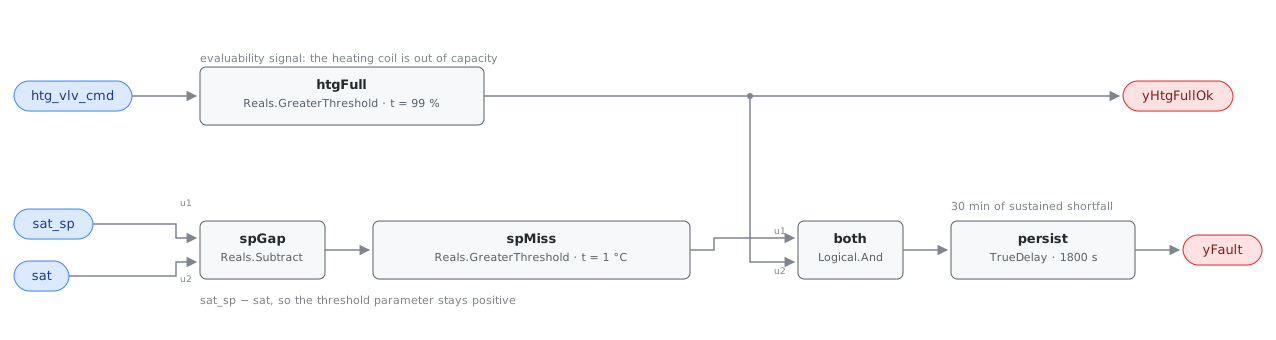
spGap subtracts in the direction that keeps the threshold positive —
sat < sat_sp − ε and sat_sp − sat > ε are the same statement, and the second
needs no negative constant. htgFull is both a term of the fault condition and
the boundary output yHtgFullOk, the same test read two ways: a valve at 60%
with the discharge 6 °C short is not a healthy unit, it is a unit this rule has
no opinion about, because the loop still has capacity and the shortfall could be
a slow morning. False yHtgFullOk means the rule made no claim, and the host
must publish NO_EVAL rather than healthy. Both comparisons are strict: a
shortfall of exactly 1.0 °C is not a fault and a valve reporting exactly 99.0% is
not full, which matters on quantized valve commands (see Deviations). persist
requires 30 continuous minutes, riding out a morning recovery from night
setback; recovery is immediate because TrueDelay has no off-delay, and
delayOnInit = true holds the window across a restart.
Possible Diagnoses
- Heating coil fouled or air-locked — the air side blocked with lint and dust, which an FCU filter in a hotel room reliably supplies, or an air pocket on the water side that a bleed valve clears in minutes
- HW supply temperature too low — a plant or reset-schedule finding, not a unit finding. Check this first: it explains every unit on the riser at once
- Heating valve stuck closed — the command reads 100% and the plug has not moved; the temperature across the coil piping separates this from a fouled coil in thirty seconds at the unit
- SAT sensor out of calibration — a thermistor reading low invents this fault and nothing in the rule can see it. Suspect it first when one unit reports and its neighbours on the same riser do not
Energy Impact
EXCESS_CONSUMPTION, MEDIUM confidence, PROXY_ESTIMATION. The reference gives
2–5% of zone heating energy. PROXY because the rule sees three signals and none
of them is airflow or power: the heat not delivered is
fcu_airflow × ρ × cp × (sat_sp − sat), with airflow coming from the nameplate.
MEDIUM confidence because what the shortfall costs depends on what picks up the
load — an unheated hotel room at 3 a.m. costs nothing, the same room with an
electric space heater under the desk costs a great deal. Heating-dominant by
construction: the rule only evaluates in the heating state.
Emissions Impact
Scope 1, PROXY_EMISSIONS, MEDIUM confidence; typically 50–400 kg CO₂e/yr per FCU. Scope 1 because the heat a fan coil fails to deliver is heat a boiler burned gas to make — the emissions are the combustion the plant did on this unit’s behalf, whether or not the air ever carried it. Avoided-emissions basis is the marginal operating emissions rate (MOER) where the makeup heat is electric; where it is more of the same hot water, the saving is fuel at the boiler.
Deviations
- The chapter states no tunables for this card at all — it carries the
equation and the operating state and nothing else — so all three parameters
here are adopted rather than transcribed, and each is named as such in
params. epsilon_sat= 1.0 °C, adopted from G36. The chapter’s equation namesε_satand never defines it; G36 Table 5.16.14.7 puts εSAT at 1 °C (2 °F), AHU-0007 carries that value, and it is the library’s house convention. It is a sensor-error allowance, not a performance target: raise it and the rule tolerates an underperforming coil, lower it and it becomes a thermistor-accuracy alarm.alarm_delay= 1800 s, adopted from G36 and not from the chapter. The chapter gives FCU-0001 60 min and this card none, so the sibling’s number is not automatically right. 1800 s is G36’s own default and matches AHU-0007; 30 minutes is long for a coil that charges in a few minutes, so a site can safely shorten it once the mode-delay precondition is enforced.hc_full_thresholdcompares strictly, so the chapter’s≥ 99%is read as> 99%. CDL Reals has noGreaterEqual. On an analog signal the difference is measure-zero, but valve commands are frequently quantized to whole percent, which makes it a real blind spot: a host whose command saturates at an integer 99 will never evaluate this rule, and must sethc_full_thresholdto 98.9.epsilon_satcompares strictly too, so a shortfall of exactly 1.0 °C is clear and 1.1 °C alarms. Measure-zero on a real-valued temperature, erring toward silence.- The subtraction runs
sat_sp − sat. The chapter writessat < (sat_sp − ε_sat), which read literally needs a negative threshold on a signed difference; reversing the operands keepsepsilon_satpositive and is algebraically identical. yHtgFullOkis exposed as a boundary output; AHU-0007 exposes onlyyFault. The valve conjunct is computable in-rule and is the whole applicability test for this card, so SCHEMA.md’s rule for in-rule evaluability applies. It is a threshold comparison rather than an echo of the input — a host reading it learns the coil is saturated, whichhtg_vlv_cmdalone does not say without knowinghc_full_threshold. Shape precedent: VFD-0001’syCmdOk.- The valve conjunct is the chapter’s
htg_vlv_cmd ≥ 99%, not “commanded open”. A rule that fired on any open valve would report every FCU in its morning pull-up. - The chapter’s runtime estimator is transcribed but is not scale-invariant.
waste_kw ≈ (sat_sp − sat) / sat_sp × fcu_htg_capacity_kwdivides a temperature difference by a temperature, so a 6 °C shortfall against a 35 °C setpoint reads 17% of capacity and the same physical state in kelvin reads 1.9%. It is kept because the chapter is the source of record, with the dimensionally sound makeup term beside it; a host accumulating energy should use the second. - No coil-entering temperature is available, so there is no companion test.
G36 pairs FC#7 with FC#5 (SAT above MAT) on an air handler, catching a coil
doing nothing at all rather than merely too little. The FCU dictionary carries
ratas the entering proxy (FCU-0004/FCU-0005 use it that way) but this card’s equation does not, and it adds no points the reference did not give it. Recorded as the obvious upgrade:sat > ratin heating needs no adopted constants. - Operating-state gating and the mode delay live in frontmatter, not in the graph. The graph is silent outside full heating only because the valve conjunct happens to be false there, and that coincidence is not a substitute for the host’s OS#1 gate — a unit can saturate its heating valve while the sequence is in a state where the discharge setpoint means something else.
- The reference publishes no vectors, so the whole suite is authored from the equation and every assertion edge was checked by replaying the graph at the pinned engine rev.
- Frontmatter
clustersis empty. The reference lists no cluster for this fault and this card does not invent one; the relationship to the rest of the FCU family is carried by the shared playbook. persist.delayOnInit = true(Modelica/CDL default isfalse), the library’s standing choice: a unit already short of setpoint at full valve waits out the alarm delay instead of alarming on the first tick after a restart.- Severity 3 (warning) and method
rule, per the reference’s chapter 12 card and the FCU index; its §5.8.5 index carries no severity column.
Notes
Order the service by scope. Step 2.2 of the fcu-faults playbook is the plant check — is the hot water supply temperature adequate? — and it belongs first because it is free, remote, and explains the correlated case: if every FCU on a riser reports at once, no coil is fouled, a reset schedule is. If one unit reports and its neighbours do not, step 3.1 is the visit — bleed the coil, then clean it, then verify the valve actually strokes. Diagnosis 4 sits outside that order, and the cheapest way to rule it in is to compare the discharge reading against return air with the valve closed.
Expect FCU-0005 on the same units in the opposite season: a heating valve worn enough not to seat is a valve that will also fail to open fully, and the same seat that leaks in July starves the coil in January.
Test Vectors
12 scenarios, clock step 300 s over 5400 s.
| Scenario | Description |
|---|---|
part_load_heating_holding_setpoint | Healthy OS#1 operation: the valve is at 60% and sat is 0.5 C under a 35.0 C discharge setpoint. Neither half of the conjunction is true - the loop has capacity left and the error is inside epsilon_sat. yHtgFullOk is false throughout, so a host reading it correctly records NO_EVAL rather than a clean bill of health |
full_heating_still_on_setpoint | The valve is wide open on a design-day morning but sat is only 0.5 C short - a unit sized close to its design point, not a broken one. Saturation alone is not a fault, and yHtgFullOk true with yFault false is the one combination that means healthy |
part_load_missing_setpoint | sat is 6 C short of setpoint with the valve at 60%. The coil still has capacity, so the shortfall is a control-loop finding rather than a capacity finding and this rule makes no claim: yFault false because yHtgFullOk is false |
full_heating_missing_setpoint | The reportable case: valve at 100% and sat 6 C below setpoint. The coil is saturated and still losing, so the shortfall is capacity, hot water supply, or sensing. Alarms one alarm_delay (1800 s) after the condition appears |
error_exactly_at_threshold | Threshold edge, low side: sat_sp - sat = 1.0 C exactly with the valve at 100%. spMiss is a strict ‘>’, so an error sitting precisely on epsilon_sat reads healthy |
error_just_over_threshold | Threshold edge, high side: sat_sp - sat = 1.1 C clears the strict comparison and alarms after alarm_delay |
valve_exactly_at_full_threshold | Threshold edge, low side on the valve: the command reports exactly 99.0% with a 6 C error present. htgFull is a strict ‘>’, so the chapter’s ‘htg_vlv_cmd >= 99%’ reads as not-full here - the case a host with integer-quantized valve feedback must retune hc_full_threshold to 98.9 to catch. yHtgFullOk false says NO_EVAL, which is the honest verdict |
valve_just_over_full_threshold | Threshold edge, high side on the valve: 99.5% clears the strict comparison, so the same 6 C error alarms after alarm_delay |
morning_warmup_clears_before_delay | Transient: the coil pins at 100% and sat sits 6 C short through a cold start, then reaches 34.5 C at t = 1200 s. Twenty minutes is short of alarm_delay, so an FCU recovering from night setback never alarms |
valve_modulates_off_before_delay | Transient on the other input: the 6 C error holds but the valve backs off to 70% at t = 1200 s, which means the loop was never out of capacity. Both halves must be true at once, so persistence restarts and no alarm follows. yHtgFullOk drops with the valve, telling the host the rule stopped evaluating rather than cleared |
fault_clears_on_recovery | A sustained shortfall alarms at 1800 s; hot water returns at t = 3000 s and sat reaches 34.5 C, dropping the alarm on that tick - TrueDelay has no off-delay |
valve_closed_unit_off | The FCU is idle: the valve is at 0% and sat has drifted to room temperature, 15 C below the discharge setpoint. yHtgFullOk is false and yFault stays false - the rule is structurally silent on a unit that is not heating, which is NO_EVAL and not a health claim |
vectors.json
{
  "schema": "cxf-library/vectors/v1",
  "clock": {
    "step_s": 300,
    "horizon_s": 5400
  },
  "scenarios": [
    {
      "name": "part_load_heating_holding_setpoint",
      "description": "Healthy OS#1 operation: the valve is at 60% and sat is 0.5 C under a 35.0 C discharge setpoint. Neither half of the conjunction is true - the loop has capacity left and the error is inside epsilon_sat. yHtgFullOk is false throughout, so a host reading it correctly records NO_EVAL rather than a clean bill of health",
      "inputs": {
        "sat": 34.5,
        "sat_sp": 35.0,
        "htg_vlv_cmd": 60.0
      },
      "expect": [
        {
          "output": "yFault",
          "from_s": 0,
          "to_s": 5400,
          "equals": false
        },
        {
          "output": "yHtgFullOk",
          "from_s": 0,
          "to_s": 5400,
          "equals": false
        }
      ]
    },
    {
      "name": "full_heating_still_on_setpoint",
      "description": "The valve is wide open on a design-day morning but sat is only 0.5 C short - a unit sized close to its design point, not a broken one. Saturation alone is not a fault, and yHtgFullOk true with yFault false is the one combination that means healthy",
      "inputs": {
        "sat": 34.5,
        "sat_sp": 35.0,
        "htg_vlv_cmd": 100.0
      },
      "expect": [
        {
          "output": "yFault",
          "from_s": 0,
          "to_s": 5400,
          "equals": false
        },
        {
          "output": "yHtgFullOk",
          "from_s": 0,
          "to_s": 5400,
          "equals": true
        }
      ]
    },
    {
      "name": "part_load_missing_setpoint",
      "description": "sat is 6 C short of setpoint with the valve at 60%. The coil still has capacity, so the shortfall is a control-loop finding rather than a capacity finding and this rule makes no claim: yFault false because yHtgFullOk is false",
      "inputs": {
        "sat": 29.0,
        "sat_sp": 35.0,
        "htg_vlv_cmd": 60.0
      },
      "expect": [
        {
          "output": "yFault",
          "from_s": 0,
          "to_s": 5400,
          "equals": false
        },
        {
          "output": "yHtgFullOk",
          "from_s": 0,
          "to_s": 5400,
          "equals": false
        }
      ]
    },
    {
      "name": "full_heating_missing_setpoint",
      "description": "The reportable case: valve at 100% and sat 6 C below setpoint. The coil is saturated and still losing, so the shortfall is capacity, hot water supply, or sensing. Alarms one alarm_delay (1800 s) after the condition appears",
      "inputs": {
        "sat": 29.0,
        "sat_sp": 35.0,
        "htg_vlv_cmd": 100.0
      },
      "expect": [
        {
          "output": "yFault",
          "from_s": 0,
          "to_s": 1500,
          "equals": false
        },
        {
          "output": "yFault",
          "from_s": 2100,
          "to_s": 5400,
          "equals": true
        },
        {
          "output": "yHtgFullOk",
          "from_s": 0,
          "to_s": 5400,
          "equals": true
        }
      ]
    },
    {
      "name": "error_exactly_at_threshold",
      "description": "Threshold edge, low side: sat_sp - sat = 1.0 C exactly with the valve at 100%. spMiss is a strict '>', so an error sitting precisely on epsilon_sat reads healthy",
      "inputs": {
        "sat": 34.0,
        "sat_sp": 35.0,
        "htg_vlv_cmd": 100.0
      },
      "expect": [
        {
          "output": "yFault",
          "from_s": 0,
          "to_s": 5400,
          "equals": false
        },
        {
          "output": "yHtgFullOk",
          "from_s": 0,
          "to_s": 5400,
          "equals": true
        }
      ]
    },
    {
      "name": "error_just_over_threshold",
      "description": "Threshold edge, high side: sat_sp - sat = 1.1 C clears the strict comparison and alarms after alarm_delay",
      "inputs": {
        "sat": 33.9,
        "sat_sp": 35.0,
        "htg_vlv_cmd": 100.0
      },
      "expect": [
        {
          "output": "yFault",
          "from_s": 0,
          "to_s": 1500,
          "equals": false
        },
        {
          "output": "yFault",
          "from_s": 2100,
          "to_s": 5400,
          "equals": true
        },
        {
          "output": "yHtgFullOk",
          "from_s": 0,
          "to_s": 5400,
          "equals": true
        }
      ]
    },
    {
      "name": "valve_exactly_at_full_threshold",
      "description": "Threshold edge, low side on the valve: the command reports exactly 99.0% with a 6 C error present. htgFull is a strict '>', so the chapter's 'htg_vlv_cmd >= 99%' reads as not-full here - the case a host with integer-quantized valve feedback must retune hc_full_threshold to 98.9 to catch. yHtgFullOk false says NO_EVAL, which is the honest verdict",
      "inputs": {
        "sat": 29.0,
        "sat_sp": 35.0,
        "htg_vlv_cmd": 99.0
      },
      "expect": [
        {
          "output": "yFault",
          "from_s": 0,
          "to_s": 5400,
          "equals": false
        },
        {
          "output": "yHtgFullOk",
          "from_s": 0,
          "to_s": 5400,
          "equals": false
        }
      ]
    },
    {
      "name": "valve_just_over_full_threshold",
      "description": "Threshold edge, high side on the valve: 99.5% clears the strict comparison, so the same 6 C error alarms after alarm_delay",
      "inputs": {
        "sat": 29.0,
        "sat_sp": 35.0,
        "htg_vlv_cmd": 99.5
      },
      "expect": [
        {
          "output": "yFault",
          "from_s": 0,
          "to_s": 1500,
          "equals": false
        },
        {
          "output": "yFault",
          "from_s": 2100,
          "to_s": 5400,
          "equals": true
        },
        {
          "output": "yHtgFullOk",
          "from_s": 0,
          "to_s": 5400,
          "equals": true
        }
      ]
    },
    {
      "name": "morning_warmup_clears_before_delay",
      "description": "Transient: the coil pins at 100% and sat sits 6 C short through a cold start, then reaches 34.5 C at t = 1200 s. Twenty minutes is short of alarm_delay, so an FCU recovering from night setback never alarms",
      "inputs": {
        "sat": [
          {
            "t": 0,
            "value": 29.0
          },
          {
            "t": 1200,
            "value": 34.5
          }
        ],
        "sat_sp": 35.0,
        "htg_vlv_cmd": 100.0
      },
      "expect": [
        {
          "output": "yFault",
          "from_s": 0,
          "to_s": 5400,
          "equals": false
        },
        {
          "output": "yHtgFullOk",
          "from_s": 0,
          "to_s": 5400,
          "equals": true
        }
      ]
    },
    {
      "name": "valve_modulates_off_before_delay",
      "description": "Transient on the other input: the 6 C error holds but the valve backs off to 70% at t = 1200 s, which means the loop was never out of capacity. Both halves must be true at once, so persistence restarts and no alarm follows. yHtgFullOk drops with the valve, telling the host the rule stopped evaluating rather than cleared",
      "inputs": {
        "sat": 29.0,
        "sat_sp": 35.0,
        "htg_vlv_cmd": [
          {
            "t": 0,
            "value": 100.0
          },
          {
            "t": 1200,
            "value": 70.0
          }
        ]
      },
      "expect": [
        {
          "output": "yFault",
          "from_s": 0,
          "to_s": 5400,
          "equals": false
        },
        {
          "output": "yHtgFullOk",
          "from_s": 0,
          "to_s": 900,
          "equals": true
        },
        {
          "output": "yHtgFullOk",
          "from_s": 1200,
          "to_s": 5400,
          "equals": false
        }
      ]
    },
    {
      "name": "fault_clears_on_recovery",
      "description": "A sustained shortfall alarms at 1800 s; hot water returns at t = 3000 s and sat reaches 34.5 C, dropping the alarm on that tick - TrueDelay has no off-delay",
      "inputs": {
        "sat": [
          {
            "t": 0,
            "value": 29.0
          },
          {
            "t": 3000,
            "value": 34.5
          }
        ],
        "sat_sp": 35.0,
        "htg_vlv_cmd": 100.0
      },
      "expect": [
        {
          "output": "yFault",
          "from_s": 0,
          "to_s": 1500,
          "equals": false
        },
        {
          "output": "yFault",
          "from_s": 2100,
          "to_s": 2700,
          "equals": true
        },
        {
          "output": "yFault",
          "from_s": 3300,
          "to_s": 5400,
          "equals": false
        },
        {
          "output": "yHtgFullOk",
          "from_s": 0,
          "to_s": 5400,
          "equals": true
        }
      ]
    },
    {
      "name": "valve_closed_unit_off",
      "description": "The FCU is idle: the valve is at 0% and sat has drifted to room temperature, 15 C below the discharge setpoint. yHtgFullOk is false and yFault stays false - the rule is structurally silent on a unit that is not heating, which is NO_EVAL and not a health claim",
      "inputs": {
        "sat": 20.0,
        "sat_sp": 35.0,
        "htg_vlv_cmd": 0.0
      },
      "expect": [
        {
          "output": "yFault",
          "from_s": 0,
          "to_s": 5400,
          "equals": false
        },
        {
          "output": "yHtgFullOk",
          "from_s": 0,
          "to_s": 5400,
          "equals": false
        }
      ]
    }
  ]
}