HW-0005 — HW loop DP too high (pump speed vs mild OAT)
| Status | verified — engine e2ff2f8, cxf:fnv1a128:6d35dff9c968ba4897bf8966d5555c16, 2026-08-17 |
| Severity | 3 |
| Method | rule |
| Phase | 2 |
| Category | EXCESS_CONSUMPTION |
| Confidence | MEDIUM |
| Estimation | PROXY_ESTIMATION |
| G36 | — |
| Clusters | — |
| Suppresses | — |
| Suppressed by | — |
| Related | HW-0004, HW-0006, HW-0003, CHW-0003, PMP-0002 |
| Playbooks | hot-water-plant-faults |
| Source | PNNL-27338 §4.2 (high hot-water loop differential pressure, pp. 4.7-4.8) — both thresholds: pump VFD above 45% with outdoor air above 60 °F; PNNL-27338 (Katipamula et al. 2018) — adapted via an internal paraphrased deep-read digest, not distributed (paraphrased algorithm digest; candidate 4); Sibling precedent: HW-0003 (mild-OAT comparator plus TrueDelay), CHW-0004 (evaluability output shape), CHW-0003 (the DP-reset finding this rule does not duplicate); Library extension: the HVAC FDD Reference v1.0 ch.14 specifies only HW-0001..052 — see faults/hw/README.md |
| Operating states | Heating distribution enabled with variable-speed pumps under differential-pressure control, in weather above mild_weather_oat — the rule’s own yMildWeather is that second half |
Preconditions (host-enforced): hw_pump_vfd_speed must be a speed feedback from the distribution pumps that serve the heating loop, and it must fall to zero when the pump stops. A drive that latches its last commanded speed while stopped, or a point bound to the speed command rather than the feedback, fabricates this fault on an idle plant; bind the feedback, or gate host-side on hw_pump_status. On a multi-pump loop bind the lead drive or a host-computed maximum across the running drives — an average across a lead/standby pair halves the reading and hides the fault. The loop must be variable-flow under DP control for the inference to hold at all: a constant-speed pump reads full speed forever and alarms every mild day, and a three-way-valve loop has no DP control to mis-set. oat must be a trustworthy outdoor reading on the same site; a sensor in afternoon sun reads high and manufactures evaluability, one shaded or over-damped reads low and hides the fault for weeks. The plant must not be circulating for a domestic hot water or process load: a DHW recirculation pump running through July is not a DP setpoint fault, and nothing in two points tells them apart — exclude the rule, bind a pump that does not serve DHW, or accept summer noise, the same decision HW-0003 forces. Evaluability is signalled in-rule by yMildWeather; when it is false the verdict is NO_EVAL, not a healthy loop.
Points: hw_pump_vfd_speed, oat
Outputs:
yFault— True while the HW distribution pumps have run above high_pump_speed with outdoor air above mild_weather_oat, continuously for at least alarm_delayyMildWeather— Evaluability signal — true when oat is above mild_weather_oat, the weather above which a hard-working distribution pump has no load to justify it. False means NO_EVAL and the host must ignore yFault
Parameters:
| Name | Default | Unit | CXF path | Description |
|---|---|---|---|---|
high_pump_speed | 45.0 | % | pumpHigh.t | Distribution pump speed above which the pumps are working harder than mild weather can justify. PNNL-27338 §4.2’s threshold verbatim (its avg_pump_vfd > 45%). |
mild_weather_oat | 15.6 | °C | mildOat.t | Outdoor air temperature above which the heating load is light enough that pump speed becomes evidence about the DP setpoint. PNNL-27338 §4.2’s 60 °F, converted and rounded to a tenth of a kelvin. Distinct from HW-0003’s heating_plant_lockout_temp despite the similar value — different rule, different source, retune separately (see Deviations). |
alarm_delay | 3600.0 | s | sustained.delayTime | Continuous hard pumping in mild weather required before the alarm asserts (60 min). ADOPTED — PNNL-27338 specifies a 15-60 min averaging window (§1.2), not an alarm persistence; 60 min matches HW-0003 and HW-0004. |
Description
A variable-speed heating loop tells you what its pressure setpoint costs by how fast the pumps have to run. On a mild day the heating valves are mostly closed and a pump holding a properly reset differential pressure should be near its minimum; find it still turning at 80% and the loop is being pressurised to a number nobody chose for that day — almost always the design-day setpoint the balancer left behind. The evidence is the pump, not the pressure: the setpoint is being tracked perfectly in nearly every building carrying this fault, which is exactly why the waste is invisible on a DP trend. Pump power follows the cube of speed, so the economics are unusually good — the repair is a reset schedule and a lower base setpoint, both remote. This rule is a library extension; the reference’s ch.14 stops at HW-0003 and both thresholds come from PNNL-27338 §4.2.
Detection Logic
yMildWeather = oat > mild_weather_oat                    (false ⇒ host reports NO_EVAL)
yFault = hw_pump_vfd_speed > high_pump_speed AND yMildWeather,
         sustained continuously for alarm_delay
Block graph (rule.cxf.jsonld):
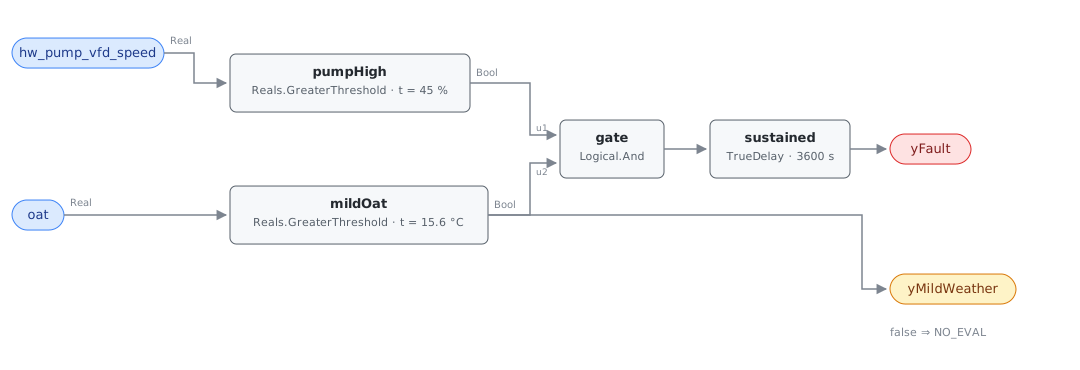
Four blocks, and both comparisons are PNNL-27338 §4.2’s own numbers. pumpHigh
and mildOat are strict, so a drive sitting exactly at 45.0% reads clear and
outdoor air exactly at 15.6 °C is NO_EVAL rather than a fault.
mildOat.y feeds both the conjunction and the yMildWeather boundary output,
and that second consumer is the whole NO_EVAL story: on a cold day a pump at 80%
is doing what it was bought to do, so yFault = false there means the question
was not asked. It also separates a repair from the weather turning — when the
alarm and its evaluability drop on the same tick, nothing was fixed.
sustained requires 60 continuous minutes and carries delayOnInit = true.
Continuous means continuous: a dip below the speed threshold discards the
elapsed time rather than pausing it, so the clock restarts from the second
crossing. TrueDelay asserts at exactly T + delayTime, making the realized
test “above both thresholds for strictly more than alarm_delay” at tick
resolution.
Possible Diagnoses
Library-authored — PNNL-27338 §4.2 specifies a threshold test, not causes:
- No DP reset schedule at all — the usual finding and the reason this rule exists. HW-0006 tests the setpoint trend directly and is the confirming rule
- A reset that exists but resets from the wrong thing, or across too narrow a range — outdoor-air-based reset on an internally-driven load, or a 10 kPa span on a loop that could give up 60
- The base setpoint itself too high — a commissioned schedule whose whole range sits above what the loop needs looks healthy on a setpoint trend and still fails this test, which is the case HW-0006 cannot see
- Balancing valves throttled hard at the far end of the loop, so the pumps overcome a restriction a rebalance would remove
- The DP sensor in the wrong place — at the pump discharge rather than near the hydraulically most remote coil, forcing the loop to carry a distribution loss no coil ever sees
- Manual override or hand mode on the drive, which reads identically to a setpoint that is too high
- Oversized pumps against a load the building never reached — the case with no repair beyond a trim or a lower setpoint, where the speed is telling the truth
Energy Impact
EXCESS_CONSUMPTION, MEDIUM confidence, PROXY_ESTIMATION. The waste is pump
electricity and the arithmetic is the affinity law:
pump_waste_kw ≈ hw_pump_kw × [1 − (1 − speed_reduction/100)³], CHW-0003’s
estimator on the heating loop’s drives — a loop that could run at 55% instead of
80% is giving away roughly two thirds of its pump power. §4.2 publishes no
savings range, so savings_range carries the DP-reset figure this library uses
on the chilled water side (0.5-2% of site energy, PNNL-25985 EEM-10/11); treat
it as an order of magnitude. Confidence is MEDIUM because the evidence is one
step removed — the rule does not measure the setpoint, and diagnoses 4 through 7
fail the test honestly.
Emissions Impact
Scope 2, PROXY_EMISSIONS, MEDIUM confidence. All of the direct waste is purchased electricity for the distribution pumps, so the scope does not vary by site the way a boiler fault’s does and the marginal operating emissions rate is the right factor. There is a second-order Scope 1 term this card does not quantify: over-pressurising the loop costs valve authority and therefore delta-T, and that penalty belongs to HW-0004, which measures it directly.
Deviations
- This rule is a library extension, not a transcription. The reference’s
ch.14 specifies HW-0001, 051 and 052 and stops;
faults/hw/README.mdframes FC-053 through 057 as library-authored rules grounded in PNNL-27338 §4. The name, severity 3 andmethod: ruleare that index’s, both thresholds are §4.2’s, and the graph is HW-0003’s shape; the rest is authored here. hw_dpandhw_dp_spare deliberately not bound. A DP tracking comparison measures whether the pressure controller is working, and in almost every building carrying this fault it is working perfectly. A DP threshold would need a per-loop number with no published basis — 60 kPa is generous on one loop and starvation on another, and §4.2 does not test pressure either. Pump speed already normalises for the loop, because it is what the plant must do to hold whatever setpoint it has. Binding the pressure points as context would also make them binding obligations for signals the graph never reads, sopointsstays at two.yMildWeatheris an evaluability output, and HW-0003’s identical comparison deliberately is not. There the mild weather is the fault claim, so a cold day is a healthy verdict; here it is what makes a pump-speed reading interpretable at all, soyFault = falsebelow the floor must not be read as a clean loop. Exposing the conjunct adds no logic and changes no verdict, and it is a comparison against a parameter rather than an echo of an input, which is what SCHEMA.md asks such an output to be. Same shape as CHW-0004’syLoadOk.- 15.6 °C and 16.0 °C are two different parameters and must stay that way.
This rule’s
mild_weather_oatis §4.2’s 60 °F converted and rounded to a tenth; HW-0003’sheating_plant_lockout_tempis the reference’s ch.14 number. One is the temperature above which a heating plant should be off, the other the temperature above which pump speed becomes evidence — a host that consolidates them retunes two rules with one edit. - Strict
>on both comparisons. CDLRealshas noGreaterEqual, and §4.2’s own arithmetic is strict. Both disagreements are measure-zero and both err toward silence, but a BAS that quantises drive speed to whole percent or outdoor air to whole degrees will sit on a boundary often, and should set the parameters between two quantisation levels. - Persistence stands in for PNNL’s window average. §4.2 tests
avg_pump_vfdandavg_OATover a 15-60 minute window (§1.2); this rule consumes instantaneous points and requires the condition continuously, so a 10-minute dip to 40% restarts the hour where an average would have carried through it. The trade — never alarming on a transient, but talkable-out-of a finding by a loop that oscillates around the threshold — is worth it on a fault whose whole character is that it sits still for months. - No run-status conjunct. The rule reads speed alone and relies on a stopped
pump reporting 0%. Adding
hw_pump_statuswould guard against drives that latch their last commanded speed while stopped, at the cost of a third point and a second binding obligation for what is a wiring question rather than a plant one. It ispreconditionstext instead, alongside the multi-pump binding rule (lead drive or host-computed maximum, never an average across a lead/standby pair). - The domestic-hot-water confound is HW-0003’s, and is not detectable here
either. A plant circulating in July for a service water or process load runs
its pumps in mild weather for a legitimate reason and produces identical values
on both points. Exclude the rule, bind a pump that does not serve DHW, or
accept summer noise — never raise
mild_weather_oat, which converts a false positive into a silent miss across the whole shoulder season. suppressesandsuppressed_byare both empty, and the HW-0006 pairing is why that is worth saying. The tempting edge is “HW-0006 suppresses HW-0005”, and it is wrong in both directions: a commissioned reset whose entire range sits too high fails this test and passes HW-0006’s (diagnosis 3), while a flat setpoint low enough to keep the drives under 45% fails HW-0006’s and passes this one. Where both fire they are cause and consequence, and suppressing the consequence would delete the energy claim that justifies writing the reset schedule.related, not suppression.playbooks: [hot-water-plant-faults], notmissing-reset. The hot water playbook’s Step 3 ends on this finding — high HW differential pressure setpoints, reset from the most-open valve — and its energy row names the same PNNL-27338 measures.missing-resetis the natural home for HW-0006, whose verification step is a setpoint trend; this rule’s is a pump-speed trend against outdoor air. The playbook’s Applies-To row is the index owner’s edit.clusters: [].clusters/clusters.jsonhas no hot water cluster, and CLU-02 (Missing Reset Strategy) is triggered by AHU-0023 with AHU and CHW members; this rule is a plausible future member and adding it is the cluster owner’s edit.alarm_delay = 3600 sis adopted. PNNL-27338 specifies a data window and a minimum sample count, not an alarm persistence; an hour matches HW-0003 and HW-0004, and this fault moves on a scale of months.sustained.delayOnInit = true(CDL defaultfalse), the library’s standing choice: a plant already pumping hard in mild weather at controller restart waits out the full hour rather than alarming on the first tick.- No published test vectors exist for this algorithm. §4.2 specifies
thresholds, not cases, so every scenario in
vectors.jsonis authored from the equation and replayed against the pinned engine rev. - Operating states and preconditions are declared in frontmatter for host enforcement rather than encoded in the block graph, per the library’s design stance.
Notes
Read yMildWeather before yFault. Through most of a heating season this rule
is not evaluating anything, which is the intended behaviour: it has one useful
window, the mild hours.
Verify with a scatter plot before dispatching anyone. Plot pump speed against outdoor air for a fortnight of the shoulder season: a loop with a working reset draws a slope, a loop with this fault draws a horizontal band, and the height of that band is roughly what the setpoint is costing. If the DP setpoint trend is flat the finding is HW-0006’s as well and the schedule is the repair; if it moves and the pumps still do not slow down, the base setpoint is too high.
Then find the DP sensor — diagnosis 5 survives every remote fix, because no reset schedule written against a sensor at the pump discharge can give back a distribution loss no coil ever sees. Re-check the loop’s delta-T after the setpoint comes down; this fault and HW-0004 travel together.
Test Vectors
16 scenarios, clock step 60 s over 7200 s.
| Scenario | Description |
|---|---|
mild_day_pumps_loafing | The healthy mild-weather case: 20 degC outdoors and the distribution pumps at 30%. The loop is asking for little and the drives have backed off, which is what a working DP reset looks like. |
cold_day_pumps_working_hard | NO_EVAL: 0 degC outdoors with the pumps at 80%. The plant is meant to work hard on a design day, so pump speed carries no information about the DP setpoint and yMildWeather = false tells the host not to read yFault as a clean bill of health. |
mild_day_pumps_working_hard | The fault as PNNL-27338 sec.4.2 writes it: 20 degC outdoors, pumps at 80%. Light load, hard-working pumps, and the alarm lands at exactly alarm_delay because delayOnInit holds the condition from the first tick. |
pump_speed_exactly_at_the_threshold | Threshold edge from below: the drives sit exactly on high_pump_speed (45%) in mild weather. Reals.GreaterThreshold is strict, so 45.0% is not above 45.0% and nothing is reported. |
pump_speed_just_below_the_threshold | 44.9% in the same mild weather: still clear, by a tenth of a percent of drive speed. |
pump_speed_just_above_the_threshold | 45.1% in the same mild weather: the alarm arrives at 3600 s. Both sides of the pump-speed boundary are pinned so the strictness cannot change silently. |
oat_exactly_at_the_mild_weather_floor | Threshold edge on the evaluability conjunct: outdoor air exactly at mild_weather_oat (15.6 degC) with the pumps at 80%. Strict comparison, so exactly-at-the-floor is NO_EVAL rather than a fault. |
oat_just_below_the_mild_weather_floor | 15.5 degC with the same hard-working pumps: still NO_EVAL. |
oat_just_above_the_mild_weather_floor | 15.7 degC with the same hard-working pumps: evaluable, and the alarm lands at exactly alarm_delay. A tenth of a degree of outdoor air is the whole difference between this scenario and the one before last. |
plant_off_in_mild_weather | The other healthy mild-weather case: the distribution is off and the drive reports 0%. The rule needs no run-status conjunct as long as the speed feedback falls to zero with the pump - a drive that latches its last commanded speed while stopped fabricates this fault, which is why preconditions asks for feedback rather than command. |
morning_warms_through_the_floor | A spring morning: the pumps run at 80% from midnight and outdoor air crosses 15.6 degC at t = 1800 s. The clock starts at the crossing, not at the start of the run, and the alarm lands at 5400 s. |
pumps_slow_after_alarm | The repair, seen from the trend: the DP setpoint is reset down at t = 5400 s and the drives fall to 30%. yFault clears on that tick - TrueDelay passes the falling edge with no delay - while yMildWeather stays true, so the host can tell a fix from a weather change. |
evening_cooldown_releases_evaluability | The weather change, for contrast: an alarming plant sees outdoor air fall to 10 degC at t = 5400 s with the pumps still at 80%. yFault and yMildWeather drop on the same tick and nothing was repaired. |
pump_speed_dips_and_restarts_the_clock | Persistence is continuous, not accumulated: a 600 s dip to 40% at t = 1800 s discards the elapsed time rather than pausing it, so the alarm lands at 6000 s - one full alarm_delay after the second crossing. PNNL-27338’s window average would have carried the dip through instead (see Deviations). |
pumps_slow_on_the_maturity_tick | Delay edge from below: the condition holds from t = 0 and the drives fall to 30% at exactly 3600 s, the tick the timer matures on. The input is false when the timer comes due, so a full hour of hard pumping in mild weather is never reported. |
pumps_slow_one_tick_later | Delay edge from above: the same run held 60 s longer asserts at exactly 3600 s and clears at 3660 s. The pair makes the T + delayTime boundary observable rather than assumed. |
vectors.json
{
  "schema": "cxf-library/vectors/v1",
  "clock": {
    "step_s": 60,
    "horizon_s": 7200
  },
  "scenarios": [
    {
      "name": "mild_day_pumps_loafing",
      "description": "The healthy mild-weather case: 20 degC outdoors and the distribution pumps at 30%. The loop is asking for little and the drives have backed off, which is what a working DP reset looks like.",
      "inputs": {
        "hw_pump_vfd_speed": 30.0,
        "oat": 20.0
      },
      "expect": [
        {
          "output": "yFault",
          "from_s": 0,
          "to_s": 7200,
          "equals": false
        },
        {
          "output": "yMildWeather",
          "from_s": 0,
          "to_s": 7200,
          "equals": true
        }
      ]
    },
    {
      "name": "cold_day_pumps_working_hard",
      "description": "NO_EVAL: 0 degC outdoors with the pumps at 80%. The plant is meant to work hard on a design day, so pump speed carries no information about the DP setpoint and yMildWeather = false tells the host not to read yFault as a clean bill of health.",
      "inputs": {
        "hw_pump_vfd_speed": 80.0,
        "oat": 0.0
      },
      "expect": [
        {
          "output": "yFault",
          "from_s": 0,
          "to_s": 7200,
          "equals": false
        },
        {
          "output": "yMildWeather",
          "from_s": 0,
          "to_s": 7200,
          "equals": false
        }
      ]
    },
    {
      "name": "mild_day_pumps_working_hard",
      "description": "The fault as PNNL-27338 sec.4.2 writes it: 20 degC outdoors, pumps at 80%. Light load, hard-working pumps, and the alarm lands at exactly alarm_delay because delayOnInit holds the condition from the first tick.",
      "inputs": {
        "hw_pump_vfd_speed": 80.0,
        "oat": 20.0
      },
      "expect": [
        {
          "output": "yFault",
          "from_s": 0,
          "to_s": 3540,
          "equals": false
        },
        {
          "output": "yFault",
          "from_s": 3600,
          "to_s": 7200,
          "equals": true
        },
        {
          "output": "yMildWeather",
          "from_s": 0,
          "to_s": 7200,
          "equals": true
        }
      ]
    },
    {
      "name": "pump_speed_exactly_at_the_threshold",
      "description": "Threshold edge from below: the drives sit exactly on high_pump_speed (45%) in mild weather. Reals.GreaterThreshold is strict, so 45.0% is not above 45.0% and nothing is reported.",
      "inputs": {
        "hw_pump_vfd_speed": 45.0,
        "oat": 20.0
      },
      "expect": [
        {
          "output": "yFault",
          "from_s": 0,
          "to_s": 7200,
          "equals": false
        },
        {
          "output": "yMildWeather",
          "from_s": 0,
          "to_s": 7200,
          "equals": true
        }
      ]
    },
    {
      "name": "pump_speed_just_below_the_threshold",
      "description": "44.9% in the same mild weather: still clear, by a tenth of a percent of drive speed.",
      "inputs": {
        "hw_pump_vfd_speed": 44.9,
        "oat": 20.0
      },
      "expect": [
        {
          "output": "yFault",
          "from_s": 0,
          "to_s": 7200,
          "equals": false
        },
        {
          "output": "yMildWeather",
          "from_s": 0,
          "to_s": 7200,
          "equals": true
        }
      ]
    },
    {
      "name": "pump_speed_just_above_the_threshold",
      "description": "45.1% in the same mild weather: the alarm arrives at 3600 s. Both sides of the pump-speed boundary are pinned so the strictness cannot change silently.",
      "inputs": {
        "hw_pump_vfd_speed": 45.1,
        "oat": 20.0
      },
      "expect": [
        {
          "output": "yFault",
          "from_s": 0,
          "to_s": 3540,
          "equals": false
        },
        {
          "output": "yFault",
          "from_s": 3600,
          "to_s": 7200,
          "equals": true
        },
        {
          "output": "yMildWeather",
          "from_s": 0,
          "to_s": 7200,
          "equals": true
        }
      ]
    },
    {
      "name": "oat_exactly_at_the_mild_weather_floor",
      "description": "Threshold edge on the evaluability conjunct: outdoor air exactly at mild_weather_oat (15.6 degC) with the pumps at 80%. Strict comparison, so exactly-at-the-floor is NO_EVAL rather than a fault.",
      "inputs": {
        "hw_pump_vfd_speed": 80.0,
        "oat": 15.6
      },
      "expect": [
        {
          "output": "yFault",
          "from_s": 0,
          "to_s": 7200,
          "equals": false
        },
        {
          "output": "yMildWeather",
          "from_s": 0,
          "to_s": 7200,
          "equals": false
        }
      ]
    },
    {
      "name": "oat_just_below_the_mild_weather_floor",
      "description": "15.5 degC with the same hard-working pumps: still NO_EVAL.",
      "inputs": {
        "hw_pump_vfd_speed": 80.0,
        "oat": 15.5
      },
      "expect": [
        {
          "output": "yFault",
          "from_s": 0,
          "to_s": 7200,
          "equals": false
        },
        {
          "output": "yMildWeather",
          "from_s": 0,
          "to_s": 7200,
          "equals": false
        }
      ]
    },
    {
      "name": "oat_just_above_the_mild_weather_floor",
      "description": "15.7 degC with the same hard-working pumps: evaluable, and the alarm lands at exactly alarm_delay. A tenth of a degree of outdoor air is the whole difference between this scenario and the one before last.",
      "inputs": {
        "hw_pump_vfd_speed": 80.0,
        "oat": 15.7
      },
      "expect": [
        {
          "output": "yFault",
          "from_s": 0,
          "to_s": 3540,
          "equals": false
        },
        {
          "output": "yFault",
          "from_s": 3600,
          "to_s": 7200,
          "equals": true
        },
        {
          "output": "yMildWeather",
          "from_s": 0,
          "to_s": 7200,
          "equals": true
        }
      ]
    },
    {
      "name": "plant_off_in_mild_weather",
      "description": "The other healthy mild-weather case: the distribution is off and the drive reports 0%. The rule needs no run-status conjunct as long as the speed feedback falls to zero with the pump - a drive that latches its last commanded speed while stopped fabricates this fault, which is why preconditions asks for feedback rather than command.",
      "inputs": {
        "hw_pump_vfd_speed": 0.0,
        "oat": 25.0
      },
      "expect": [
        {
          "output": "yFault",
          "from_s": 0,
          "to_s": 7200,
          "equals": false
        },
        {
          "output": "yMildWeather",
          "from_s": 0,
          "to_s": 7200,
          "equals": true
        }
      ]
    },
    {
      "name": "morning_warms_through_the_floor",
      "description": "A spring morning: the pumps run at 80% from midnight and outdoor air crosses 15.6 degC at t = 1800 s. The clock starts at the crossing, not at the start of the run, and the alarm lands at 5400 s.",
      "inputs": {
        "hw_pump_vfd_speed": 80.0,
        "oat": [
          {
            "t": 0,
            "value": 12.0
          },
          {
            "t": 1800,
            "value": 20.0
          }
        ]
      },
      "expect": [
        {
          "output": "yFault",
          "from_s": 0,
          "to_s": 5340,
          "equals": false
        },
        {
          "output": "yFault",
          "from_s": 5400,
          "to_s": 7200,
          "equals": true
        },
        {
          "output": "yMildWeather",
          "from_s": 0,
          "to_s": 1740,
          "equals": false
        },
        {
          "output": "yMildWeather",
          "from_s": 1800,
          "to_s": 7200,
          "equals": true
        }
      ]
    },
    {
      "name": "pumps_slow_after_alarm",
      "description": "The repair, seen from the trend: the DP setpoint is reset down at t = 5400 s and the drives fall to 30%. yFault clears on that tick - TrueDelay passes the falling edge with no delay - while yMildWeather stays true, so the host can tell a fix from a weather change.",
      "inputs": {
        "hw_pump_vfd_speed": [
          {
            "t": 0,
            "value": 80.0
          },
          {
            "t": 5400,
            "value": 30.0
          }
        ],
        "oat": 20.0
      },
      "expect": [
        {
          "output": "yFault",
          "from_s": 0,
          "to_s": 3540,
          "equals": false
        },
        {
          "output": "yFault",
          "from_s": 3600,
          "to_s": 5340,
          "equals": true
        },
        {
          "output": "yFault",
          "from_s": 5400,
          "to_s": 7200,
          "equals": false
        },
        {
          "output": "yMildWeather",
          "from_s": 0,
          "to_s": 7200,
          "equals": true
        }
      ]
    },
    {
      "name": "evening_cooldown_releases_evaluability",
      "description": "The weather change, for contrast: an alarming plant sees outdoor air fall to 10 degC at t = 5400 s with the pumps still at 80%. yFault and yMildWeather drop on the same tick and nothing was repaired.",
      "inputs": {
        "hw_pump_vfd_speed": 80.0,
        "oat": [
          {
            "t": 0,
            "value": 20.0
          },
          {
            "t": 5400,
            "value": 10.0
          }
        ]
      },
      "expect": [
        {
          "output": "yFault",
          "from_s": 0,
          "to_s": 3540,
          "equals": false
        },
        {
          "output": "yFault",
          "from_s": 3600,
          "to_s": 5340,
          "equals": true
        },
        {
          "output": "yFault",
          "from_s": 5400,
          "to_s": 7200,
          "equals": false
        },
        {
          "output": "yMildWeather",
          "from_s": 0,
          "to_s": 5340,
          "equals": true
        },
        {
          "output": "yMildWeather",
          "from_s": 5400,
          "to_s": 7200,
          "equals": false
        }
      ]
    },
    {
      "name": "pump_speed_dips_and_restarts_the_clock",
      "description": "Persistence is continuous, not accumulated: a 600 s dip to 40% at t = 1800 s discards the elapsed time rather than pausing it, so the alarm lands at 6000 s - one full alarm_delay after the second crossing. PNNL-27338's window average would have carried the dip through instead (see Deviations).",
      "inputs": {
        "hw_pump_vfd_speed": [
          {
            "t": 0,
            "value": 80.0
          },
          {
            "t": 1800,
            "value": 40.0
          },
          {
            "t": 2400,
            "value": 80.0
          }
        ],
        "oat": 20.0
      },
      "expect": [
        {
          "output": "yFault",
          "from_s": 0,
          "to_s": 5940,
          "equals": false
        },
        {
          "output": "yFault",
          "from_s": 6000,
          "to_s": 7200,
          "equals": true
        },
        {
          "output": "yMildWeather",
          "from_s": 0,
          "to_s": 7200,
          "equals": true
        }
      ]
    },
    {
      "name": "pumps_slow_on_the_maturity_tick",
      "description": "Delay edge from below: the condition holds from t = 0 and the drives fall to 30% at exactly 3600 s, the tick the timer matures on. The input is false when the timer comes due, so a full hour of hard pumping in mild weather is never reported.",
      "inputs": {
        "hw_pump_vfd_speed": [
          {
            "t": 0,
            "value": 80.0
          },
          {
            "t": 3600,
            "value": 30.0
          }
        ],
        "oat": 20.0
      },
      "expect": [
        {
          "output": "yFault",
          "from_s": 0,
          "to_s": 7200,
          "equals": false
        },
        {
          "output": "yMildWeather",
          "from_s": 0,
          "to_s": 7200,
          "equals": true
        }
      ]
    },
    {
      "name": "pumps_slow_one_tick_later",
      "description": "Delay edge from above: the same run held 60 s longer asserts at exactly 3600 s and clears at 3660 s. The pair makes the T + delayTime boundary observable rather than assumed.",
      "inputs": {
        "hw_pump_vfd_speed": [
          {
            "t": 0,
            "value": 80.0
          },
          {
            "t": 3660,
            "value": 30.0
          }
        ],
        "oat": 20.0
      },
      "expect": [
        {
          "output": "yFault",
          "from_s": 0,
          "to_s": 3540,
          "equals": false
        },
        {
          "output": "yFault",
          "from_s": 3600,
          "to_s": 3600,
          "equals": true
        },
        {
          "output": "yFault",
          "from_s": 3660,
          "to_s": 7200,
          "equals": false
        },
        {
          "output": "yMildWeather",
          "from_s": 0,
          "to_s": 7200,
          "equals": true
        }
      ]
    }
  ]
}