HP-0006 — Reversing-valve internal bypass leakage
| Status | verified — engine e2ff2f8, cxf:fnv1a128:04bdf03b92bee643d7e6186c505038a1, 2026-08-18 |
| Severity | 3 |
| Method | rule |
| Phase | 2 |
| Category | EFFICIENCY_LOSS |
| Confidence | MEDIUM |
| Estimation | PROXY_ESTIMATION |
| G36 | — |
| Clusters | — |
| Suppresses | — |
| Suppressed by | — |
| Related | HP-0003, HP-0004, HP-0001, HP-0007 |
| Playbooks | heat-pump-faults |
| Source | NIST SP 1087, Kim, Yoon, Payne & Domanski, Cooling Mode Fault Detection and Diagnosis Method for a Residential Heat Pump (October 2008), §5.1 Table 5.2 — zone-A fault-direction chart; NIST SP 1087 §5.4.2 (TXV control-limit test), §5.5.1 Figs 5.16-5.17 and §5.5.2 Tables 5.12/5.18 (EER sensitivity, misdiagnosis floor), §3.2.3 Table 3.3 (no-fault steady-state values); Li & Braun 2007, HVAC&R Research 13(2) — multiple-simultaneous-fault caveat |
| Operating states | cooling, compressor running and settled — the source’s direction chart is cooling-mode only (see Deviations) |
Preconditions (host-enforced): The compressor must be running and must have held its current capacity for at least 15 min: the source’s own steady-state detector needed 6-15 min after a start before its features settled, and a unit still pulling down shows deviations on physics rather than on fault. Defrost must be excluded, not merely tolerated — a defrost cycle reverses the circuit deliberately and scrambles every refrigerant-side temperature this rule reads, so the host gates on defrost_status. The four nominals are commissioning values, not library constants; until the host has written them from this unit’s own no-fault operation at the condition the instance runs in, the rule is comparing against the source rig’s numbers and means nothing (see Deviations). Nothing in the rule cross-checks its inputs: a drifted discharge sensor, or a P-T lookup configured for the wrong refrigerant, moves a conjunct on its own. TXV evaluability is signalled in-rule by yTxvOk; when it is false the verdict is NO_EVAL, not healthy.
Points: evap_sat_temp, cond_sat_temp, comp_discharge_temp, liquid_temp
Outputs:
yFault— True while all four refrigerant-side deviations — evaporating and discharge temperature above nominal, condensing temperature and subcooling below it — have held together for at least alarm_delayyTxvOk— Evaluability signal — true when subcooling is above txv_control_min_subcool, the inlet condition under which the expansion valve is still compensating and the source’s direction chart applies; false means NO_EVAL and the host must ignore yFault
Parameters:
| Name | Default | Unit | CXF path | Description |
|---|---|---|---|---|
evap_sat_nominal | 10.0 | °C | kEvapNom.k | Expected evaporating saturation temperature for this unit at this operating condition. PER-UNIT COMMISSIONING VALUE; the shipped default is the source rig’s no-fault reading (see Deviations) |
evap_sat_rise_min | 2.0 | K | evapHigh.t | Rise above evap_sat_nominal that counts as the leakage signature. Adopted — the source classifies residuals against a fitted model, not a fixed band |
disch_nominal | 66.0 | °C | kDschNom.k | Expected compressor discharge line temperature. PER-UNIT COMMISSIONING VALUE on the same terms as evap_sat_nominal |
disch_rise_min | 5.0 | K | dschHigh.t | Rise above disch_nominal that counts. Wider than the other bands because discharge temperature swings hardest with lift and load |
cond_sat_nominal | 40.0 | °C | kCondNom.k | Expected condensing saturation temperature. PER-UNIT COMMISSIONING VALUE |
cond_sat_fall_min | 2.0 | K | condLow.t | Fall below cond_sat_nominal that counts. This is the conjunct that separates leakage from condenser airflow restriction, which pushes condensing temperature the other way |
subcool_nominal | 5.0 | K | kScNom.k | Expected liquid-line subcooling (cond_sat_temp − liquid_temp). PER-UNIT COMMISSIONING VALUE |
subcool_fall_min | 1.5 | K | scLow.t | Fall below subcool_nominal that counts. Must stay below subcool_nominal − txv_control_min_subcool or the fault band closes entirely (see Deviations) |
txv_control_min_subcool | 0.5 | K | txvOk.t | Subcooling below which the expansion valve inlet is two-phase, the valve has reached its opening limit and the source’s zone-A chart no longer describes the unit. Taken directly from NIST SP 1087 §5.4.2 |
alarm_delay | 1800.0 | s | persist.delayTime | Continuous persistence of the full pattern required before the alarm asserts (30 min) |
Description
A reversing valve fails two ways and HP-0003 only catches the first: a valve that never shifts, caught by discharge air that contradicts the commanded mode. This card catches the second — a valve that shifts correctly and then leaks internally, letting hot discharge gas bypass the slide straight back to the suction line. The unit still heats when told to heat, so the air-side test sees nothing and capacity quietly falls instead. NIST SP 1087 imposed graded leakage on an instrumented R410A residential heat pump and found it the most EER-sensitive of the six faults studied: 5.0% leakage cost 5.5% EER, while every other fault needed more than 10% fault level to lose the same 5%.
Detection Logic
subcooling = cond_sat_temp − liquid_temp

evap_rise  = evap_sat_temp       − evap_sat_nominal  > evap_sat_rise_min
disch_rise = comp_discharge_temp − disch_nominal     > disch_rise_min
cond_fall  = cond_sat_nominal    − cond_sat_temp     > cond_sat_fall_min
subc_fall  = subcool_nominal     − subcooling        > subcool_fall_min

yTxvOk = subcooling > txv_control_min_subcool   (false ⇒ host reports NO_EVAL)
yFault = evap_rise AND disch_rise AND cond_fall AND subc_fall AND yTxvOk,
         sustained continuously for alarm_delay
Block graph (rule.cxf.jsonld):
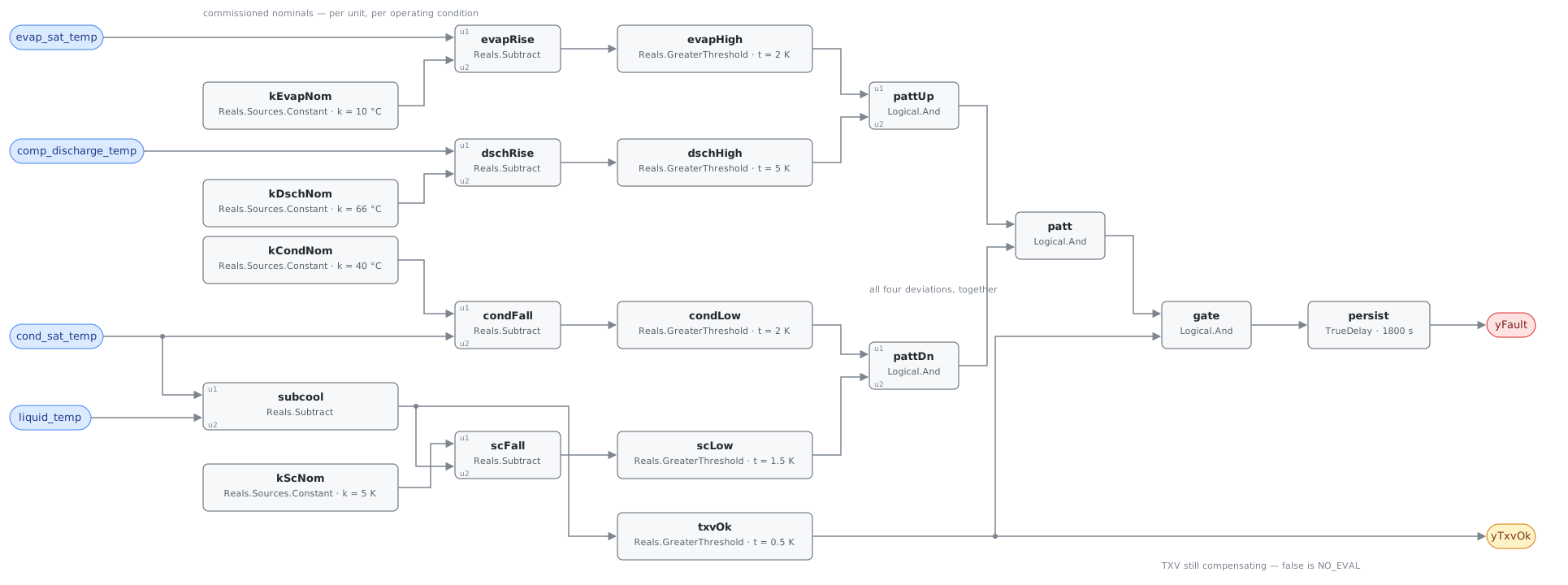
The conjunction is the diagnosis, not a robustness measure. Condenser airflow restriction also raises evaporating and discharge temperature and drops subcooling, but pushes condensing temperature up; undercharge drops condensing temperature and subcooling but leaves evaporating and discharge temperature alone. Drop either conjunct and the rule stops naming this fault.
yTxvOk is the source’s own control-limit test: above roughly 0.5 K of
subcooling the valve inlet is single-phase liquid and the valve is still
compensating, which is the regime its direction chart describes. Deploy knowing
the consequence — the evaluable subcooling window is
(txv_control_min_subcool, subcool_nominal − subcool_fall_min), so a leak
severe enough to collapse subcooling past the floor reads NO_EVAL, not FAULT.
All five comparisons are strict. persist requires 30 continuous minutes, and
delayOnInit = true holds that window across a controller restart.
Possible Diagnoses
- Reversing valve internal bypass leakage — an eroded or worn slide seal; the valve body is replaced rather than repaired, $500–$2,000 plus refrigerant recovery
- Compressor internal leakage — worn discharge valves or scroll flanks produce the same refrigerant-side pattern from a different component, and the source imposed both under one fault label. The service call separates them; this rule cannot
- Valve parked off-seat — a weak solenoid, a blocked pilot line, or low charge leaving too little differential to seat the slide, which then leaks by definition
- Stale nominals — an instance commissioned at one operating condition and evaluated at another. Check the commissioning record before condemning hardware
- Refrigerant-side instrumentation — a discharge sensor reading high, or a host P-T lookup configured for the wrong refrigerant, each move a conjunct with nothing in the rule to contradict them
Energy Impact
EFFICIENCY_LOSS, MEDIUM confidence, PROXY_ESTIMATION. NIST SP 1087 Table 5.12
measured EER degradation tracking leakage close to one-for-one across four test
conditions: 5.0% leakage → 5.5% EER lost, 9.3% → 8.9%, 27.2% → 23.0%, 38.2% →
33.5%. The estimator is waste_kw = elec_power × eer_degradation_fraction,
with the fraction taken from that relationship or from HP-0001’s fitted
baseline on the same unit. PROXY because this rule reads four temperatures and
no power at all. MEDIUM because the direction evidence is a controlled
fault-imposition study but the magnitudes come from one lab unit in one mode.
Emissions Impact
Scope 2, PROXY_EMISSIONS, MEDIUM confidence; typically 200–1,500 kg CO₂e/yr for a commercial packaged heat pump, all of it compressor electricity, so the avoided-emissions basis is the marginal operating emissions rate (MOER). Note what is not here: an internally leaking valve loses nothing to atmosphere, so there is no scope 1 refrigerant component to add — the whole impact is the extra electricity, and it is worst at high lift, when the unit runs longest and the grid is dirtiest.
Deviations
- Fixed nominal targets replace the source’s regressed reference model. NIST SP 1087 classifies each feature’s residual against a third-order polynomial fitted in three variables (indoor drybulb, outdoor drybulb, indoor dew point). The block set’s only regression primitive is a host-fitted line (HP-0001), so the four nominals become commissioning constants valid near the condition they were recorded at — the same named simplification RTU-0002 makes when it fixes its per-stage split baselines.
- The shipped nominals are the source’s rig, not your unit. 10 °C evaporating, 66 °C discharge, 40 °C condensing and 5 K subcooling are the no-fault steady-state readings of NIST SP 1087 §3.2.3, taken on an R410A residential split at 26.7 °C indoor / 27.8 °C outdoor. They make the card runnable as delivered and nothing more.
- The deviation bands are adopted, not transcribed. The source’s neutral-case thresholds run 0.3–1.0 K at 99% credibility, derived from lab instrumentation and a fitted model. Against a fixed nominal the operating-condition swing that model absorbed lands in the residual instead, so the shipped bands are several times wider. Narrow them only as far as a site’s own commissioning spread allows.
- Superheat is not consumed, though the source lists it as a feature. Its
chart marks superheat neutral for this fault and for every other TXV-in-control
pattern, so a neutrality conjunct would discriminate nothing while adding
suction_tempand two thresholds. Measurement point matters here: the source’s superheat is at the evaporator exit where the TXV holds it, whereas a superheat computed fromsuction_tempsits downstream of the bypass and would read high — which is a reason for charge rules to distrust suction-line superheat while this fault is live, not a reason to test it here. - The evaluability test is the source’s general control-limit criterion, not its rig-specific zone split. §5.4.2 grounds it physically — subcooling above ~0.5 K at the valve inlet means single-phase liquid and a valve still compensating — while the 9 °C superheat boundary the report also uses is a fitted artifact of that rig’s flow-coefficient curve. Only the general form belongs in a portable graph.
- Not a suppression relationship with HP-0003. That card asks whether the
valve switched at all, from discharge air; this one asks whether a switched
valve holds its seal, from refrigerant temperatures. Neither failure implies
the other and both can be absent at once, so the link is carried by
relatedandsuppresses/suppressed_bystay empty. - Cooling mode only. The source imposed every fault in cooling and publishes no heating-mode direction chart. Symmetry is physically plausible and unverified, and this library does not ship unverified direction charts; a heating-mode instance needs its own grounding and its own nominals.
- A leak below roughly 5% of refrigerant flow is out of reach. The source’s own classifier misread 2.4–2.5% leaks as no-fault or as undercharge at EER losses of 1.3–3.4% (Table 5.18) — with lab instrumentation and a regressed baseline. A fixed-nominal rule is strictly weaker, so treat silence as “not this fault yet”, never as a clean valve.
- Single-fault reasoning only. The direction chart is fitted from single-fault tests and its classifier assumes independence across features (Li & Braun 2007). Two simultaneous faults can cancel a conjunct or fabricate one; this card names one hypothesis, and the playbook’s charge check is what rules out the common companion.
- Strict comparisons at all five limits. CDL Reals has no
GreaterEqual, so a feature sitting exactly on its band edge reads healthy and subcooling exactly attxv_control_min_subcoolreads NO_EVAL. The disagreement is measure-zero on real-valued signals and both sides of every limit are pinned by vectors. persist.delayOnInit = true(CDL default isfalse), the library’s standing choice: a unit already showing the full pattern when the controller restarts waits out the 30 minutes rather than alarming on the first tick.- Operating state, the compressor-running gate and the defrost exclusion live in frontmatter for host enforcement rather than in the block graph, per the library’s design stance. Defrost is the sharp case: it reverses the circuit on purpose, which is this rule’s fault pattern by design.
- The source publishes no deployable test vectors; every scenario in
vectors.jsonis authored from its Table 5.2 direction chart and replayed against the pinned engine rev.
Notes
Check charge first: undercharge shares two of this rule’s four conjuncts, is far
more common, and is cheap to rule out. The
heat-pump-faults playbook orders that
work. Expect HP-0001 on the same unit — a leak large enough for this rule to
see costs 5% EER or more, a third of the way to that card’s alarm. Read
yTxvOk before yFault: a severe leak can drive subcooling under the
control-limit floor and silence the rule when it matters most. evap_sat_temp
and cond_sat_temp are host-derived P-T conversions, and a lookup configured
for the wrong refrigerant biases three of the four conjuncts at once.
Test Vectors
16 scenarios, clock step 60 s over 3600 s.
| Scenario | Description |
|---|---|
no_fault_at_commissioned_nominals | Every feature sits on its commissioned nominal: evaporating 10 °C, discharge 66 °C, condensing 40 °C, liquid line 35 °C for 5 K of subcooling. The expansion valve is comfortably in control. |
internal_bypass_leakage_full_pattern | All four deviations present at once: evaporating +3 K, discharge +8 K, condensing −3.5 K, subcooling 2.5 K. The alarm lands one alarm_delay after the first tick. |
condenser_airflow_restriction_lookalike | The source’s condenser-airflow pattern: evaporating and discharge up and subcooling down exactly as for leakage, but condensing temperature UP (43 °C) instead of down. condLow blocks alone and the rule stays quiet — this is the conjunct that separates the two faults. |
undercharge_lookalike | The source’s undercharge pattern with the valve still in control: condensing temperature and subcooling fall while evaporating and discharge stay on nominal. Both rise conjuncts block and the rule stays quiet — HP-0001 owns this one. |
evap_rise_exactly_at_band | Boundary: evaporating temperature exactly evap_sat_rise_min above nominal (12.0 °C) with the other three conjuncts satisfied. GreaterThreshold is strict, so the band edge itself reads healthy. |
evap_rise_just_past_band | Boundary from the other side: 12.1 °C clears the strict comparison and the alarm follows on schedule. |
discharge_rise_exactly_at_band | Boundary: discharge exactly disch_rise_min above nominal (71.0 °C) with the other three conjuncts satisfied. dschHigh blocks alone. |
discharge_rise_just_past_band | Boundary from the other side: 71.1 °C trips dschHigh and the pattern completes. |
cond_fall_exactly_at_band | Boundary: condensing temperature exactly cond_sat_fall_min below nominal (38.0 °C), with the liquid line moved to hold subcooling at 2.5 K so only condLow sits at its edge. |
cond_fall_just_past_band | Boundary from the other side: 37.9 °C condensing, liquid line moved with it to hold subcooling at 2.5 K. |
subcool_fall_exactly_at_band | Boundary: subcooling exactly subcool_fall_min below nominal (3.5 K, from 36.5 − 33.0) with the other three conjuncts satisfied. scLow blocks alone. |
subcool_fall_just_past_band | Boundary from the other side: subcooling 3.4 K completes the pattern. |
txv_at_control_limit_is_no_eval | Subcooling exactly at txv_control_min_subcool (0.5 K, from 36.5 − 36.0) with every other conjunct screaming leakage. The strict comparison puts yTxvOk false, so yFault is held down and the host must read NO_EVAL rather than health. |
txv_just_inside_control_limit | The other side of the evaluability edge: subcooling 0.6 K clears txvOk, the pattern is judged, and the alarm asserts. |
transient_shorter_than_alarm_delay | The full pattern appears for 1200 s — a load swing or a post-defrost recovery the host failed to gate — and then everything returns to nominal. Nothing reaches alarm_delay, so the rule never alarms. |
alarm_clears_after_valve_replacement | Recovery: the alarm asserts, the valve is replaced at t = 2400 s and every feature returns to nominal. TrueDelay passes falling edges immediately, so yFault clears on that tick. |
vectors.json
{
  "schema": "cxf-library/vectors/v1",
  "clock": {
    "step_s": 60,
    "horizon_s": 3600
  },
  "scenarios": [
    {
      "name": "no_fault_at_commissioned_nominals",
      "description": "Every feature sits on its commissioned nominal: evaporating 10 \u00b0C, discharge 66 \u00b0C, condensing 40 \u00b0C, liquid line 35 \u00b0C for 5 K of subcooling. The expansion valve is comfortably in control.",
      "inputs": {
        "evap_sat_temp": 10.0,
        "comp_discharge_temp": 66.0,
        "cond_sat_temp": 40.0,
        "liquid_temp": 35.0
      },
      "expect": [
        {
          "output": "yFault",
          "from_s": 0,
          "to_s": 3600,
          "equals": false
        },
        {
          "output": "yTxvOk",
          "from_s": 0,
          "to_s": 3600,
          "equals": true
        }
      ]
    },
    {
      "name": "internal_bypass_leakage_full_pattern",
      "description": "All four deviations present at once: evaporating +3 K, discharge +8 K, condensing \u22123.5 K, subcooling 2.5 K. The alarm lands one alarm_delay after the first tick.",
      "inputs": {
        "evap_sat_temp": 13.0,
        "comp_discharge_temp": 74.0,
        "cond_sat_temp": 36.5,
        "liquid_temp": 34.0
      },
      "expect": [
        {
          "output": "yFault",
          "from_s": 0,
          "to_s": 1740,
          "equals": false
        },
        {
          "output": "yFault",
          "from_s": 1860,
          "to_s": 3600,
          "equals": true
        },
        {
          "output": "yTxvOk",
          "from_s": 0,
          "to_s": 3600,
          "equals": true
        }
      ]
    },
    {
      "name": "condenser_airflow_restriction_lookalike",
      "description": "The source's condenser-airflow pattern: evaporating and discharge up and subcooling down exactly as for leakage, but condensing temperature UP (43 \u00b0C) instead of down. condLow blocks alone and the rule stays quiet \u2014 this is the conjunct that separates the two faults.",
      "inputs": {
        "evap_sat_temp": 13.0,
        "comp_discharge_temp": 74.0,
        "cond_sat_temp": 43.0,
        "liquid_temp": 40.5
      },
      "expect": [
        {
          "output": "yFault",
          "from_s": 0,
          "to_s": 3600,
          "equals": false
        },
        {
          "output": "yTxvOk",
          "from_s": 0,
          "to_s": 3600,
          "equals": true
        }
      ]
    },
    {
      "name": "undercharge_lookalike",
      "description": "The source's undercharge pattern with the valve still in control: condensing temperature and subcooling fall while evaporating and discharge stay on nominal. Both rise conjuncts block and the rule stays quiet \u2014 HP-0001 owns this one.",
      "inputs": {
        "evap_sat_temp": 10.0,
        "comp_discharge_temp": 66.0,
        "cond_sat_temp": 36.5,
        "liquid_temp": 34.0
      },
      "expect": [
        {
          "output": "yFault",
          "from_s": 0,
          "to_s": 3600,
          "equals": false
        },
        {
          "output": "yTxvOk",
          "from_s": 0,
          "to_s": 3600,
          "equals": true
        }
      ]
    },
    {
      "name": "evap_rise_exactly_at_band",
      "description": "Boundary: evaporating temperature exactly evap_sat_rise_min above nominal (12.0 \u00b0C) with the other three conjuncts satisfied. GreaterThreshold is strict, so the band edge itself reads healthy.",
      "inputs": {
        "evap_sat_temp": 12.0,
        "comp_discharge_temp": 74.0,
        "cond_sat_temp": 36.5,
        "liquid_temp": 34.0
      },
      "expect": [
        {
          "output": "yFault",
          "from_s": 0,
          "to_s": 3600,
          "equals": false
        }
      ]
    },
    {
      "name": "evap_rise_just_past_band",
      "description": "Boundary from the other side: 12.1 \u00b0C clears the strict comparison and the alarm follows on schedule.",
      "inputs": {
        "evap_sat_temp": 12.1,
        "comp_discharge_temp": 74.0,
        "cond_sat_temp": 36.5,
        "liquid_temp": 34.0
      },
      "expect": [
        {
          "output": "yFault",
          "from_s": 0,
          "to_s": 1740,
          "equals": false
        },
        {
          "output": "yFault",
          "from_s": 1860,
          "to_s": 3600,
          "equals": true
        }
      ]
    },
    {
      "name": "discharge_rise_exactly_at_band",
      "description": "Boundary: discharge exactly disch_rise_min above nominal (71.0 \u00b0C) with the other three conjuncts satisfied. dschHigh blocks alone.",
      "inputs": {
        "evap_sat_temp": 13.0,
        "comp_discharge_temp": 71.0,
        "cond_sat_temp": 36.5,
        "liquid_temp": 34.0
      },
      "expect": [
        {
          "output": "yFault",
          "from_s": 0,
          "to_s": 3600,
          "equals": false
        }
      ]
    },
    {
      "name": "discharge_rise_just_past_band",
      "description": "Boundary from the other side: 71.1 \u00b0C trips dschHigh and the pattern completes.",
      "inputs": {
        "evap_sat_temp": 13.0,
        "comp_discharge_temp": 71.1,
        "cond_sat_temp": 36.5,
        "liquid_temp": 34.0
      },
      "expect": [
        {
          "output": "yFault",
          "from_s": 0,
          "to_s": 1740,
          "equals": false
        },
        {
          "output": "yFault",
          "from_s": 1860,
          "to_s": 3600,
          "equals": true
        }
      ]
    },
    {
      "name": "cond_fall_exactly_at_band",
      "description": "Boundary: condensing temperature exactly cond_sat_fall_min below nominal (38.0 \u00b0C), with the liquid line moved to hold subcooling at 2.5 K so only condLow sits at its edge.",
      "inputs": {
        "evap_sat_temp": 13.0,
        "comp_discharge_temp": 74.0,
        "cond_sat_temp": 38.0,
        "liquid_temp": 35.5
      },
      "expect": [
        {
          "output": "yFault",
          "from_s": 0,
          "to_s": 3600,
          "equals": false
        }
      ]
    },
    {
      "name": "cond_fall_just_past_band",
      "description": "Boundary from the other side: 37.9 \u00b0C condensing, liquid line moved with it to hold subcooling at 2.5 K.",
      "inputs": {
        "evap_sat_temp": 13.0,
        "comp_discharge_temp": 74.0,
        "cond_sat_temp": 37.9,
        "liquid_temp": 35.4
      },
      "expect": [
        {
          "output": "yFault",
          "from_s": 0,
          "to_s": 1740,
          "equals": false
        },
        {
          "output": "yFault",
          "from_s": 1860,
          "to_s": 3600,
          "equals": true
        }
      ]
    },
    {
      "name": "subcool_fall_exactly_at_band",
      "description": "Boundary: subcooling exactly subcool_fall_min below nominal (3.5 K, from 36.5 \u2212 33.0) with the other three conjuncts satisfied. scLow blocks alone.",
      "inputs": {
        "evap_sat_temp": 13.0,
        "comp_discharge_temp": 74.0,
        "cond_sat_temp": 36.5,
        "liquid_temp": 33.0
      },
      "expect": [
        {
          "output": "yFault",
          "from_s": 0,
          "to_s": 3600,
          "equals": false
        },
        {
          "output": "yTxvOk",
          "from_s": 0,
          "to_s": 3600,
          "equals": true
        }
      ]
    },
    {
      "name": "subcool_fall_just_past_band",
      "description": "Boundary from the other side: subcooling 3.4 K completes the pattern.",
      "inputs": {
        "evap_sat_temp": 13.0,
        "comp_discharge_temp": 74.0,
        "cond_sat_temp": 36.5,
        "liquid_temp": 33.1
      },
      "expect": [
        {
          "output": "yFault",
          "from_s": 0,
          "to_s": 1740,
          "equals": false
        },
        {
          "output": "yFault",
          "from_s": 1860,
          "to_s": 3600,
          "equals": true
        }
      ]
    },
    {
      "name": "txv_at_control_limit_is_no_eval",
      "description": "Subcooling exactly at txv_control_min_subcool (0.5 K, from 36.5 \u2212 36.0) with every other conjunct screaming leakage. The strict comparison puts yTxvOk false, so yFault is held down and the host must read NO_EVAL rather than health.",
      "inputs": {
        "evap_sat_temp": 13.0,
        "comp_discharge_temp": 74.0,
        "cond_sat_temp": 36.5,
        "liquid_temp": 36.0
      },
      "expect": [
        {
          "output": "yTxvOk",
          "from_s": 0,
          "to_s": 3600,
          "equals": false
        },
        {
          "output": "yFault",
          "from_s": 0,
          "to_s": 3600,
          "equals": false
        }
      ]
    },
    {
      "name": "txv_just_inside_control_limit",
      "description": "The other side of the evaluability edge: subcooling 0.6 K clears txvOk, the pattern is judged, and the alarm asserts.",
      "inputs": {
        "evap_sat_temp": 13.0,
        "comp_discharge_temp": 74.0,
        "cond_sat_temp": 36.5,
        "liquid_temp": 35.9
      },
      "expect": [
        {
          "output": "yTxvOk",
          "from_s": 0,
          "to_s": 3600,
          "equals": true
        },
        {
          "output": "yFault",
          "from_s": 0,
          "to_s": 1740,
          "equals": false
        },
        {
          "output": "yFault",
          "from_s": 1860,
          "to_s": 3600,
          "equals": true
        }
      ]
    },
    {
      "name": "transient_shorter_than_alarm_delay",
      "description": "The full pattern appears for 1200 s \u2014 a load swing or a post-defrost recovery the host failed to gate \u2014 and then everything returns to nominal. Nothing reaches alarm_delay, so the rule never alarms.",
      "inputs": {
        "evap_sat_temp": [
          {
            "t": 0,
            "value": 13.0
          },
          {
            "t": 1200,
            "value": 10.0
          }
        ],
        "comp_discharge_temp": [
          {
            "t": 0,
            "value": 74.0
          },
          {
            "t": 1200,
            "value": 66.0
          }
        ],
        "cond_sat_temp": [
          {
            "t": 0,
            "value": 36.5
          },
          {
            "t": 1200,
            "value": 40.0
          }
        ],
        "liquid_temp": [
          {
            "t": 0,
            "value": 34.0
          },
          {
            "t": 1200,
            "value": 35.0
          }
        ]
      },
      "expect": [
        {
          "output": "yFault",
          "from_s": 0,
          "to_s": 3600,
          "equals": false
        }
      ]
    },
    {
      "name": "alarm_clears_after_valve_replacement",
      "description": "Recovery: the alarm asserts, the valve is replaced at t = 2400 s and every feature returns to nominal. TrueDelay passes falling edges immediately, so yFault clears on that tick.",
      "inputs": {
        "evap_sat_temp": [
          {
            "t": 0,
            "value": 13.0
          },
          {
            "t": 2400,
            "value": 10.0
          }
        ],
        "comp_discharge_temp": [
          {
            "t": 0,
            "value": 74.0
          },
          {
            "t": 2400,
            "value": 66.0
          }
        ],
        "cond_sat_temp": [
          {
            "t": 0,
            "value": 36.5
          },
          {
            "t": 2400,
            "value": 40.0
          }
        ],
        "liquid_temp": [
          {
            "t": 0,
            "value": 34.0
          },
          {
            "t": 2400,
            "value": 35.0
          }
        ]
      },
      "expect": [
        {
          "output": "yFault",
          "from_s": 0,
          "to_s": 1740,
          "equals": false
        },
        {
          "output": "yFault",
          "from_s": 1860,
          "to_s": 2340,
          "equals": true
        },
        {
          "output": "yFault",
          "from_s": 2460,
          "to_s": 3600,
          "equals": false
        }
      ]
    }
  ]
}