AHU-0034 — Economizing past changeover
| Status | verified — engine e2ff2f8, cxf:fnv1a128:c68dcb56b390b6fa7294fb9245b6f8f2, 2026-08-18 |
| Severity | 3 |
| Method | rule |
| Phase | 2 |
| Category | EXCESS_CONSUMPTION |
| Confidence | HIGH |
| Estimation | DIRECT_MEASUREMENT |
| G36 | — |
| Clusters | — |
| Suppresses | — |
| Suppressed by | — |
| Related | AHU-0017, AHU-0030 |
| Playbooks | economizer-failure |
| Source | Bushby, Castro, Schein, House (2001), NIST/CEC PIER Project 2.3 report — §4.2 Rule 9 (Table 1, p. 9): Toa > Tco + εt in Mode 3; Mode 1-5 actuator signatures §4.1-4.2 (pp. 6-7); threshold defaults §4.2.3 (p. 11); House, Vaezi-Nejad, Whitcomb (2001), ASHRAE Transactions 107(1), ‘An Expert Rule Set for Fault Detection in Air-Handling Units’ — the paper the PIER report names as APAR’s derivation; PNNL-27338 §3.4 (Katipamula et al. 2018) — the same test seventeen years later: a damper-position-only ‘economizing when it should not’ check, gated on the differential dry-bulb comparison rather than a fixed changeover temperature; Both reports were read through internal paraphrased digests; neither is redistributed with this library; Sibling precedent: AHU-0017 (mirrored graph, changeover-type switch, every parameter shape); AHU-0030 (the heating-side excess-OA relative); Library extension: the HVAC FDD Reference v1.0 ch.9 specifies AHU-0001..065 and stops — see faults/ahu/README.md |
| Operating states | OS#3 (mechanical cooling with 100% outdoor air) — host-gated. The actuator half of that signature, a modulating cooling coil with the OA damper open, is also tested in-rule by clgOn and dmprHigh; the mode determination itself is the host’s. |
Preconditions (host-enforced): Supply fan running, and the unit must have a return-air path — a 100%-outdoor-air or makeup-air unit has no changeover to miss and reads as a permanent fault. The outdoor/return comparison must be evaluable: |oat - rat| >= TMIN (APAR’s own ∆Tmin is 5.6 °C / 10 °F, §4.2.3 p. 11; AHU-0017 cites PNNL-27338’s 5 °F for the same gate), since two sensors reading within their combined error of each other cannot establish which air is warmer. Hosts also gate on OAT sensor quality — a sensor reading low produces this fault’s signature with the economizer control working correctly (diagnosis 3). When either gate is unmet the verdict is NO_EVAL, not healthy.
Points: oat, rat, clg_vlv_cmd, oa_dmpr_cmd
Outputs:
yFault— True while outdoor conditions have been past changeover, mechanical cooling has run, and the OA damper command has stayed above econ_damper_high_threshold, all continuously for at least alarm_delay
Parameters:
| Name | Default | Unit | CXF path | Description |
|---|---|---|---|---|
econ_type_is_ddb | True | bool | isDDB.k | Changeover type — true = differential dry-bulb (compare oat to rat), false = fixed changeover temperature (compare oat to econ_hl_temp). Same parameter, same meaning, same default as AHU-0017; a unit running both rules must carry the same value in both |
econ_hl_temp | 21.0 | °C | hlConst.k | Fixed changeover temperature, used only when econ_type_is_ddb is false. This is APAR’s Tco, the temperature at which the unit should step from 100% outdoor air to minimum outdoor air |
temp_deadband | 1.0 | °C | ddbPast.t, hlPast.t | Margin the changeover comparison must clear before economizing counts as unjustified; binds both changeover branches. APAR’s own value for this threshold is εt = 1.7 °C (§4.2.3, p. 11) — see Deviations |
cooling_enabled_threshold | 10.0 | % | clgOn.t | Cooling valve command above which mechanical cooling counts as active |
econ_damper_high_threshold | 75.0 | % | dmprHigh.t | OA damper command above which the unit counts as still economizing rather than holding a minimum position |
alarm_delay | 1800.0 | s | persist.delayTime | Continuous fault persistence required before the alarm asserts (30 min) |
Description
Outdoor air stopped being worth having and the dampers never found out. The unit opened wide for free cooling on a mild morning, the afternoon turned hot, and the sequence that should have stepped the dampers back to minimum did not run — so the coil carries the load plus the load the open dampers keep importing. On a 30 °C afternoon against 22 °C return air, every point of outdoor air fraction above the ventilation minimum hands the coil another 8 °C of sensible lift on that share of the airflow, and more once the outdoor air is humid. This is AHU-0017 run backwards: same four points, same three conjuncts, same graph with the temperature and damper comparisons both reversed, and because both cards use the same deadband around the same comparison they cannot assert on one unit at the same time. It is the quieter of the two failures — until the coil runs out of capacity the unit holds setpoint and looks healthy. Library extension: chapter 9 does not specify it, and the logic comes from APAR Rule 9 with the graph shape and parameter set taken from AHU-0017.
Detection Logic
past_changeover = (oat - rat)          > temp_deadband   when econ_type_is_ddb
                = (oat - econ_hl_temp) > temp_deadband   otherwise

yFault = past_changeover
     AND clg_vlv_cmd > cooling_enabled_threshold
     AND oa_dmpr_cmd > econ_damper_high_threshold
     sustained continuously for alarm_delay
Block graph (rule.cxf.jsonld):
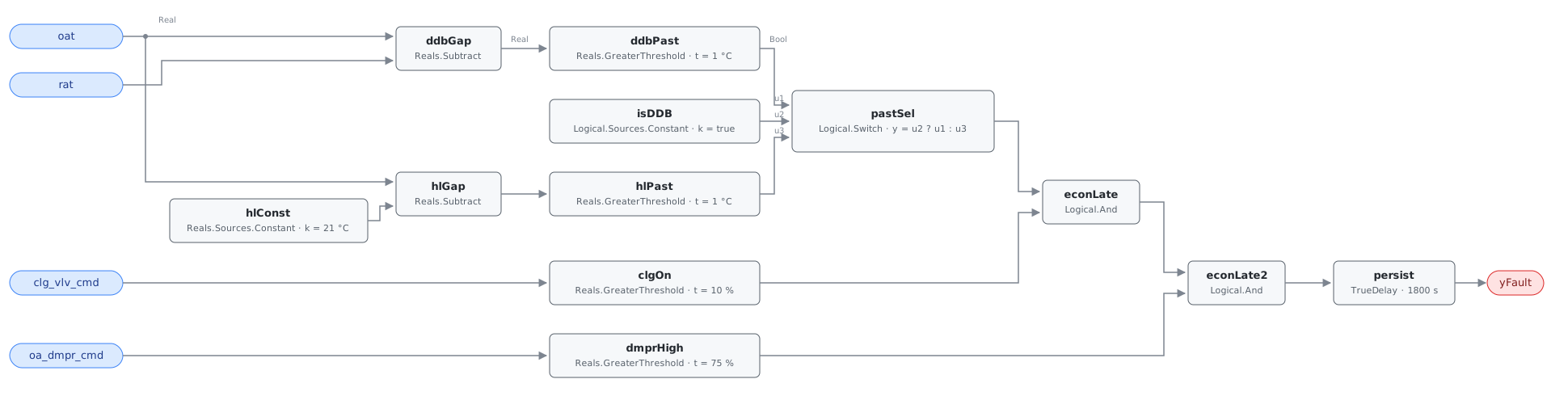
Both changeover branches are computed on every tick and pastSel
(Logical.Switch, y = u2 ? u1 : u3) picks one: isDDB selects the
differential branch (oat - rat, the default) or the fixed-changeover branch
(oat - econ_hl_temp). The two are the two sources’ two forms — APAR Rule 9 is
written against a fixed changeover temperature Tco, which is hlPast;
PNNL-27338 §3.4 gates on a differential dry-bulb comparison, which is ddbPast.
Thresholding the difference is what lets one temp_deadband serve both, and it
is the operand order — oat on u1 in both subtractions — that makes this the
reverse of AHU-0017, where oat sits on u2. clgOn and dmprHigh carry
the APAR Mode-3 actuator signature in-graph, so the finding is self-evident from
the rule rather than dependent on how a host classified the mode; the cooling
conjunct is load-bearing, since with the coil shut there is no mechanical
cooling being paid for and an open damper is a purge cycle or a comfort problem
instead. All three comparisons are strict, so a damper commanded to exactly 75%,
a cooling valve at exactly 10%, or an excess of exactly 1.0 °C does not trip the
rule. persist requires 30 continuous minutes, long enough to ride out the
damper stroke and the marginal minutes either side of the changeover point;
delayOnInit = true holds that window across a controller restart.
Possible Diagnoses
APAR establishes no fault set for its rules (§4.2.2), so this list is authored from the mechanisms that raise an outdoor-air damper command past changeover:
- Changeover setpoint too high, or a fixed high limit left at a factory default that does not fit the climate
- Economizer enable logic with no disable path — the sequence opens on a favorable comparison and never re-tests it
- OAT sensor reading low (sun-shielded, soffit-mounted, over a warm roof, or drifted), so outdoor air still looks worth importing
- A changeover device — dry-bulb or enthalpy switch — failed in its “economize” state, a single point of failure with no other symptom
- A mixed-air low-limit or freeze-protection loop holding the damper open past changeover, its setpoint never re-tuned for cooling weather
- An override left in place after service (AHU-0027 finds the flag itself)
A damper commanded to minimum but mechanically stuck open never raises
oa_dmpr_cmd and is invisible here — that is AHU-0020 and AHU-0028
territory, recorded as a blind spot under Deviations.
Energy Impact
EXCESS_CONSUMPTION, HIGH confidence, DIRECT_MEASUREMENT. The waste is the
sensible load the unit imports above its ventilation minimum,
(oa_dmpr_cmd/100 − design_min_oa_fraction) × supply_airflow × ρ·cp × (oat − rat), and every term but the design fraction and the airflow is already
on this rule’s wires. It is a floor rather than a total: sensible-only, and in a
humid climate the latent load of the excess outdoor air is the larger half.
PNNL-27338 §3’s 5–20% of cooling energy covers economizer faults as a class,
including AHU-0017’s direction and AHU-0021’s, so read savings_range as
the size of the family rather than of this member. Cooling-dominant and sharply
seasonal — born on a mild shoulder-season afternoon, billed in July.
Emissions Impact
Scope 2, DIRECT_EMISSIONS, HIGH confidence; typical 1,000-6,000 kg CO₂e/yr, scaled from AHU-0017’s range for the same equipment and the same mechanical cooling. The whole impact is electric compressor or chiller work, so it lands in purchased electricity, and the hours are the grid’s worst: this fault bills during hot afternoons coincident with cooling peaks, so use the marginal operating emissions rate (MOER), not an average grid factor.
Deviations
- This rule is a library extension, not a transcription: chapter 9 specifies
AHU-0001..065 and stops. The name, severity 3, phase 2 and
method: ruleare assigned here — severity 3 to match AHU-0017 and AHU-0030, phase 2 because the rule presupposes a site that has already configured a changeover type and threshold for AHU-0017. The graph, parameters, diagnosis list and energy claim are authored from APAR Rule 9, PNNL-27338 §3.4 and FC-051. - APAR Rule 9 is a Mode 3 rule, so
clgOntests cooling active, not closed: Mode 3 is mechanical cooling with 100% outdoor air, a modulating cooling coil with the damper fully open. The intuitive reading — “economizing” as Mode 2, both coils closed — is the wrong mode here and would invert the conjunct. - Differential dry-bulb is the shipped default even though Rule 9 is literally
a fixed-changeover test (
Toa > Tco + εt, which ishlPast). AHU-0017 ships DDB, a mirrored pair configured two ways is worse than either, and PNNL-27338 §3.4 gates on the differential comparison. A site running APAR literally setsecon_type_is_ddb = falseandecon_hl_tempto its Tco. temp_deadbandships at 1.0 °C, not APAR’s flat εt = 1.7 °C, and the reason is the pair rather than the physics: one deadband on both cards brackets a symmetric ±1.0 °C dead zone around the changeover point, where 1.0 against 1.7 would be lopsided for no gain. The cost is real — 1.0 °C is inside the combined error of two commodity sensors, which is what 1.7 °C was sized to clear — so a site with untrimmed sensors must raise it on both cards.econ_damper_high_threshold = 75%sits between the two sources. APAR’s “fully open” is above 98%, which would miss every damper hanging at 80%; PNNL-27338 §3.4’s 30% would make this a damper-position restatement of AHU-0021. 75% is above any plausible minimum-position setting and mirrors AHU-0017’s 25% line. Retuning to 30% buys PNNL’s sensitivity and FC-055’s overlap with it.- The rule reads the damper command, not its position — what AHU-0017 reads
and what APAR’s
udis — so a damper commanded to minimum and mechanically stuck open produces the whole physical fault and none of this signature. Run AHU-0020 on the OA damper alongside this rule; the pairing is the coverage. - The evaluability gate
|oat - rat| >= ∆Tminis a precondition, not an in-graph output: APAR attaches such a gate to Rules 2 and 18 and to Rule 9 not at all, so there is no NO_EVAL semantics to expose as ay…Okoutput the way AHU-0030 does. It is declared for host enforcement with APAR’s own ∆Tmin = 5.6 °C, placed exactly as AHU-0017 places its gate. - All three comparisons are strict (
>); neither source specifies boundary behaviour, and the engine’sRealscomparisons are strict in any case. alarm_delay = 1800 sis adopted from AHU-0017; neither source specifies a persistence. APAR evaluates per sample, PNNL-27338 averages a 15–60 minute window — a different mechanism with a similar effect — and 30 minutes keeps the pair’s alarms comparable in latency.persist.delayOnInit = true(Modelica/CDL default isfalse), the library’s standing choice: a unit already past changeover with its damper open when the controller restarts waits out the full 30 minutes instead of alarming on the first tick.- CLU-03 is deliberately not claimed. Its contract is that fixing the trigger (AHU-0017) clears the members within 24-48 h, and that does not hold here — a damper stuck open is not cleared by repairing one stuck closed, and the two cannot be true of one unit at once. This card shares CLU-03’s playbook and none of its clearing semantics.
suppressesandsuppressed_byare empty. AHU-0021 is the nearest candidate, since a damper open past changeover also inflates the outdoor-air fraction it measures, but both findings are true and separately actionable, and any edge would be an index-level decision declared on both cards.- Neither source publishes test cases — APAR gives a rule table and threshold
list, PNNL-27338 an algorithm — so every scenario in
vectors.jsonis authored. - Operating states and preconditions are declared in frontmatter for host
enforcement rather than encoded in the block graph, per the library’s design
stance. APAR derives its five modes from coil-valve and damper signals alone
with no mode sensor, which is the same host-side derivation this library’s
operating_statesconvention already assumes.
Notes
Read this card and AHU-0017 as one policy. They bind the same four points and
carry the same six parameters with the same names and defaults, differing only
in the direction of the temperature and damper comparisons. Retuning one without
the other is the mistake to guard against: raise temp_deadband here alone and
the dead zone between the two rules goes lopsided; change econ_type_is_ddb on
one and the pair answers two different questions about the same unit.
With default parameters the shipped vectors exercise only the DDB branch —
vectors/v1 stages inputs, not parameters, so hlConst, hlGap and hlPast
are structurally verified but never reach yFault through u3. A host setting
econ_type_is_ddb = false should commission that path itself.
Do not deploy on a unit without a return-air path: a 100%-outdoor-air or makeup-air unit has its damper open by design and every conjunct will hold every hot afternoon. When the alarm is real, command the OA damper to minimum and watch MAT fall toward return temperature. If it moves, the sequence never commanded minimum and the fix is at a desk; if it does not, AHU-0020 on the OA damper is the rule that will say so. Check the OAT sensor before either — a sensor reading 4 °C low manufactures this fault out of working economizer logic.
Test Vectors
11 scenarios, clock step 60 s over 3600 s.
| Scenario | Description |
|---|---|
past_changeover_damper_at_min | Healthy changeover: OAT 30 °C against RAT 22 °C with mechanical cooling at 40% — the unit has handed back to minimum outdoor air (damper 15%), which is the correct response |
past_changeover_damper_still_open | The fault: OAT 30 °C is 8 °C hotter than return air, mechanical cooling is running, and the OA damper is still at 95% — the unit never stopped economizing; alarms after alarm_delay (1800 s) |
still_favorable_for_economizing | Temperature conjunct blocking alone: OAT 10 °C is well below the 22 °C return air, so a wide-open damper with cooling running is free cooling doing its job |
no_cooling_call | Cooling conjunct blocking alone: hot outdoor air and a wide-open damper, but the cooling valve is shut — no mechanical cooling is paying for the outdoor air, so there is no waste to report |
damper_exactly_at_threshold | Edge case: damper parked exactly at econ_damper_high_threshold (75%) past changeover with cooling running — the strict > keeps it out of the alarm |
damper_just_above_threshold | Edge case, other side: damper at 75.1% clears the threshold by a tenth of a point and the alarm follows at 1800 s |
cooling_exactly_at_threshold | Edge case: cooling valve exactly at cooling_enabled_threshold (10%) with the damper wide open past changeover — the strict > means the coil does not count as cooling |
cooling_just_above_threshold | Edge case, other side: cooling valve at 10.1% counts as mechanical cooling and the alarm follows at 1800 s |
deadband_edge_then_past_changeover | Edge case: oat − rat sits exactly on temp_deadband (1.0 °C) — no alarm; at t=1200 the outdoor air rises to 23.5 °C, opening the gap to 1.5 °C, and the alarm follows 1800 s later |
damper_closes_before_delay | Transient: the economizer is wide open against hot outdoor air with cooling running, but the damper drives to 20% at t=1200 — the condition clears before alarm_delay completes, so no alarm |
damper_cycle_resets_persistence | Transient: the damper closes at t=900 and drives back open at t=1200 under an unbroken past-changeover-plus-cooling condition — persistence restarts from the reopen, so the alarm lands at 3000 s, not 1800 s |
vectors.json
{
  "schema": "cxf-library/vectors/v1",
  "clock": {
    "step_s": 60,
    "horizon_s": 3600
  },
  "scenarios": [
    {
      "name": "past_changeover_damper_at_min",
      "description": "Healthy changeover: OAT 30 \u00b0C against RAT 22 \u00b0C with mechanical cooling at 40% \u2014 the unit has handed back to minimum outdoor air (damper 15%), which is the correct response",
      "inputs": {
        "oat": 30.0,
        "rat": 22.0,
        "clg_vlv_cmd": 40.0,
        "oa_dmpr_cmd": 15.0
      },
      "expect": [
        {
          "output": "yFault",
          "from_s": 0,
          "to_s": 3600,
          "equals": false
        }
      ]
    },
    {
      "name": "past_changeover_damper_still_open",
      "description": "The fault: OAT 30 \u00b0C is 8 \u00b0C hotter than return air, mechanical cooling is running, and the OA damper is still at 95% \u2014 the unit never stopped economizing; alarms after alarm_delay (1800 s)",
      "inputs": {
        "oat": 30.0,
        "rat": 22.0,
        "clg_vlv_cmd": 40.0,
        "oa_dmpr_cmd": 95.0
      },
      "expect": [
        {
          "output": "yFault",
          "from_s": 0,
          "to_s": 1740,
          "equals": false
        },
        {
          "output": "yFault",
          "from_s": 1860,
          "to_s": 3600,
          "equals": true
        }
      ]
    },
    {
      "name": "still_favorable_for_economizing",
      "description": "Temperature conjunct blocking alone: OAT 10 \u00b0C is well below the 22 \u00b0C return air, so a wide-open damper with cooling running is free cooling doing its job",
      "inputs": {
        "oat": 10.0,
        "rat": 22.0,
        "clg_vlv_cmd": 40.0,
        "oa_dmpr_cmd": 95.0
      },
      "expect": [
        {
          "output": "yFault",
          "from_s": 0,
          "to_s": 3600,
          "equals": false
        }
      ]
    },
    {
      "name": "no_cooling_call",
      "description": "Cooling conjunct blocking alone: hot outdoor air and a wide-open damper, but the cooling valve is shut \u2014 no mechanical cooling is paying for the outdoor air, so there is no waste to report",
      "inputs": {
        "oat": 30.0,
        "rat": 22.0,
        "clg_vlv_cmd": 0.0,
        "oa_dmpr_cmd": 95.0
      },
      "expect": [
        {
          "output": "yFault",
          "from_s": 0,
          "to_s": 3600,
          "equals": false
        }
      ]
    },
    {
      "name": "damper_exactly_at_threshold",
      "description": "Edge case: damper parked exactly at econ_damper_high_threshold (75%) past changeover with cooling running \u2014 the strict `>` keeps it out of the alarm",
      "inputs": {
        "oat": 30.0,
        "rat": 22.0,
        "clg_vlv_cmd": 40.0,
        "oa_dmpr_cmd": 75.0
      },
      "expect": [
        {
          "output": "yFault",
          "from_s": 0,
          "to_s": 3600,
          "equals": false
        }
      ]
    },
    {
      "name": "damper_just_above_threshold",
      "description": "Edge case, other side: damper at 75.1% clears the threshold by a tenth of a point and the alarm follows at 1800 s",
      "inputs": {
        "oat": 30.0,
        "rat": 22.0,
        "clg_vlv_cmd": 40.0,
        "oa_dmpr_cmd": 75.1
      },
      "expect": [
        {
          "output": "yFault",
          "from_s": 0,
          "to_s": 1740,
          "equals": false
        },
        {
          "output": "yFault",
          "from_s": 1860,
          "to_s": 3600,
          "equals": true
        }
      ]
    },
    {
      "name": "cooling_exactly_at_threshold",
      "description": "Edge case: cooling valve exactly at cooling_enabled_threshold (10%) with the damper wide open past changeover \u2014 the strict `>` means the coil does not count as cooling",
      "inputs": {
        "oat": 30.0,
        "rat": 22.0,
        "clg_vlv_cmd": 10.0,
        "oa_dmpr_cmd": 95.0
      },
      "expect": [
        {
          "output": "yFault",
          "from_s": 0,
          "to_s": 3600,
          "equals": false
        }
      ]
    },
    {
      "name": "cooling_just_above_threshold",
      "description": "Edge case, other side: cooling valve at 10.1% counts as mechanical cooling and the alarm follows at 1800 s",
      "inputs": {
        "oat": 30.0,
        "rat": 22.0,
        "clg_vlv_cmd": 10.1,
        "oa_dmpr_cmd": 95.0
      },
      "expect": [
        {
          "output": "yFault",
          "from_s": 0,
          "to_s": 1740,
          "equals": false
        },
        {
          "output": "yFault",
          "from_s": 1860,
          "to_s": 3600,
          "equals": true
        }
      ]
    },
    {
      "name": "deadband_edge_then_past_changeover",
      "description": "Edge case: oat \u2212 rat sits exactly on temp_deadband (1.0 \u00b0C) \u2014 no alarm; at t=1200 the outdoor air rises to 23.5 \u00b0C, opening the gap to 1.5 \u00b0C, and the alarm follows 1800 s later",
      "inputs": {
        "rat": 22.0,
        "oat": [
          {
            "t": 0,
            "value": 23.0
          },
          {
            "t": 1200,
            "value": 23.5
          }
        ],
        "clg_vlv_cmd": 40.0,
        "oa_dmpr_cmd": 95.0
      },
      "expect": [
        {
          "output": "yFault",
          "from_s": 0,
          "to_s": 2940,
          "equals": false
        },
        {
          "output": "yFault",
          "from_s": 3060,
          "to_s": 3600,
          "equals": true
        }
      ]
    },
    {
      "name": "damper_closes_before_delay",
      "description": "Transient: the economizer is wide open against hot outdoor air with cooling running, but the damper drives to 20% at t=1200 \u2014 the condition clears before alarm_delay completes, so no alarm",
      "inputs": {
        "oat": 30.0,
        "rat": 22.0,
        "clg_vlv_cmd": 40.0,
        "oa_dmpr_cmd": [
          {
            "t": 0,
            "value": 95.0
          },
          {
            "t": 1200,
            "value": 20.0
          }
        ]
      },
      "expect": [
        {
          "output": "yFault",
          "from_s": 0,
          "to_s": 3600,
          "equals": false
        }
      ]
    },
    {
      "name": "damper_cycle_resets_persistence",
      "description": "Transient: the damper closes at t=900 and drives back open at t=1200 under an unbroken past-changeover-plus-cooling condition \u2014 persistence restarts from the reopen, so the alarm lands at 3000 s, not 1800 s",
      "inputs": {
        "oat": 30.0,
        "rat": 22.0,
        "clg_vlv_cmd": 40.0,
        "oa_dmpr_cmd": [
          {
            "t": 0,
            "value": 95.0
          },
          {
            "t": 900,
            "value": 20.0
          },
          {
            "t": 1200,
            "value": 95.0
          }
        ]
      },
      "expect": [
        {
          "output": "yFault",
          "from_s": 0,
          "to_s": 2940,
          "equals": false
        },
        {
          "output": "yFault",
          "from_s": 3060,
          "to_s": 3600,
          "equals": true
        }
      ]
    }
  ]
}